
These moves cost between $10 for a soap pump and a few hundred for a new mirror, and which one fits depends on what the room already has and what part bothers you most.
A tray pulls together scattered countertop products in ten minutes.
A stool beside the tub becomes the most-used surface once it’s there. Hooks take less wall space than a towel bar, which matters when every inch is spoken for.
1. Group Vanity and Countertop Items on a Tray
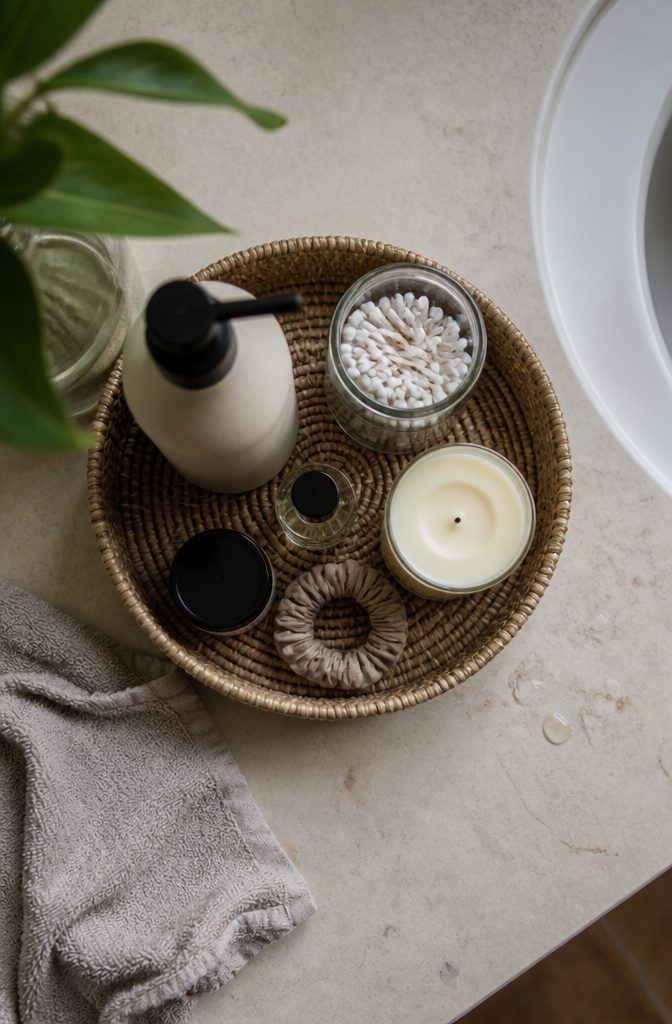
A tray gathers soap, hand lotion, a candle, and whatever else sits on the vanity into a single contained arrangement instead of letting those items spread across the counter.
The effect is immediate: the eye reads order where it used to read clutter. This is one of the most widely recommended styling moves for a reason—it works with products you already own, and the change takes ten minutes.
I prefer trays in marble, woven materials, or scalloped metal, depending on the rest of the bathroom’s finish. A round woven tray sits well beside a plant and a glass jar of cotton swabs.
A scalloped version holds a soap pump, a small vase for toothbrushes, and a faux succulent without looking crowded. The tray defines the boundaries of the display, so everything inside feels deliberate rather than left out by accident.
2. Add Plants or Greenery

Greenery softens a bathroom in ways hard surfaces never can, and even a single plant changes how finished the room feels.
Real plants are the first choice when the bathroom gets natural light — something simple on the counter or a floor plant in the corner if there’s space.
But bathrooms without windows can still work if you pick something hardy and rotate it out every few weeks.
I’ve kept a snake plant alive in a powder room with no natural light for over two years by moving it to a sunny spot in the kitchen now and then to let it recover.
Faux greenery is the fallback when that kind of maintenance won’t happen, and it still brings in the color and softness that break up all that tile and glass.
3. Use Decorative, Matching Containers for Everyday Products

Transferring hand soap, cotton swabs, and shampoo out of their retail bottles cuts visual noise immediately.
The eye no longer bounces between competing label colors, fonts, and brand logos — everything reads as part of the same decorative system instead of a shelf of errands you forgot to put away.
I start with the soap pump, because it sits on the counter all day and costs almost nothing to fix.
A $10 rattan soap pump replaces the plastic Target bottle, and the change registers faster than anything else at that price point.
For the shower, the 16-ounce white and gold shampoo and conditioner pumps do the same work: you refill them from the bulk size you already buy, and the shower wall stops looking like a product lineup.
The material choice matters less than consistency. Match the finish across what sits together — all ceramic, all rattan, all glass — and the bathroom feels considered rather than assembled one purchase at a time.
4. Add Open Shelving and Style It Deliberately

Open shelves give you two wins at once: storage you need and a chance to make the wall itself part of the design.
I use them for towels, toiletries, and a small rotation of objects that look good together without trying too hard. A stack of folded towels, a candle, something green, and maybe a small framed piece is enough.
The arrangement works when you leave space between items instead of filling every inch. That breathing room is what separates a display that feels intentional from one that reads as overflow.
Floating wood shelves next to the shower or a brass unit above the toilet both do the job.
Rolled towels stacked neatly bring texture into a room dominated by tile and porcelain, and the effect borrows straight from how luxury hotels style their bathrooms. Balance what you use with what you look at, not one or the other.
5. Use Baskets and Bins for Storage and Texture

Woven baskets soften a bathroom’s hard surfaces while hiding what you don’t want to see. I use a lidded seagrass hamper as a laundry basket because it conceals clothes between wash days and adds texture to tile and glass.
The large size holds enough for a week in a primary bathroom; the medium works in a shared or smaller space.
Cheaper baskets lose their shape after a year or two and snag fabric on broken strands. A quality seagrass basket with a sturdy frame and tight weave lasts years longer, and the difference shows immediately when you lift the lid.
The expense is higher, but replacing a $30 basket every two years costs more than buying one good one at the start.
Beyond the hamper, smaller woven bins on open shelves organize washcloths, extra toilet paper, and toiletries without the visual clutter of seeing every individual item.
A belly basket or a white woven bin keeps the storage functional and the look intentional.
6. Make Use of the Toilet Tank Top

The top of the toilet tank holds an extra roll of toilet paper plus a small plant or other decorative piece, and most people forget it exists.
I treat it the way I would a narrow shelf: something functional first, then one or two items that add color or texture without crowding the surface.
A single roll stacked upright, a small potted succulent, and maybe a candle or a folded hand towel fit without turning the tank into a shelf display.
The win here is function that doesn’t look accidental. A spare roll sitting out in the open reads as intentional when it shares space with greenery or a simple tray, and it saves a trip to the cabinet mid-shower.
Keep the scale small. The tank top is narrow, and anything tall or wide tips the proportions wrong.
7. Use Towel or Robe Hooks Instead of a Towel Bar

Hooks take up less wall space than a towel bar, which matters in a bathroom where every inch is already spoken for.
I prefer the look of hooks, and they fit into spots a bar would never work. In a primary bathroom, three robe or towel hooks in the Golden Champagne finish handled daily use without towels slipping off or staying damp.
In a bathroom with no good wall space at all, the back of the door becomes the storage spot. Hooks mounted there keep towels off the floor and out of the way when the door swings open.
The worry with hooks is always whether towels will dry properly when they’re bunched instead of stretched out.
That hasn’t been a problem. Air circulation is usually enough, even in smaller bathrooms, and the towels stay put once you hang them.
If you have the space for a bar, a bar might still win, but when the layout is tight or you want a cleaner wall, hooks do the job without compromise.
8. Add a Stool or Bench Near the Tub or Shower

A small stool or bench next to the tub becomes the most-used surface in the bathroom once it’s there.
I use it to hold a drink while soaking, a folded towel, bath salts, a book, or whatever skincare routine I’m working through that week.
It’s one of those upgrades that feels minor until you realize how often you reach for it.
For a shower, I lean toward a freestanding teak bench over a built-in tile bench. Built-in benches add expense during a remodel, they’re cold to sit on, and if they aren’t sloped correctly they become a breeding ground for mold.
A freestanding option like a small driftwood teak bench skips those problems entirely. It’s warmer to the touch, it includes a lower shelf if you need extra storage, and I think it looks better too.
The stool itself adds texture without requiring anything permanent.
Wood brings warmth, and a dip-dyed finish or natural teak tone works in almost any bathroom style. It’s the kind of detail that makes the space feel intentional rather than purely functional.
9. Mix Metal Finishes or Use Metal Accents Deliberately
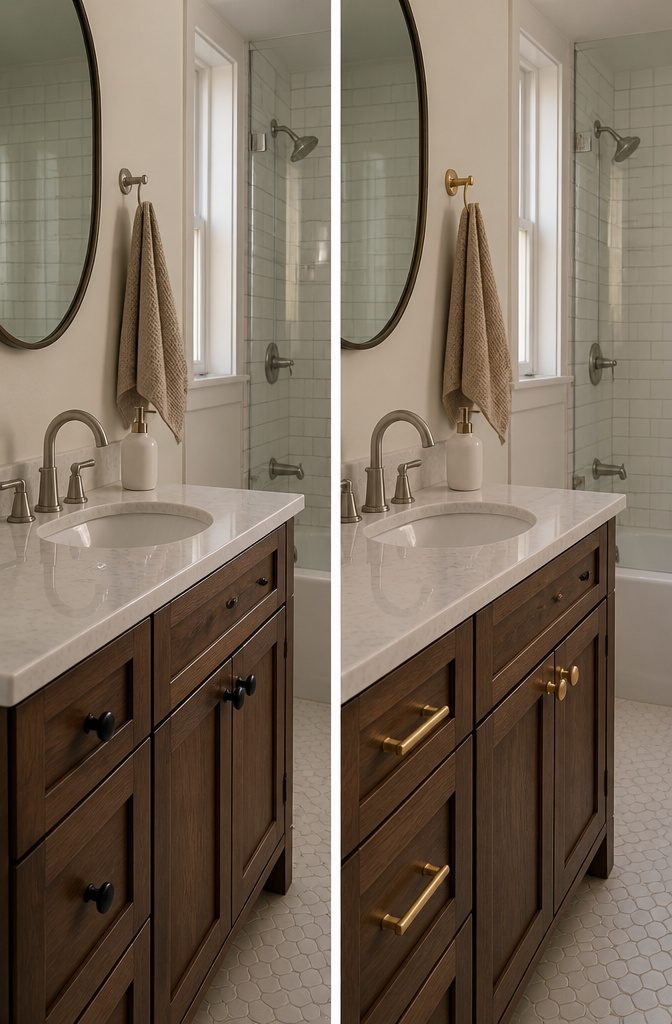
Mixed metals add depth to a bathroom in a way matched finishes can’t.
I pair brushed gold mirrors with matte black faucets, or put brass cabinet pulls next to polished nickel sconces and faucets. The contrast grounds the room visually and creates stronger focal points without feeling busy.
Stick with two finishes and repeat both in more than one spot.
Brass on cabinet pulls and robe hooks, brushed nickel on faucets and shower hardware. That pattern keeps the mix from reading as accidental.
Black accents need the same consistency. If you bring in black mirrors, repeat the black in cabinet pulls or light fixtures.
A single black faucet against chrome everywhere else looks like a leftover, not a choice. Black works because it anchors lighter surfaces, but only when it shows up deliberately across the room.
10. Replace Ordinary Mirrors with a Distinctive Mirror

A large arched mirror or an abstract frameless shape turns what used to be a functional surface into a focal point.
The change reads as more custom and intentional than the builder-grade rectangle most bathrooms start with, and the effect is immediate.
Mirrors reflect light back into the room, which makes small bathrooms feel larger and brighter without changing the square footage. That matters most in tight layouts where every decision has to work harder.
I think of mirrors less as necessities and more as functional artwork. Once you start viewing them that way, it becomes easier to justify spending a little more on one distinctive piece.
An oversized mirror with a thin metal frame or a tinted finish pulls attention the same way a statement light fixture does, but it also bounces natural light around and opens up sightlines.
In a room where you can’t change the tile or the tub, the mirror is one of the fastest ways to shift the whole feel.
11. Use Artwork to Add Personality and Color

Wall art gives a bathroom a finished look without construction. Framed prints, photographs, and murals all work, and any of them can be swapped when the room needs a refresh.
I lean toward prints in bathrooms that already have good bones but feel too neutral — one piece above the towel bar or beside the mirror adds color without competing with tile or fixtures.
Murals take more commitment but cover more wall. A statement mural behind the vanity or across from the tub changes the whole room, and if you want something permanent, mosaic tile murals hold up better than paper in humid spaces.
For smaller budgets or rental situations, peel-and-stick murals go up in an afternoon and come down clean.
A swimwear print from the 1959 Ladies’ Swimwear collection is the kind of specific choice that makes a bathroom feel intentional rather than decorated by category.
Vintage-style art like that pairs well with white subway tile and chrome fixtures, the same way botanical prints work in farmhouse bathrooms.
The frame matters as much as the image — a narrow black frame keeps the focus on the print, while a wider mat softens the look if the wall color is strong.
12. Layer Lighting or Choose Statement Lighting
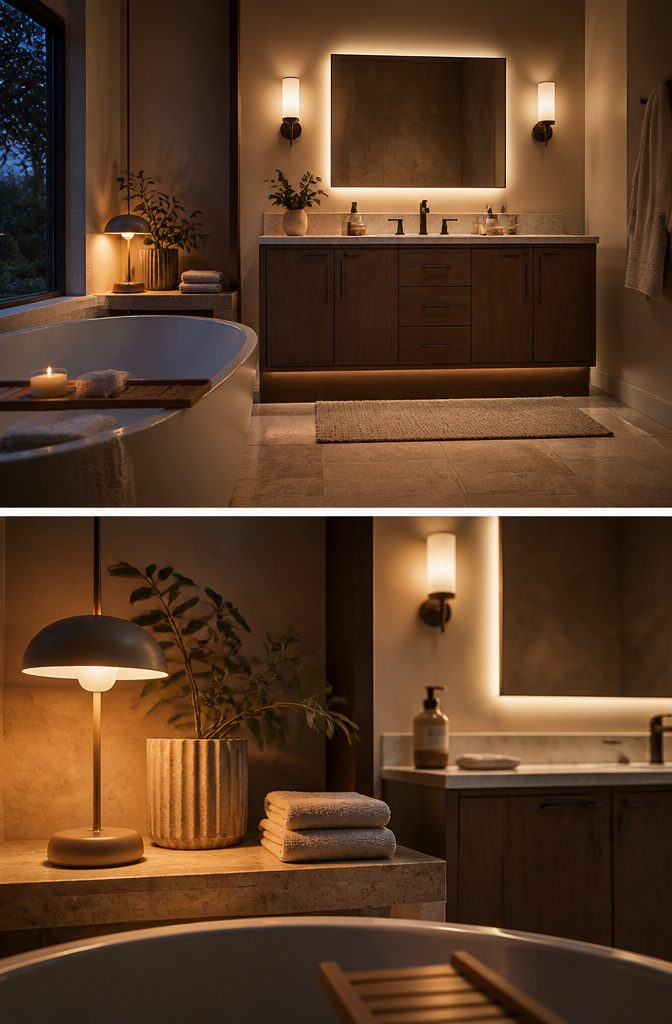
Sconces, illuminated mirrors, and accent lamps create depth that a single overhead fixture cannot. The light falls from multiple angles, which softens shadows and makes stone look richer and wood feel warmer.
I start with warm-white bulbs rather than cool-white, because the difference changes how every color in the room reads. A candle on the counter or a small lamp near the tub adds another layer without wiring.
Statement fixtures set the style as clearly as tile or paint. A streamlined pendant or matte metal sconce anchors a modern bathroom.
Classic hardware and traditional lighting ground a room with a clawfoot tub or pedestal sink. The fixture itself becomes part of the composition rather than background utility, and that shift makes the space feel styled instead of assembled.
13. Introduce Wood and Other Natural Materials

Wood takes the hard edge off tile and stone.
A teak bench beside the tub or a simple oak stool near the sink changes how the room feels the moment you step in, because wood introduces texture that tile and marble can’t.
The warmth is immediate, and it works even in small doses—a single shelf, a bamboo tray, a wood-framed mirror.
I combine wood with the harder materials already in the bathroom rather than replacing them.
Stone adds weight, metal gives contrast, and wood softens what would otherwise read cold. The three together create a layered look that feels deliberately composed instead of sterile.
This mix works across neutral color palettes because the materials themselves provide the visual interest—the grain of the wood, the veining in stone, the finish on metal hardware all register before color does.
The balance matters more than the proportion. Too much wood and the room starts to feel rustic instead of current; too little and the hard surfaces still dominate.
I look for one or two wood elements that sit where you’ll see them daily—the vanity countertop, open shelving, a stool—and let that be enough.
14. Add Color Through Easy-to-Change Accessories
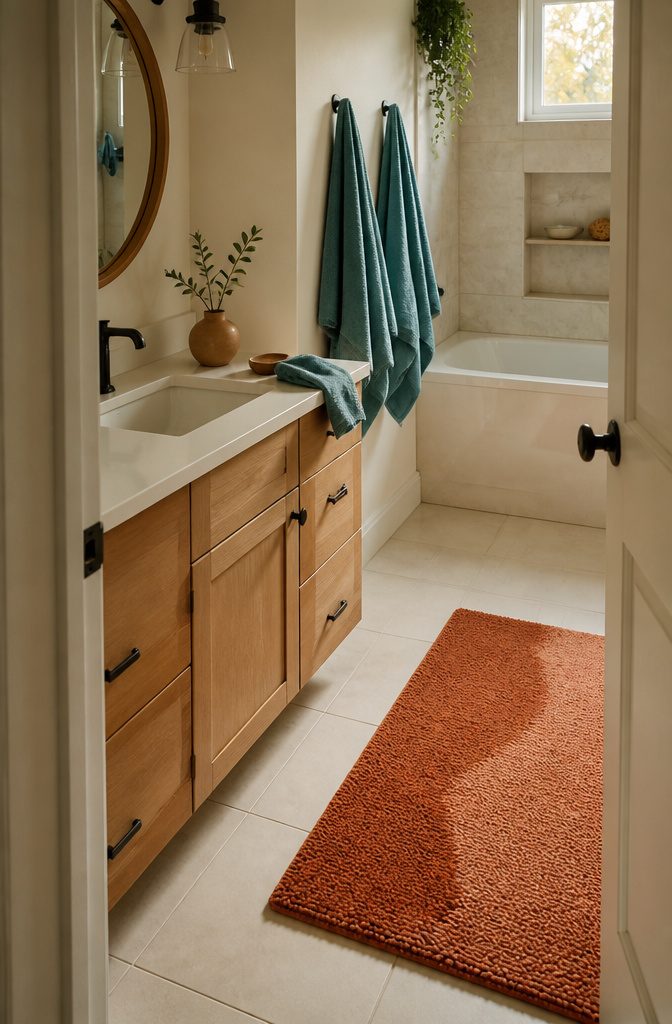
Towels, bath mats, and a few small decor pieces let you bring color into a bathroom that already has a neutral base, and the advantage is that you can swap them out whenever you want something different.
I keep the larger fixed surfaces plain and use accessories to test patterns or bold tones without committing to them permanently.
A set of teal towels or a rust-colored bath mat changes the room immediately, and if the look stops working after a season, the cost to replace it stays low.
This approach works especially well in a rental or a bathroom where you cannot repaint or replace tile.
The contrast between a neutral wall and a few strong accent pieces often reads more finished than a room where every surface competes for attention.
15. Use Wallpaper or a Mural for a Stronger Wall Treatment
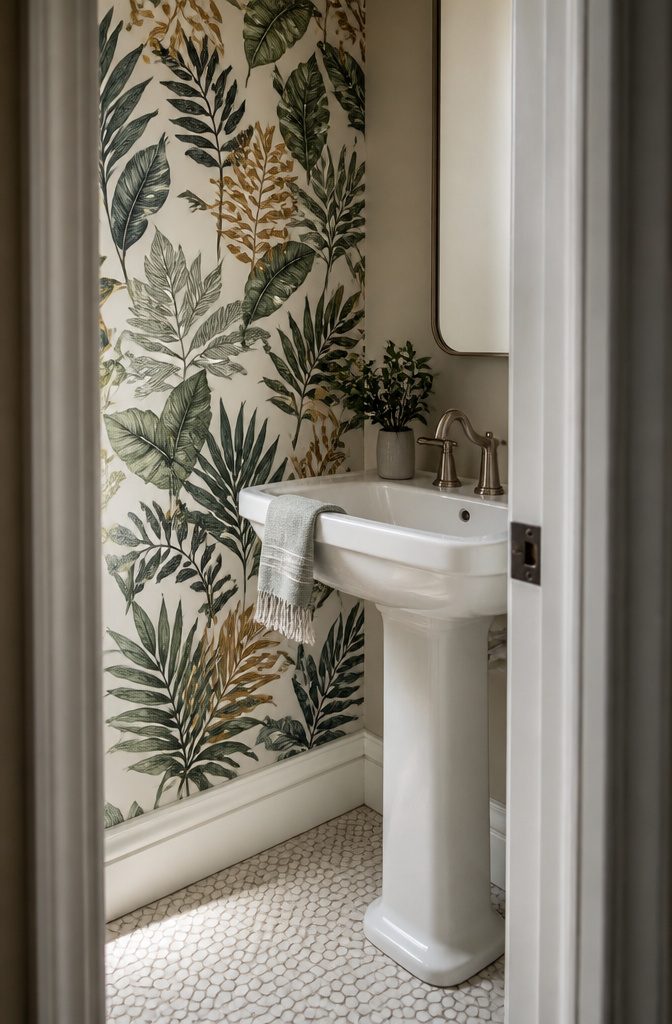
Wallpaper made for bathrooms changes a room faster than paint, but the material matters.
Look for products marked waterproof or moisture-resistant, since standard wallpaper buckles in high humidity. A bold pattern or an unexpected color does more than a safe neutral, particularly in a small powder room where the walls are all you see.
If you want something permanent and more dramatic, consider a statement mural made from mosaic tile.
It reads as custom work without the cost of tiling an entire wall, and the material holds up better than any paper product near a shower or tub.
I’d keep the design graphic rather than realistic if the bathroom is compact, since busy detail can overwhelm a tight space. Both options give you a strong focal wall without touching the floor, the fixtures, or the plumbing.
16. Choose Statement Fixtures That Fit the Room’s Style

Fixtures decide whether the bathroom reads modern or traditional before anything else arrives.
For a modern look, streamlined lighting and matte metal accents set the tone—think straight-edged sconces in black or brushed nickel and fixtures with clean geometry rather than ornament.
The same bathroom switches to traditional when you bring in classic hardware, a pedestal sink, and a clawfoot tub. Those pieces carry enough visual weight that smaller choices fall into line around them.
I find that mixing signals weakens both styles. A clawfoot tub under an industrial-style pendant reads confused, not eclectic.
Pick one direction and let the fixtures anchor it. If the room already has a pedestal sink or vintage-style faucets, leaning traditional costs less than fighting what’s there.
If you’re starting fresh and prefer a modern feel, choose fixtures with minimal detailing and finishes that stay matte rather than polished.
17. Make the Sink a Focal Point

Make the Sink a Focal Point
A sink sits front and center in nearly every bathroom layout, so treating it as a deliberate design choice instead of plumbing makes the whole room feel more finished.
Dual sink cabinets in contrasting materials turn what could be purely functional into a statement piece.
Picture one vanity in warm walnut next to another in light oak, or a marble-topped cabinet paired with painted wood. The contrast reads intentional rather than matched-set predictable.
If you’re working with painted cabinets, Swiss Coffee by Benjamin Moore is a cabinet color that skews warm without going yellow. It holds up against both brass and chrome finishes, which matters when the faucet and mirror frame don’t match.
The shade works especially well when one sink gets natural light and the other sits in shadow, because the warmth keeps the darker side from feeling cold.
This approach costs more than identical vanities, since you’re sourcing two different materials or finishes. But if the sink area is the only part of the bathroom a guest actually looks at, that’s where the budget should land.
18. Refresh Decor Seasonally

Swapping a few bathroom pieces with the seasons keeps the room feeling fresh without needing a plan or a budget.
In autumn, warm wood tones and amber accents make the space more inviting; in spring, lighter textiles and fresh greenery brighten it immediately.
The changes themselves are small: hand towels, a candle, greenery on the counter, one decorative accent near the mirror. None of it needs to match a theme or fill the room.
Most people update seasonal decor in the living room and skip the bathroom entirely, which is a missed chance.
The bathroom gets used every day, and small shifts there register more than another pillow on the couch. The updates don’t need to be dramatic to feel like something changed.
19. Create a Small Self-Care Display
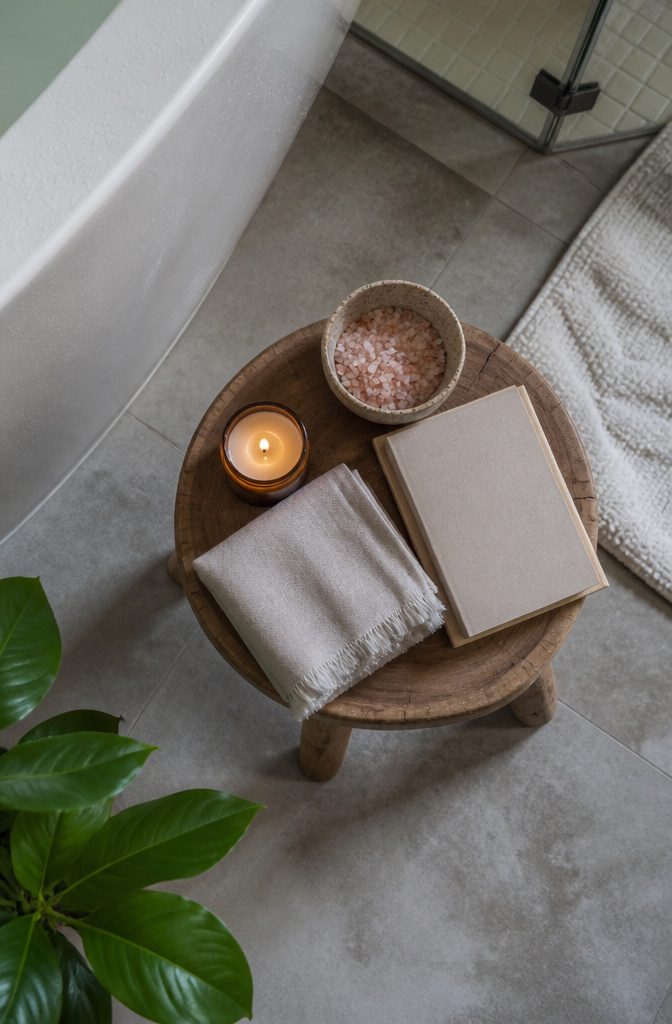
A stool or small cart beside the tub holding bath salts, candles, a book, and a folded towel turns a corner into something that reads more like a retreat than a task list.
The visual cue matters: when the setup is already there, you’re more likely to actually use it instead of letting the tub sit empty week after week.
I think of this as styling with intention rather than decoration for its own sake.
The items need to be things you’ll reach for, not just props. A wooden stool works better than plastic or metal in most bathrooms because the material feels warmer against tile and doesn’t show water spots as quickly.
Keep the display contained to what fits comfortably on the surface without crowding—three or four items at most.
The moment it looks like overflow storage, it stops feeling like a self-care station and starts reading as clutter you haven’t dealt with yet.
Small Updates Work Without a Full Remodel
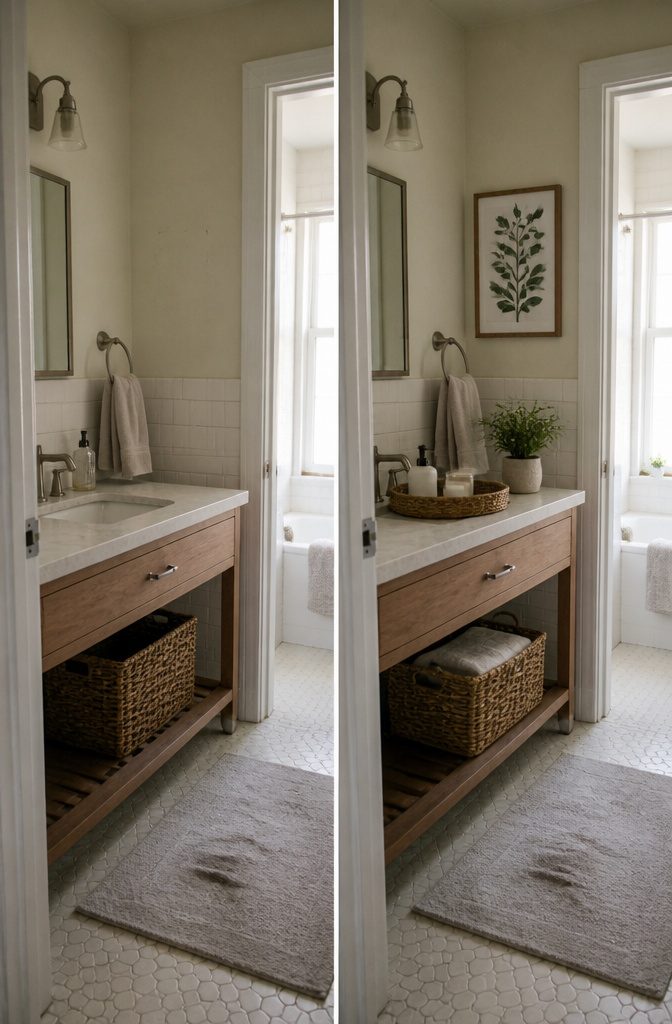
Accessories can update a neutral base without a large renovation. Towels, bath mats, and small decor pieces change out easily, which means you can experiment with patterns and color while keeping the fixtures and finishes constant.
A tray, a few plants, artwork, and updated baskets can shift the look without requiring major investment.
I focus on styling upgrades rather than renovations when I want a fresh feeling rather than fixing something broken.
Decorative trays corral countertop clutter, baskets add texture and storage, and seasonal swaps keep the space from looking stale. In autumn, warm wood tones and amber accents feel inviting.
During spring, fresh greenery and lighter textiles instantly brighten the room. The updates don’t need to be dramatic to create an impact.
Storage That Also Contributes to the Look

Storage becomes part of the look when it gives visible clutter a defined place. Grouping countertop items on a tray turns scattered products into a single organized zone, so the vanity reads as intentional instead of chaotic.
Baskets on open shelves conceal what you don’t want displayed while adding woven or rattan texture to a room full of hard surfaces.
The shelves themselves can hold folded towels, a candle, and a small plant arranged to look intentional rather than dumped.
Balance what you need within reach with what earns its spot on display.
I treat functional storage as part of the design: a woven basket holding toilet paper on a floating shelf, a white bin collecting washcloths, a tray on the toilet tank with an extra roll and something green.
Each piece solves a problem and contributes texture or color at the same time.
Avoid filling every surface. The difference between a shelf that looks designer-done and one that reads as overloaded comes down to leaving space between items and choosing what deserves to stay visible.
Why the Style Should Feel Intentional
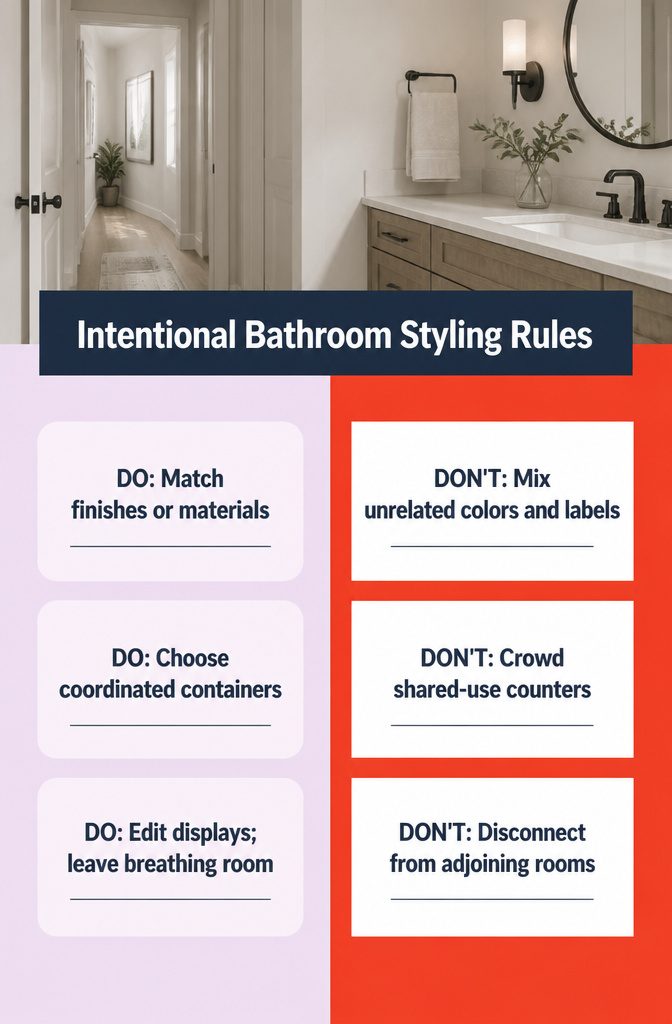
Styling a bathroom works when the choices look connected. That means picking items that share a finish, a color family, or a material rather than adding whatever catches your eye in three different stores.
Matching containers reduce visual noise because the eye isn’t pulled in five directions by competing labels and packaging colors. The same logic applies to hardware, towel colors, and anything else that sits in view.
The room’s function matters here. A bathroom used by multiple people every morning needs accessible storage and clear counters more than it needs a crowded display.
If the space doubles as a place to unwind at the end of the day, styling can lean softer, but it still benefits from editing displays and leaving breathing room.
Negative space creates calm, and calm always reads as more finished than clutter.
Consider the aesthetic of the rest of the home, too. A bathroom that feels completely disconnected from the adjoining rooms can read as an afterthought, even when the individual pieces inside it are fine on their own.
Choices Suited to Small Bathrooms
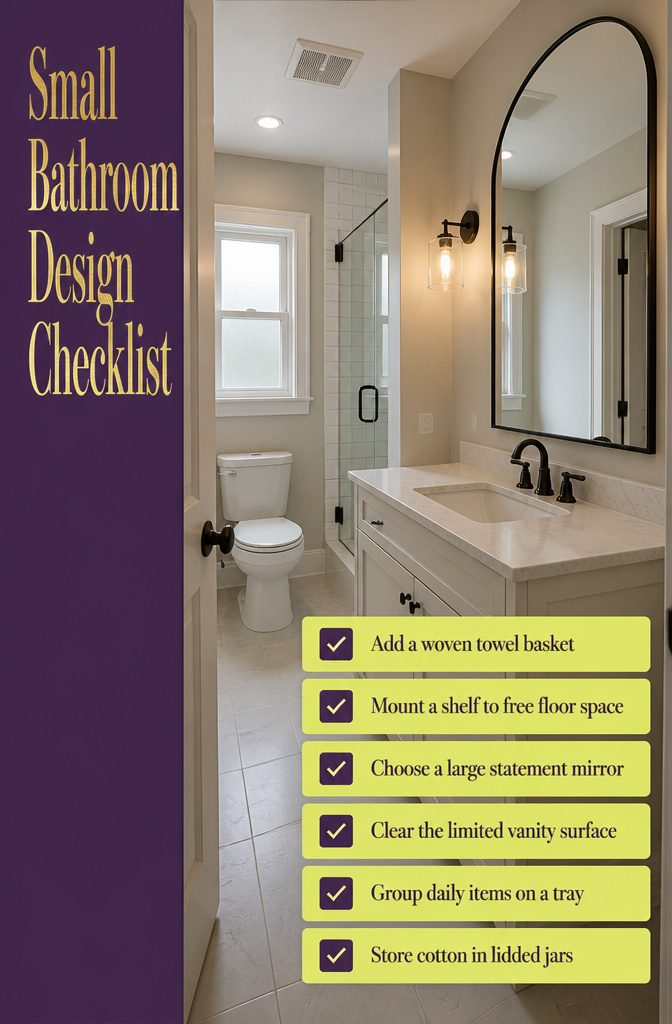
Small bathrooms need storage that keeps the design honest instead of cluttered.
In tight square footage, decorative choices work harder when they also solve a functional problem. A woven basket holds towels while adding texture.
A wall-mounted shelf opens up floor space and gives you a place to stage a plant or a stack of hand soap refills. Keep surfaces organized so the room can breathe instead of looking packed.
A large statement mirror changes how a small bathroom feels. It bounces light around the space, making the room appear both larger and brighter.
An arched mirror or one with a distinctive frame becomes a focal point without taking up floor space, which matters when every design decision has to pull its weight.
Many designers treat mirrors as functional artwork rather than simple necessities, and that shift in thinking explains why swapping out a builder-grade mirror feels so dramatic even when nothing else changes.
Keeping countertops clear matters more in a small bathroom than in a large one. When a vanity has limited real estate, a decorative tray holds soap, lotion, and a few everyday items in one organized spot.
Glass canisters or wood-lid jars store cotton balls and swabs so they stay accessible without spreading across the counter.
The difference between a bathroom that looks expensive and one that looks cramped often comes down to whether you can see the surface.
Frequently Asked Questions
How can I decorate a bathroom on a budget?
Focus on styling upgrades instead of renovations. Trays, plants, artwork, baskets, and updated accessories change the look immediately without requiring a large investment.
A $10 rattan soap pump or a set of matching containers makes more visual difference than the cost suggests, and seasonal swaps keep the room feeling fresh for almost nothing.
What are the most popular bathroom decor styles in 2026?
Organic modern, spa-inspired, Japandi, modern farmhouse, and minimalist luxury are the styles showing up most often this year. All five lean on natural materials, clean lines, and neutral palettes rather than heavy pattern or bold color.
How do I make a small bathroom look more expensive?
A statement mirror, layered lighting, matching containers, and organized surfaces create the effect of a finished space.
The mirror itself acts as functional artwork and reflects light back into the room, which makes tight layouts feel larger. Grouping countertop items on a tray instead of letting them spread across the vanity reads as deliberate rather than cluttered.
What colors work best in bathrooms?
Soft neutrals, warm whites, earthy greens, muted blues, and natural wood tones create a calming atmosphere and work across most bathroom styles.
These shades hold up well against both brass and chrome finishes, which matters when the hardware and fixtures don’t match.
How can I create an aesthetic bathroom without remodeling?
Decor changes such as lighting, artwork, greenery, stylish storage, and vanity styling shift the look without touching plumbing or tile.
A tray corrals countertop clutter, baskets on open shelves add texture while hiding what you don’t want visible, and a single plant softens hard surfaces immediately. Seasonal swaps keep the space from looking stale.
What are some modern bathroom design ideas?
Streamlined lighting, matte metal accents, and fixtures with clean geometry set a modern tone. Mixed metal finishes add depth when you stick with 2 finishes and repeat both in more than one spot.
An arched mirror or abstract frameless shape turns the wall into a focal point, and open shelving styled deliberately gives you storage and design at once.
What are some common bathroom design mistakes to avoid?
Mixing style signals weakens both directions: a clawfoot tub under an industrial pendant reads confused, not eclectic.
Filling every surface turns a styled shelf into overflow storage, and a single accent color that shows up only once looks like a leftover rather than a choice. Repeating finishes and leaving space between items keeps the room feeling intentional.