
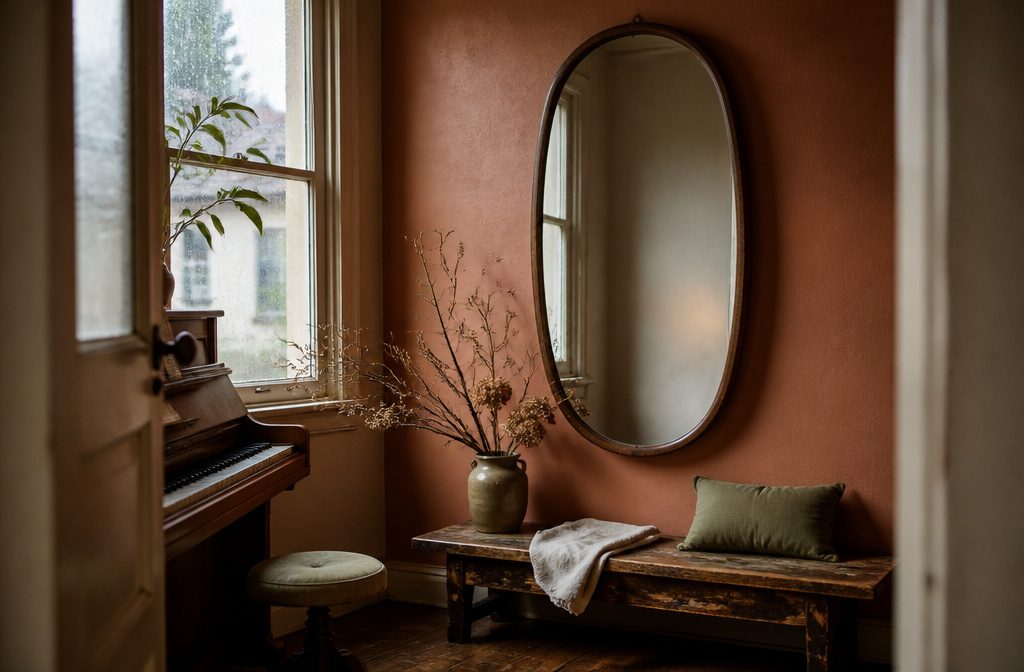
Mirrors can look like afterthoughts or like the thing that holds the room together, depending on how you hang them and what you put around them.
The difference is mostly placement and frame choice, but size trips people up more often: a mirror above a sofa should sit about 6 inches above the back, and one above a fireplace mantel needs less than 4 inches of clearance to look anchored rather than floating.
1. Reflect Light and Enlarge a Room
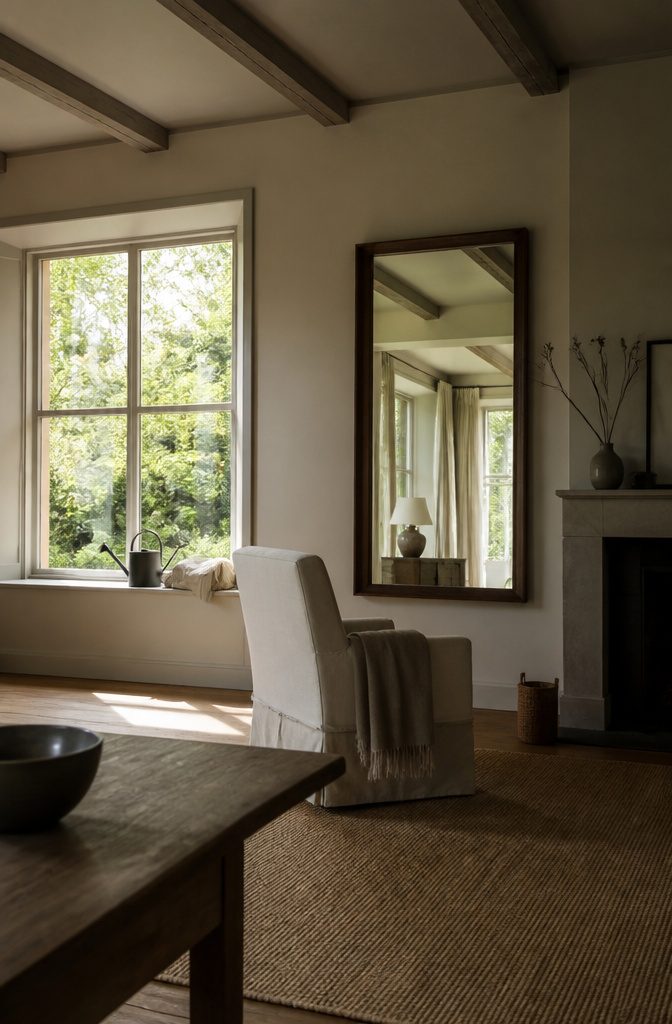
Mirrors placed to reflect windows or lamps will brighten a room noticeably and make it feel more spacious.
I position a mirror near a window so that natural light bounces deeper into the space, which matters most in rooms that otherwise stay dim through the afternoon.
The same logic holds for artificial light: a mirror angled toward a chandelier or a table lamp doubles the glow and adds dimension to the wall.
What the mirror reflects matters as much as where it sits. Point it toward an attractive view, a piece of decor worth repeating, or clean architectural lines.
Reflecting clutter, an unmade bed, or a blank wall wastes the opportunity. I also avoid hanging mirrors directly opposite each other on facing walls.
The infinite reflection that results makes the room look smaller rather than larger, and the visual loop reads as a mistake. If mirrors must go on opposing walls, hang them at different heights so they miss each other entirely.
2. Choose a Mirror’s Scale, Shape, and Style
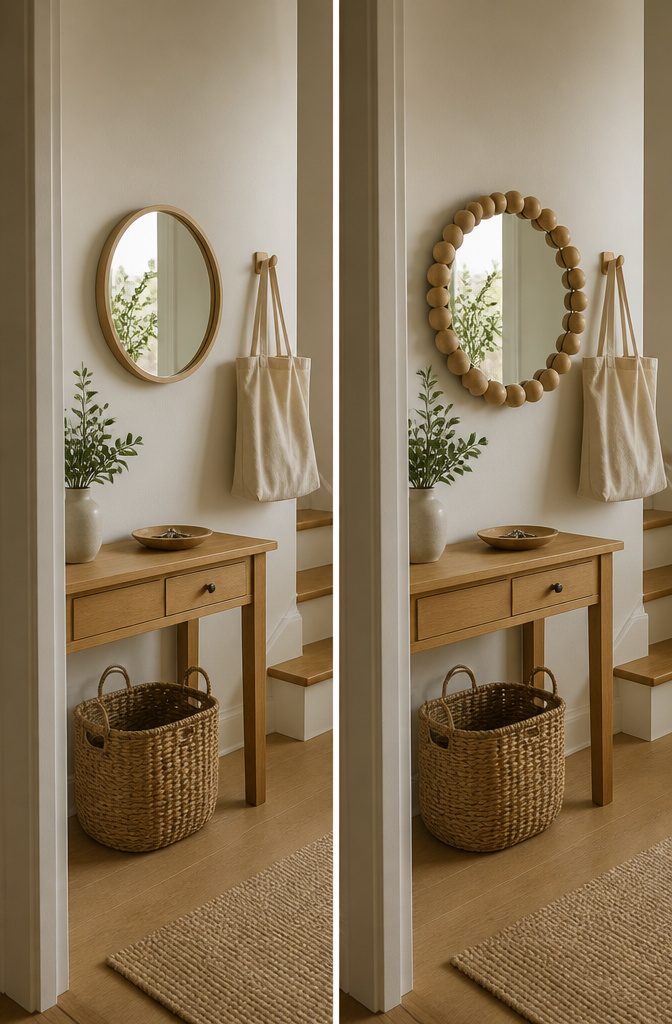
The mirror you choose should match the scale of the room and the furniture around it.
A large rectangular mirror suits a dining room with a substantial table, while a small round mirror fits better over a narrow console in an entry.
Frame style matters as much as size. Ornate carved frames add formality to a dining room, especially when gilded or painted in metallic finishes.
Simple wood frames or clean metal ones work in modern spaces. Vintage mirrors with heavy detail bring character, but a plain frame keeps the focus on what the mirror reflects rather than on the frame itself.
Shape changes how a mirror reads in a room: rectangular mirrors feel traditional, round mirrors soften hard angles, square mirrors anchor a wall symmetrically, and oval or six-sided mirrors stand out as focal points.
The frame should coordinate with other finishes in the room.
Rustic wood or woven materials add texture; metallic frames inject formality. A mirror that clashes with the rest of the room draws attention for the wrong reason.
3. Make the Mirror a Focal Point

A mirror becomes a focal point when its shape or frame is bold enough to anchor the room.
In a bedroom with an 18-foot ceiling, a large sunburst mirror above the headboard fills the height and reflects light without competing with other furniture.
The natural mango wood frame gives the piece weight, and the round shape contrasts with the horizontal line of the bed.
Above a fireplace, the same mirror reads differently against a white mantel, where the wood tone stands out and the reflection softens the vertical stack of stone or brick.
A mirror hung above furniture should not be wider than the piece below it, and when it sits above a fireplace, keep it less than four inches from the mantel. That narrow gap ties the two together visually.
If the room has no fireplace or large window to pull focus, a decorative mirror in a carved or gilded frame can create one, especially when the frame finish matches the furniture it hangs over.
The reflection adds dimension, and at night the mirror brightens a space that would otherwise flatten under overhead light alone.
4. Create a Mirror Gallery or Grouping

A grouping of smaller mirrors can create the same visual weight as one large piece, especially above furniture where a single mirror would read too small.
I’ve seen this work particularly well in powder rooms and on stairway walls, where arranging frames close together creates a cohesive focal point rather than a scattered look.
The frames can share a finish — all gold, all dark wood — while the shapes vary: square next to oval next to rectangular.
Or reverse it: different frame styles that match in color and tone, the way a collection of vintage gold mirrors reads as intentional even when no two are identical.
The layout takes the same planning as a gallery wall of photographs. Lay the mirrors on the floor first, move them around until the arrangement balances, then transfer that pattern to the wall.
Matching every frame exactly can flatten the interest; mixing a few shapes or weights keeps the eye moving. I added one non-mirror piece to a powder room grouping — same size, same finish — and it blended in without breaking the pattern.
5. Change or Decorate the Frame

Painting the frame is the most direct way to change what a mirror does to a room. Remove the mirror from the frame first, or tape newspaper over the glass to protect it while you work.
Annie Sloan Chalk Paint in Aubusson Blue and Old White works well here — finish with Clear Wax once the paint dries, and medium sandpaper between coats if you want the texture smooth.
You can also paint a base color and add a second for flowers or small geometric shapes.
For an ombre effect, start with a dark shade closest to the glass and add three or four layers that slowly lighten toward the frame’s outer edge.
If the frame itself needs more work, rope wrapped around the perimeter adds coastal texture — hemp rope holds up best.
For something brighter, tile mats from home improvement stores cut to the width of the frame and glue down in one pass. Bright blue or green tiles stand out; a mix of tile and stone keeps the look neutral.
I’ve also seen clothespins glued in a sunburst pattern around a circular mirror, and plastic spoons arranged in overlapping rows with the bowls facing out. Doilies glued to the frame turn a plain mirror vintage immediately.
6. Decorate the Mirror Surface

Decorate the Mirror Surface
Vinyl lettering, flowers, and decorative tape turn a plain mirror into something personal without touching the frame.
I lean toward uplifting phrases like "Hello beautiful" or "Smile!" for bathroom mirrors, placed near the edge rather than dead center so they don’t block your reflection.
Vinyl stickers are the fastest option, and trying out different placements before you commit saves regret later.
For tabletop or makeup mirrors, small faux flowers work well arranged around one edge or clustered at a bottom corner. On round mirrors, bigger blooms at one side with smaller ones filling the gaps create balance.
Cut the stems off and use a heavy-duty adhesive. Washi tape offers hundreds of patterns and colors, but restraint matters.
Too much tape makes the mirror look cluttered. I prefer using it as an accent stripe or border rather than covering the entire perimeter.
Flat stones glued around the edges suit outdoor mirrors especially well, either on an exterior wall or near a water feature in the garden.
The trick with any surface decoration is laying the mirror flat while you work and waiting for adhesives to dry completely before hanging. Skipping that step risks everything sliding off when you tilt it upright.
7. Use Mirrors in Entries and Hallways

An entry mirror sits where it serves two purposes at once: checking your coat and collar on the way out, and adding light to what is often a small, dim space.
In homes with 18-foot-tall entry ceilings, the room needs a large mirror to hold the scale.
A carved gilded frame works in a traditional entry, while a glass sunburst style reads more modern. Either way, the mirror becomes a focal point and a backdrop for seasonal wreaths or other decorative pieces you rotate through the year.
Hallways present a different problem.
Narrow passages in older homes can feel confining, and identical mirrors placed along the hallway wall make the space look broader by reflecting light back and forth. The effect is immediate and costs less than structural work.
One feng shui rule worth knowing: the mirror should not face the entrance directly. Placement matters more than shape, so if the layout puts the mirror opposite the door, move it to an adjacent wall instead.
8. Use Mirrors in Living Rooms
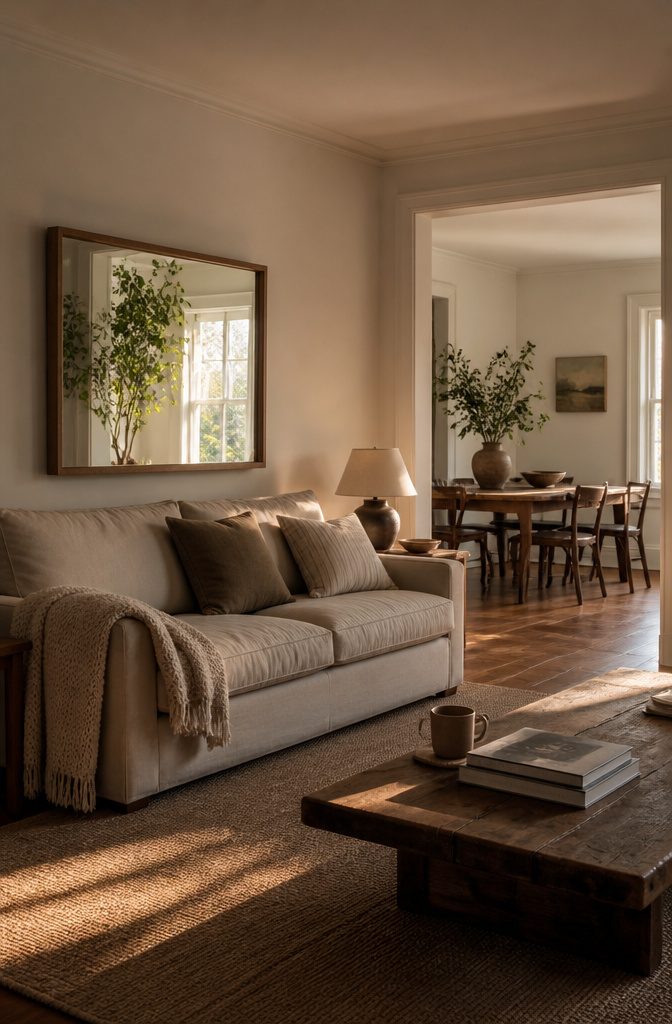
A large mirror about 6 inches above the back of the sofa gives a living room depth without competing with the furniture line.
The gap matters because too much space reads as a mistake and too little makes the mirror look like it’s sliding off the wall.
If you’re working around a fireplace, hang a large mirror less than 4 inches above the mantel or let it sit directly on the ledge. The tight clearance keeps the composition anchored instead of floating.
Bookshelves gain subtle interest when you glue thin mirror strips to the vertical boards between shelves. The reflection catches light without announcing itself, and the effect works better than a single large panel on the back wall.
That said, mirroring the back of a bookshelf is another option if the shelves are open and you want the room to feel wider. Both moves add sparkle, but strips feel more restrained.
9. Use Mirrors in Dining Rooms

Dining rooms are a natural fit for mirrors.
I’ve found they do two things especially well: they reflect candlelight and chandeliers, which makes the whole room feel warmer and more layered at night, and they anchor a wall when you need a focal point.
A large mirror above a buffet balances the horizontal weight of the furniture and pulls attention up. If you have a china cabinet, consider mirroring the back panels of the shelves.
The reflection doubles the effect of whatever is on display, and a small light at the top turns the cabinet into something that draws the eye from across the room.
Mirrors also help correct imbalance. When most of the visual weight sits at table height, a tall mirror on one wall lifts the sight line and reflects light back toward the center of the room.
Even a small vintage piece in an ornate frame adds presence without taking up floor space.
10. Use Mirrors in Bedrooms

Bedrooms give you four good places to put mirrors, and each one does something slightly different. A mirror behind a nightstand keeps the floor clear while adding symmetry, particularly when you have only one nightstand or an off-center bed.
Mirrors above the headboard work when the room is dark enough that you need to bounce ceiling light back down, or when you want a decorative grouping that fills the wall without artwork.
Armoires and closet doors take mirrors well because they give you a full-length view without claiming any wall space, which matters in a small bedroom.
A leaning floor mirror does the same job and looks less permanent, but secure it to the wall so it can’t tip.
Two cautions. Bedroom mirrors may reflect window light straight into your eyes in the morning, so check the angles before you commit to a spot.
Feng shui advises against placing a mirror directly opposite the bed, because it can amplify energy and disrupt sleep.
11. Use Mirrors in Bathrooms and Powder Rooms
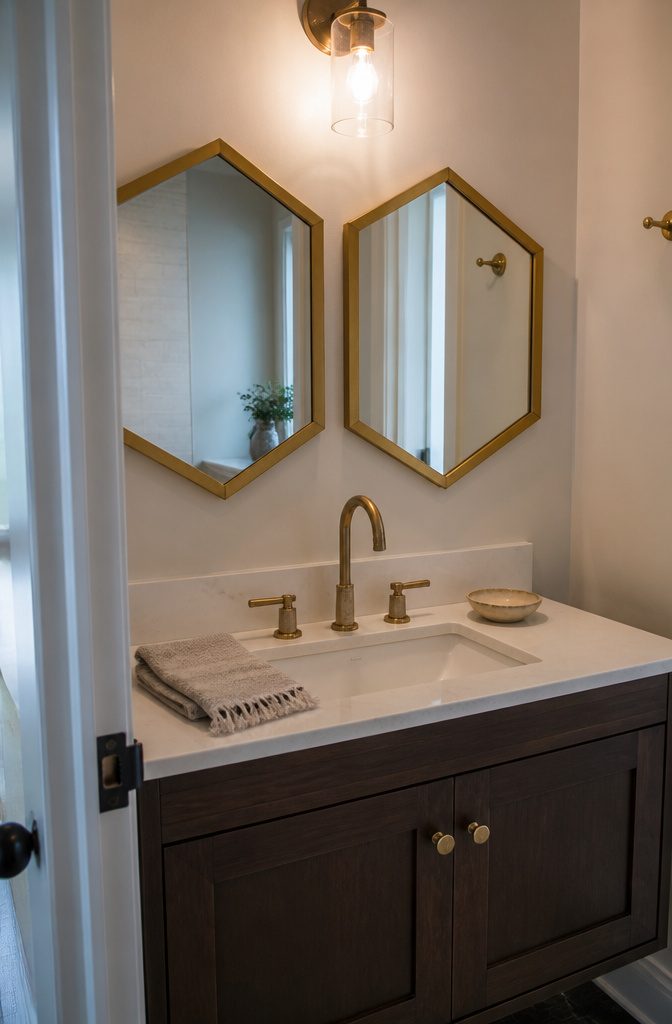
Over-sink mirrors set the tone for the whole bathroom.
I’ve found that getting the size right between the faucet and the light fixture takes actual trial, and I respect anyone who brings home three mirrors and returns them all because they were too big or too small.
That patience matters more than most of us want to admit. In a windowless powder room, the largest mirror the space allows makes the room feel less cramped.
A Venetian mirror replaces a builder-grade slab with almost no labor and changes the room immediately.
Circular mirrors work the same way when the architecture is plain and you want one strong gesture. Frame kits let you wrap what’s already there if the size is correct but the look isn’t.
When a single mirror won’t fit or the wallpaper is already bold, grouped smaller mirrors hold the wall without competing.
Two six-sided mirrors flanking the sink, or a cluster of small gold frames hung close together like a gallery wall, give you the same light return as one large piece.
The frames can differ in style as long as the finish stays consistent.
12. Use Mirrors Outdoors or to Create a Window Effect

Outdoor mirrors can make a small patio or balcony feel substantially larger by reflecting the garden or surrounding greenery back toward you.
A large round mirror mounted on an exterior wall works especially well in tight outdoor living spaces, and depending on the frame you choose, it helps define the area’s style at the same time.
I’ve also seen arched garden mirrors propped on outdoor console tables, which expands the view across a deck in the same way the same setup would inside.
The arched shape in particular reads as a window rather than a mirror, which keeps it from feeling out of place outdoors.
The window effect works indoors too. A window-shaped mirror hung on a wall that has no actual window brightens a dark corner or stairwell by giving the illusion of daylight.
Another approach is to place a mirror between two existing windows and hang curtains on either side, which creates the feeling of a wall of windows and makes the room read as larger than it is.
Hang Wall Mirrors at Eye Height

The center of a wall mirror should sit approximately 60 inches from the floor, which places it at eye height for most people.
That measurement works across entries, living rooms, bedrooms and hallways because it meets the natural sightline without forcing anyone to look up or down.
I use it as the starting point for every mirror I hang, then adjust only when the ceiling height or the furniture below demands it.
One common mistake is hanging mirrors directly across from each other, which can backfire:
Don’t put a mirror directly across from another mirror—that will create an infinite reflection that will make the room look smaller.
— Bob Vila
If you want mirrors on opposing walls, hang them at different heights so they reflect the room instead of each other. That way you keep the sense of depth without the visual clutter.
Match Frame Material to the Room
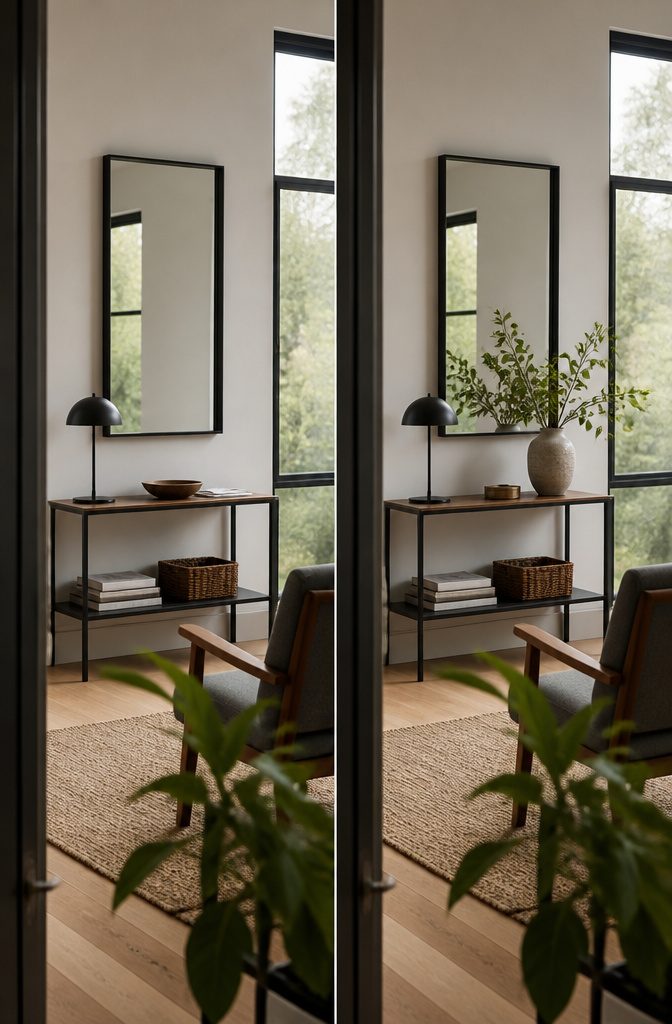
Match Frame Material to the Room
The frame often matters more than the mirror itself when you’re trying to hold a room’s look together.
Metal frames work well in spaces that already lean modern or industrial, while wood frames suit rooms where you’ve used natural materials elsewhere.
I’ve seen antique golden-framed mirrors look sophisticated in maximalist or mid-century spaces, especially near windows or behind furniture that can carry that level of detail. In plain rooms, the same mirror reads fussy instead of elegant.
Match the frame finish to existing accents in the room rather than treating the mirror as a standalone piece.
If you have brass cabinet pulls or warm metal lighting, a gold-framed mirror makes sense. Black mirrors suit rooms where you’ve already used matte black hardware or window frames.
Plaster and carved frames add texture, but they need a room that isn’t already busy. Woven or rustic wood frames feel deliberate in casual spaces and out of place in formal ones.
Clean Mirrors With Microfiber and Window Cleaner

A microfiber cloth and a household window cleaner are what you reach for when the mirror needs cleaning.
Microfiber lifts dust and grime without leaving lint, and a cleaner designed for glass cuts through fingerprints and film faster than general-purpose spray.
I wipe in broad strokes rather than small circles, which tends to leave streaks visible when light hits the surface at an angle.
The vinegar-and-water mixture you sometimes see mentioned is a decorative technique, not a cleaning method.
It creates a mercury-glass effect by etching or clouding the mirror deliberately, which is useful if you want an aged or antique look but the opposite of what regular cleaning is meant to do.
For reflecting light cleanly, stick with the window cleaner and keep the vinegar for crafts.
Frequently Asked Questions
How do you decorate a room with a mirror?
Pick a mirror size that fits the scale of the room and the furniture around it, then hang it at eye height (about 60 inches from the floor to the center).
Position it where it reflects light from windows or lamps to brighten the space, and avoid aiming it at clutter or blank walls. The frame should coordinate with other finishes in the room.
Do mirrors make a room look bigger?
Yes, mirrors placed where they reflect windows, lamps, or attractive views make a room feel more spacious by bouncing light deeper into the space.
Avoid hanging mirrors directly opposite each other, which creates an infinite reflection that actually makes the room look smaller.
What does vinegar do to mirrors?
A vinegar-and-water mixture creates a mercury-glass effect by etching or clouding the mirror deliberately, which gives it an aged or antique look.
This is a decorative technique, not a cleaning method. For regular cleaning, use window cleaner and a microfiber cloth instead.
Can you put peel and stick over a mirror?
Yes, vinyl lettering and washi tape both stick to mirror surfaces without damaging the glass.
Place vinyl phrases near the edge rather than dead center so they don’t block your reflection, and use washi tape as an accent stripe or border instead of covering the entire perimeter.
How to make your mirror look aesthetic?
Paint the frame in a color that coordinates with the room, or wrap it with rope or tile mats for added texture.
You can also decorate the mirror surface with vinyl lettering, faux flowers glued at one edge, or washi tape arranged as a border.
Match the frame material to existing accents in the room so the mirror feels intentional rather than out of place.