
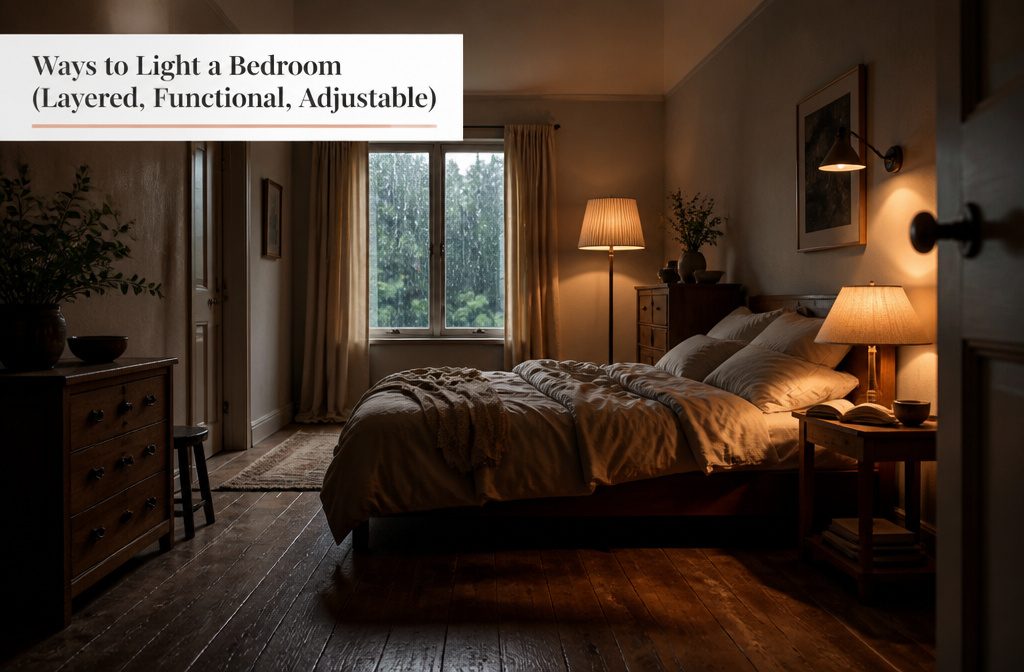
Bedroom lighting works when it combines overhead fixtures, bedside lamps, accent lights and sometimes floor or wall sources, and the right mix depends on the room’s size, how high the ceiling sits, and whether you need bright task light or softer ambient glow.
The usual mistake is relying on one ceiling fixture, which flattens the room and creates glare when you lie in bed.
Most bedrooms need 2000 to 4000 total lumens spread across multiple sources, with warm bulbs around 2700K for the areas near the bed and dimmers so the light level shifts from morning to night.
1. Layer Light Sources at Different Heights and for Different Tasks
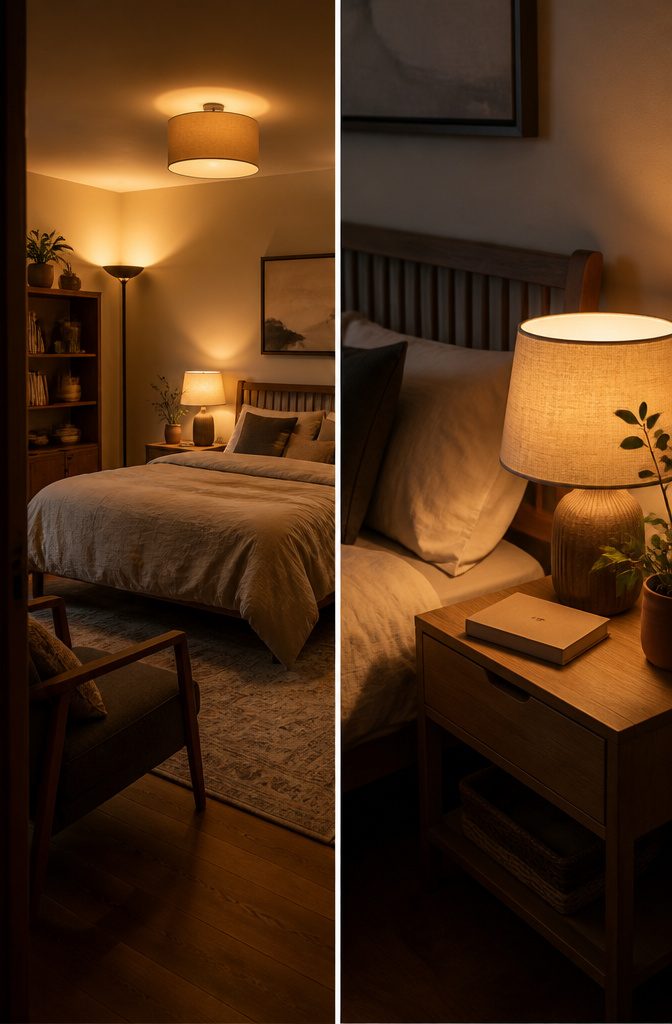
Effective bedroom lighting combines general room lighting with focused task light and softer accent or mood light, rather than relying on one source.
This approach avoids flat or harsh effects and makes lighting suit more than one activity. I organize them by height: overhead fixtures for general illumination, mid-level sources like sconces or table lamps, and lower accent pieces such as floor lamps.
When light comes from multiple sources and different levels, it fills the room more evenly and eliminates dark corners.
The flexibility matters because a bedroom is a multipurpose space: a place to sleep, read, dress, watch TV, and sometimes work. Stronger overhead lighting can feel stimulating at night, making you more alert when you’re trying to wind down.
A single bright ceiling fixture also creates unwanted glare and shadows when viewed from bed. By layering your light sources, you can adjust the mood for any activity with just a switch.
2. Use Ceiling Fixtures for General Light or a Focal Point
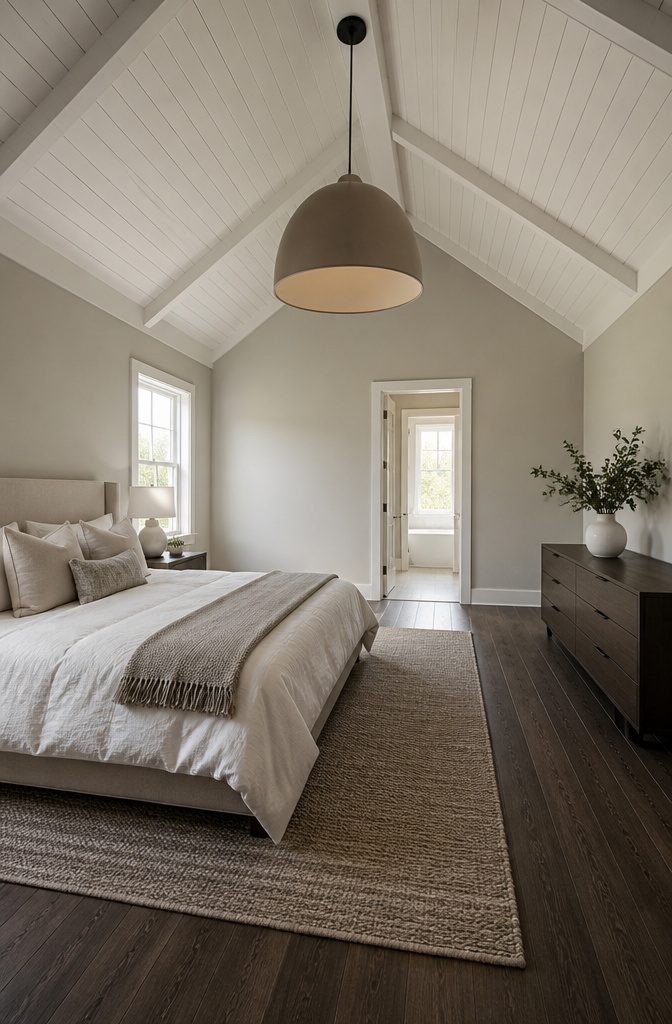
A ceiling fixture puts light everywhere at once, and in a bedroom with standard 8-foot ceilings, a flush mount sits tight to the surface so you don’t lose headroom.
At 9 feet, a semi-flush drops 8 to 12 inches and adds some shape without hanging low.
When the ceiling climbs to 10 feet or higher, a chandelier or pendant can come down 18 to 24 inches and work as a focal point over the bed or at the center of the room.
Whatever drops from the ceiling needs at least 7 feet of clearance from the floor so nobody walks into it.
Sizing follows a simple formula: add the room’s length and width in feet, and the sum in inches is roughly how wide the fixture should be.
A 12-by-14-foot bedroom calls for something around 26 inches across. I match fixture diameter to the room every time, because an undersized pendant disappears and an oversized one crowds the space before you hang a single thing on the walls.
3. Add Bedside Lighting for Reading and Nighttime Use
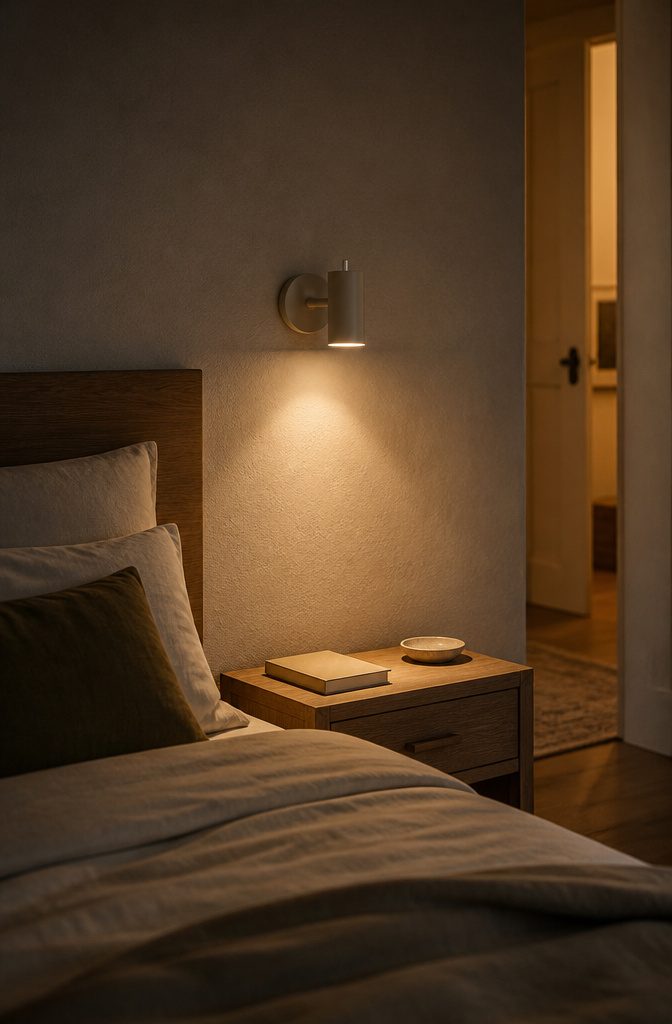
The most direct bedside light is a table lamp on the nightstand, but if the surface is small or you want it clear for a book and a phone, a wall sconce or a pendant mounted above the bed gives you the same light without using any space at all.
I lean toward sconces in narrow bedrooms where the nightstand barely fits, and they read cleaner when the bed is centered on a feature wall.
Table lamps should be between 25 to 29 inches tall and should use a dual bulb so that the level of light can be adjusted.
That height keeps the bulb near eye level when you sit up, which works for reading without glare on the ceiling. Wall sconces are usually mounted 30 to 36 inches above the mattress, measured to the center of the fixture.
Any lower and they cast too much direct light; any higher and the pool of light on the page shrinks. For brightness, around 800 lumens covers reading and anything else you do before sleep.
The nightstand itself should sit at roughly the same height as the mattress and no more than four to five inches from the bed, so you can reach the switch without stretching.
4. Use Floor Lamps to Light Corners, Seating, or Reading Areas

A floor lamp adds light away from the bed without touching the walls or requiring an outlet near the nightstand.
I use them most often next to a reading chair or in a corner that would otherwise stay dark, which makes the room feel larger and more evenly balanced.
An uplighter floor lamp bounces light off the ceiling and spreads it softly across the room, while a high-lumen reading lamp gives you enough brightness for a book without glare.
A tree floor lamp with multiple heads can light different areas at once, though that works best in larger bedrooms where you actually need coverage in more than one spot.
This brings the eye around the room rather than keeping all the light centered on the bed. Floor lamps let you do that without running new wiring or filling every surface with table lamps.
5. Use Wall Lights and Sconces Beyond the Bedside

Wall lights and sconces put soft ambient light exactly where you need it without claiming any floor space. I use them most often in compact bedrooms where a nightstand barely fits, let alone a table lamp.
Mount a pair of downlighters or swing-arm sconces above the headboard and you free up the surface entirely while still getting readable light for the last chapter before sleep.
They also work well to highlight a feature wall or frame architectural details.
I’ve seen sconces placed in pairs or trios along a wall to flank a dressing table or mirror, and the repetition gives the room a more finished look than a single ceiling fixture manages.
A sculptural sconce can stand alone as an accent in a corner or beside a doorway, especially in bedrooms with low ceilings where an overhead light feels too close.
Rechargeable sconces skip the hardwiring cost entirely, which matters in rentals or older homes where running new wiring means opening walls.
The light they cast is softer and less direct than downlights from the ceiling, so the room feels calm rather than brightly lit.
6. Add LED Strips or Other Integrated Lighting
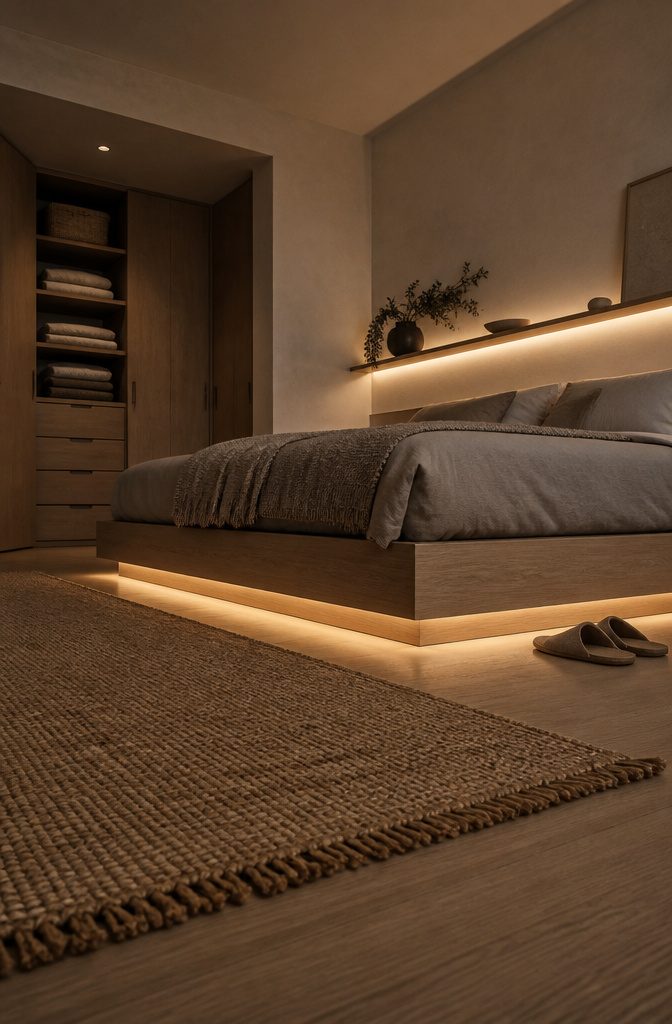
LED strips behind a headboard or under the bed frame add architectural dimension without mounting a single new fixture. The light creates a floating effect that softens the room at night and introduces structure without visible points of light.
Run strips along shelves or built-ins to accent décor, or install them along the ceiling perimeter for indirect ambient lighting that makes a room feel larger.
Tunable white and color-changing options shift the atmosphere from warm and restful to focused and bright, and they consume a fraction of the energy of traditional accent fixtures.
Closet and wardrobe lighting uses recessed downlights positioned in front of wardrobes to shine light inside, or LED strips wired inside the wardrobe and activated by a switch that comes on when the doors open.
Strategic positioning keeps the ceiling clean while putting light where you need it.
Under-cupboard lights fitted into shelving illuminate objects, and LED strips under bedside tables create a floating effect. A floor washer near the bathroom entrance acts as a night light.
7. Choose Bulbs and Shades for a Softer, Warmer Effect
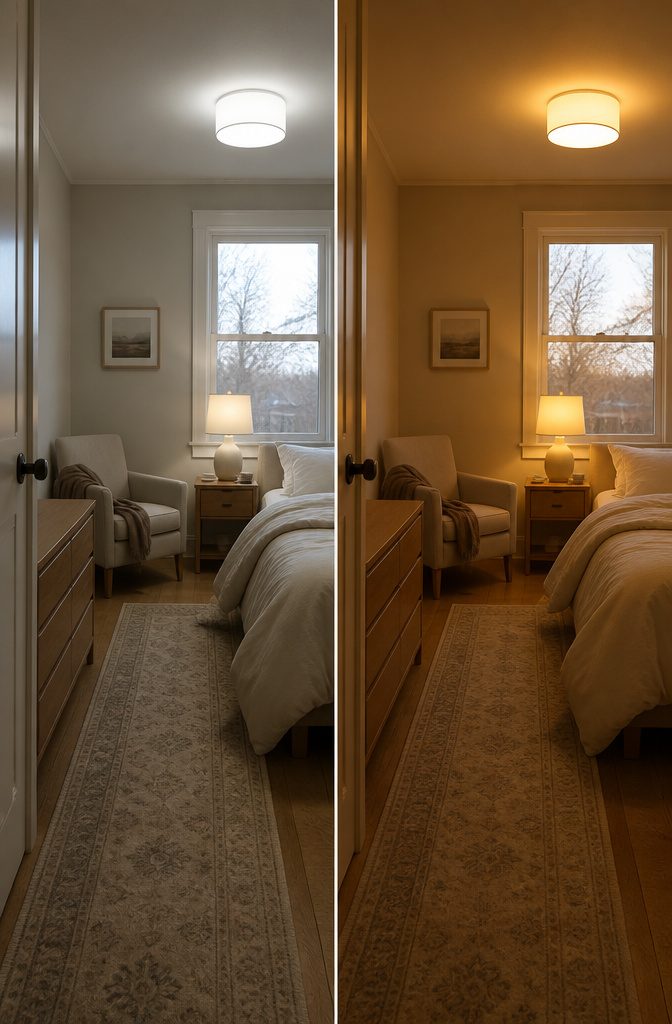
The bulb itself decides whether bedroom lighting feels restful or too bright. Warm-toned bulbs around 2700K to 3000K create the soft, inviting glow that most bedrooms need, especially for ambient fixtures and anything near the bed.
I stick with soft white around 2700K for overhead lighting and bedside lamps, which reads cozy without looking yellow.
Cooler light between 3500K and 4000K works for a reading nook or a desk where focus matters, but anything above 4000K feels too blue for general bedroom use.
The shade or cover matters as much as the bulb. Fixtures with frosted glass, fabric drum shades, or opal diffusers scatter light evenly and cut glare, which is easier on the eyes at night.
Enclosed or semi-enclosed designs that hide the bulb from direct view prevent harsh spots and sharp shadows. Paired with the right bulb temperature, a diffusing shade keeps the room balanced and comfortable at any hour.
8. Use Dimmers or Adjustable Fixtures to Change the Light

Adjustable brightness matters because the light you need at 6 a.m. is not the light you want at 10 p.m.
Dimmers give you control over mood without changing the fixture, and that flexibility is what makes a bedroom feel usable across the whole day.
I always prefer bedside lamps that offer at least two brightness settings, either through a built-in dimmer or a three-way bulb.
A lamp locked at one level forces you to turn it off entirely when you want less light, and that usually means fumbling in the dark.
Switches should sit at both the door and the bedside so you can control the overhead or wall fixture from either spot.
The door switch handles the walk-in moment, and the bedside switch handles the last thing before sleep. Most bedside lamps run on a standard 5-amp circuit, which is enough for two lamps and a phone charger without tripping anything.
9. Use Smart Controls, Schedules, or Scenes

Smart lighting lets you change brightness and color temperature without walking to a switch, and you can automate settings to match morning or evening routines.
Philips Hue is the system I see used most often in bedrooms because it handles both functions well. A 60W A19 bulb runs $54.99, and the Bloom table lamp is $109.99 if you want a standalone fixture that doesn’t need rewiring.
Both support tunable white, which means the light can shift from warm tones around 2000–2700K in the evening to cooler 3500–4000K morning light.
That range makes a difference when you want the bedroom to feel calm before sleep but still get enough alertness when you wake up.
The cost is higher than standard dimmable LEDs, but the scheduling removes the guesswork once it’s set.
10. Make Use of Natural Light and Reflections

Window treatments decide how much daylight reaches the room, and the difference shows up immediately. Sheer curtains or light-colored blinds let light filter through while still offering privacy, so the room stays bright through the morning without glare.
Heavy blackout drapes block natural light entirely, which means you rely on artificial fixtures even midday. I prefer voiles or muslins when the bedroom gets good sun exposure, because the diffused light stays softer than what comes through bare glass.
Mirrors reflect that daylight farther into the room and make the space feel larger. Placed opposite or adjacent to a window, a mirror doubles the reach of morning light and brightens corners that would otherwise stay dim.
Keep windows clean so the maximum amount of sunlight enters. The setup costs nothing beyond what you already own, and it reduces how much overhead or task lighting you need during the day.
How Much Total Light a Bedroom Needs

Most bedrooms work well with 2000 to 4000 total lumens spread across multiple fixtures, though a medium-sized room can get by on 1500 to 3000.
Another way to frame it: 10 to 20 lumens per square foot, with the lower end giving a softer feel and the higher end pushing toward brighter task zones.
If you’re working in metric, figure 20 to 40 watts of LED per 10 square meters, which translates to roughly 100 square feet.
The target shifts with room size, ceiling height, and how much daylight filters in during the afternoon, so treat these as starting points rather than fixed rules.
I find that a single overhead fixture rarely delivers this comfortably on its own, which is why layering ambient, task, and accent sources makes such a difference.
The numbers also vary depending on which source you consult, and your own preference for brightness matters more than hitting an exact figure.
Recessed Lighting Placement and Spacing

Ceiling spotlights work best set 2 feet in from the wall on a standard 8-foot ceiling, which puts the light where it should hit: at eye level, right where artwork hangs.
If the ceiling is taller, move the fixtures farther in to maintain that angle. I avoid placing recessed lights closer than 2 feet to any wall, because the wash starts to look uneven and the fixture itself can feel too obvious.
Accent lighting should be at least three times brighter than ambient lighting and controlled on its own circuit.
That separation mattersRecessed lights go 2 feet in from the wall on a standard 8-foot ceiling, far enough that the beam hits artwork or a headboard at eye level rather than washing straight down the wall.
That spacing keeps the light useful instead of decorative.
If the ceiling is taller, move the fixtures farther in so the angle stays shallow. I space recessed cans at least 2 feet apart and keep them off a separate circuit from the ambient ceiling fixture or pendant.
Accent lighting should run at least three times brighter than the general light in the room, which means higher-wattage trims or narrow beam angles.
The separate switch matters more than most people expect, because running accent and ambient light together flattens the room and kills any sense of depth.
If the bedroom has art or a textured wall worth lighting, the recessed fixtures earn their keep. Without that focal point, they read as cold and institutional.
Frequently Asked Questions
What is the best color temperature for bedroom lighting?
Warm white between 2700K and 3000K works best for ambient fixtures and bedside lamps because it creates a relaxing atmosphere without looking too yellow.
Cooler light around 3500K to 4000K suits a reading nook or desk where you need focus, but anything above 4000K feels too blue for general bedroom use.
How many lumens do you need for a bedroom?
Most bedrooms need 2000 to 4000 total lumens spread across multiple fixtures, or about 10 to 20 lumens per square foot.
A medium-sized room can work with 1500 to 3000 lumens depending on ceiling height and how much daylight comes through the windows. One overhead fixture rarely delivers this comfortably on its own, which is why layering different light sources matters.
How many watts do I need for a bedroom light?
Figure roughly 20 to 40 watts of LED per 10 square meters, which translates to about 100 square feet. The exact number shifts with room size and ceiling height, so treat it as a starting point rather than a fixed rule.
What is the best lighting for a bedroom?
Layered lighting that combines overhead fixtures, bedside lamps, and accent sources gives you the flexibility to adjust brightness and mood for different activities.
Soft, warm light works better than a single bright ceiling fixture, which creates glare and sharp shadows when viewed from bed.
Which light is best for the bedroom at night?
Bedside lamps with adjustable brightness or separate high and low switches let you control the light without getting up.
Table lamps should stand 25 to 29 inches tall to keep the bulb near eye level when you sit up, and the nightstand should sit no more than 4 to 5 inches from the bed so you can reach the switch easily.
How do you light a bedroom without overhead lights?
Floor lamps, table lamps, and plug-in wall sconces spread light around the room without requiring hardwired ceiling fixtures. LED strips behind the headboard or under the bed frame add soft ambient light, and rechargeable sconces mount without opening walls.
What are common mistakes with bedroom lighting?
Relying on one overhead source flattens the room and creates harsh shadows, especially when viewed from bed. Too many recessed cans or overly bright fixtures at night make the space feel cold and stimulating rather than restful.
How big should my bedroom lighting fixture be?
Add the room’s length and width in feet, and use that sum in inches as the fixture diameter.
A 12-by-14-foot bedroom calls for a ceiling fixture around 26 inches across, because an undersized piece disappears and an oversized one crowds the space.
What lighting makes a room cozy?
Warm, diffused light from multiple sources at different heights makes a bedroom feel inviting rather than flat.
Fixtures with frosted glass, fabric drum shades, or opal diffusers scatter light evenly and cut glare, which reads softer at night than exposed bulbs.