

The right tiny bathroom storage idea depends on whether you own the place or answer to a landlord.
That single constraint changes everything from what you can mount to how much you should spend. A $30 rolling cart stands on its own and rolls out when you move; a $300 built-in shelf demands a wall you are allowed to open.
Most of the ten ideas here sit in the $30 to $70 range, and the ones that do not require permission tend to outlast the ones that do.
1. Over-the-Toilet Storage Units
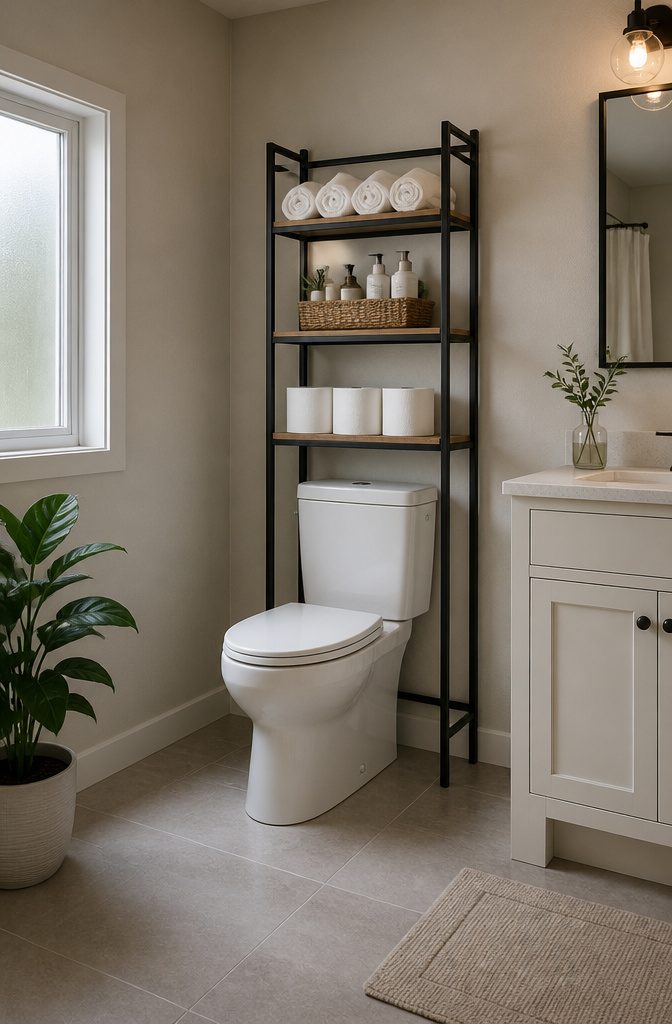
The dead space above a toilet tank is usually the first place to look when square footage is scarce.
Over-the-toilet storage units run 24–27 inches wide and 60–70 inches high, dimensions that slide into most standard setups without crowding the bowl. They borrow vertical real estate you already own and leave the floor untouched.
Three or four open shelves handle the overflow: extra toilet paper rolls, a basket of skincare, folded hand towels.
Metal frames or wood both hold up fine in humid air, though anything with adjustable shelves saves you from awkward gaps around tall bottles.
The mistake to avoid is depth. A unit too deep for your tank clearance leaves you wedged against the wall every time you stand up, or worse, it simply does not sit flush.
Measure from the wall to the front of your tank first, then check the shelf depth against that number.
Open shelving keeps a tight room from feeling boxed in, and a few woven baskets on those shelves corral the small stuff without turning it into visual noise.

[Special Design] The over the toilet storage shelf features 4 tiers storage rack, along with 4 removable hooks, providing ample storage space. The compartment below the bottom tier helps organize your toilet, washing machine, dirty clothes cart, and many other large items.
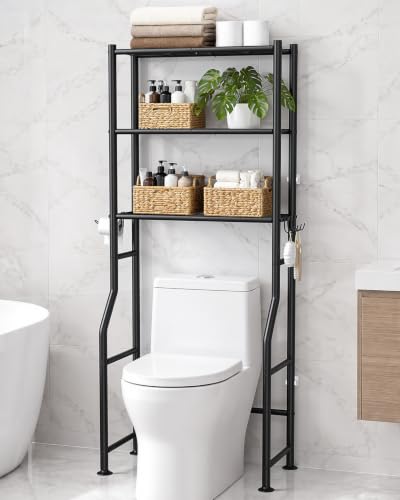
FITS TALL & BIDET TOILETS - Bottom shelf sits 39 inches off the floor, clearing standard, elongated, comfort-height and bidet toilets with the lid free to lift fully.

[Utility Design] Our over the toilet storage shelf features three open shelves and 1 storage basket, along with 3 removable hooks and a toilet paper holder, providing ample storage space. The compartment below the basket helps organize your toilet, washing machine, dirty clothes cart, and other large items.
2. Floating Shelves
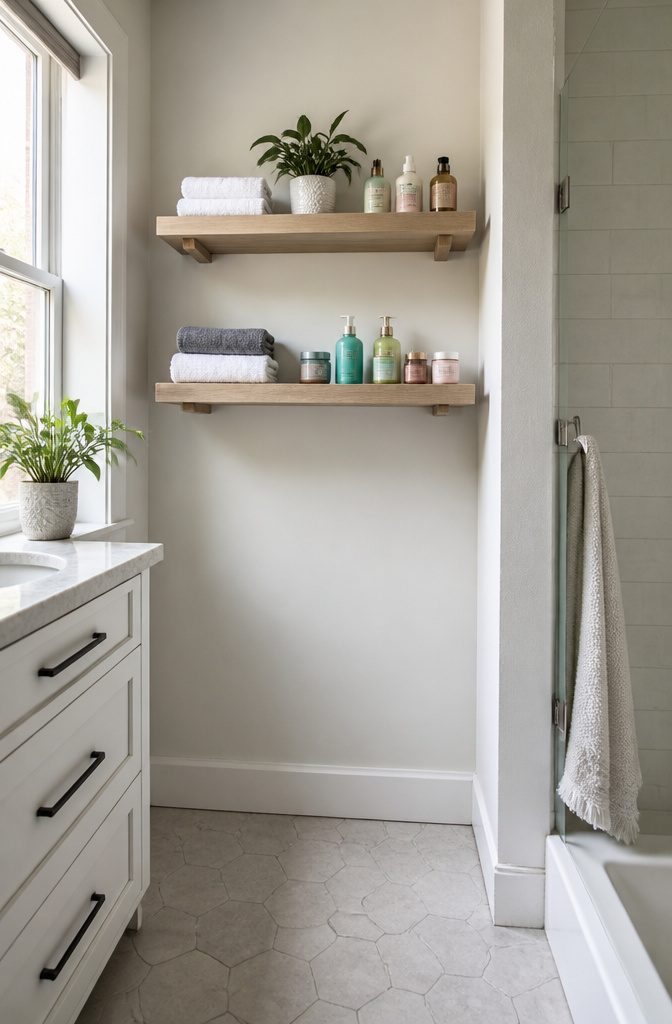
Wall-mounted shelves free up the counter space you do not have to begin with.
In a narrow bathroom, the visual bulk of a cabinet can turn a tight room into a corridor; floating shelves sit flat against the wall and keep the floor line open.
For standard towel storage, mount them 16–18 inches apart so a folded bath towel stacks without crushing the one below. Ten to twelve inches works better for smaller items like toiletries or rolled hand towels.
The stud finder is non-negotiable.
Drywall anchors hold picture frames; they do not hold glass containers, several towels, and the humidity cycle of a bathroom. Skip the studs and you will eventually skip straight to patching a wall.
No source I found listed weight limits or exact bracket dimensions, so I go by what holds in practice: brackets into studs, level checked twice, and nothing heavier on the top shelf than a small plant or a spare soap dish.

𝐄𝐱𝐩𝐚𝐧𝐝 𝐒𝐩𝐚𝐜𝐞 𝐚𝐧𝐝 𝐌𝐨𝐝𝐞𝐫𝐧 𝐃𝐞𝐬𝐢𝐠𝐧: With clean lines and a warm finish, these small bathroom shelves expand wall space in dry bathroom zones and double as stylish bathroom organizers and storage. Effortlessly organize towels, toiletries, and decor with the invisible bracket that creates a sleek, modern display appearing to float seamlessly on your wall — perfect for over the toilet bathroom organizer setups and completing your bathroom wall decor

Superior Quality: Our floating shelf bracket is expertly crafted from premium steel, ensuring exceptional durability and an impressive weight capacity of 110lbs.
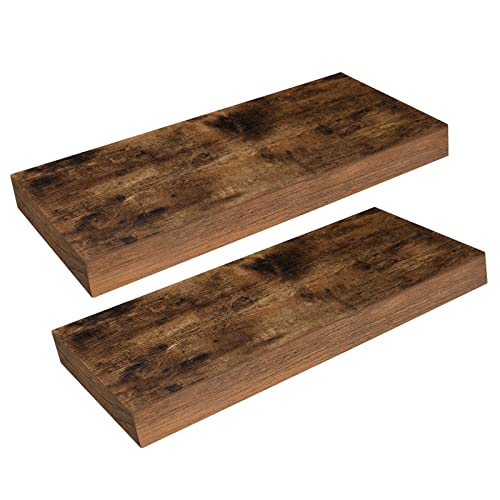
High Quality: Sized in 15.7"L x 7.9"W x 1.5"H. The 1.5" thick floating shelves for wall are fixed with Invisible and enhanced dual-pipe iron Brackets, stable with great load up to 22 lb per wall mounted shelf
3. Narrow Cabinets and Storage Towers

A 6- to 12-inch-wide tower sounds like free real estate until you discover the door clips the toilet paper holder or the drawer won’t clear the baseboard.
I measure the gap, then I measure again with the door swung open to its full arc. The footprint alone lies.
The box promises four or five shelves of capacity, enough for twenty to thirty rolled towels.
What it actually holds is a looser stack than that, plus the bottles that fall over when you pull the drawer. Pull-out models help, but only if the slide clears the plumbing you forgot to account for.
Corners are trickier.
The diagonal eats more space than the wall length suggests, and a triangular unit often ends up holding one soap dispenser and a lot of dust. I skip them unless the sink leg leaves a true rectangle.
For the narrowest gaps, the old CD rack trick still works: four to six toilet paper rolls in a footprint barely wider than the rolls themselves. No door swing to worry about when there is no door.

Vertical Space Savior: Maximize small bathroom/laundry room spaces with this 65.4" height tower cabinet. Its ultra-narrow 11.8" depth fits perfectly beside toilets, in corners, or tight apartment spaces where every inch counts.

【4 Drawer Storage Cabinet】This bathroom cabinet features 4 deep drawers. It provides enough room to place towels, rolls, toiletries, soap, shower gel, ect. And the slide-free design simplifies the assembly steps which is friendly to the user
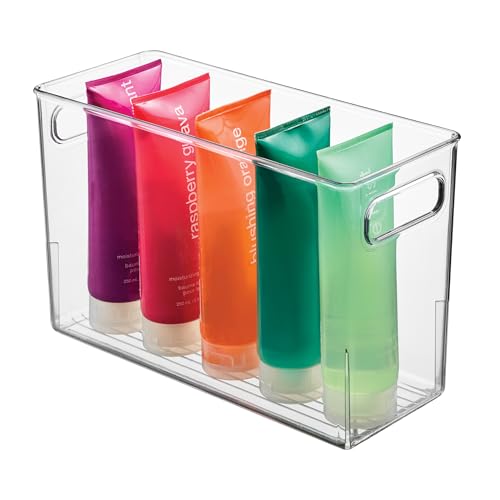
SLIM DESIGN - The iDesign Narrow Bin fits perfectly on bathroom countertops, under sinks, or inside tight cabinets to help maximize space while keeping things organized; Perfect for storing lotion bottles, creams, serums, hair products, and toiletries
4. Under-Sink Organizers

The cabinet beneath a bathroom sink swallows cleaning supplies, backup shampoo bottles, and extra toilet paper faster than you’d think, mostly because everything lands in one layer that ignores the vertical space.
A two-tier sliding organizer fixes that by putting daily essentials in the front drawer and reserve stock behind it, though the P-trap running down the center kills more storage plans than cabinet size ever does.
I learned this the hard way with a wire two-tier unit that looked purpose-built online.
The shelves slid smoothly in the product photos, but the center support beam sat exactly where my drain pipe needed to be. U-shaped or side-mounted organizers work around plumbing without forcing you to rebuild the cabinet.
Stackable bins split by category, one for hair products and another for skincare, keep the back corners from becoming a graveyard of half-used bottles you’ll find three years later.

【Flexible 4 Tier Storage Cart】- The 4-tier slim storage cart is 4.75 in design which can be used in tight spaces in your home for storage. Suitable for closets, kitchens, bathrooms, garages, laundry rooms, offices or in-between your washer and dryer. Our entire storage cart is made of plastic. Please note that the wheels, hooks and rods are all made of plastic.
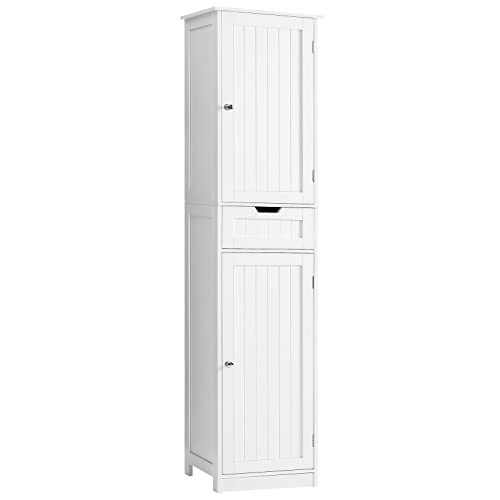
【Perfect for Tight Spaces】It is 67" tall so is a great vertical storage solution, while taking very little floor space. Measuring just 15.7"L x 11.8"D at the base, it easily fits into narrow nooks. With 6 hidden shelves and a spacious drawer(store all your movies, CDs, photos) , this cabinet provides plenty of some eye level storage.

1.Gap Storage Expert: 4-Tier Intelligent Height Differential Design:(4.9"W x 38.7"H x 15.3"D)Engineered for modern compact living! With its slim 4.9-inch profile, this organizer fits perfectly into narrow gaps between furniture and appliances. Its core advantage lies in the innovative four-tier height differential design: the lower two tiers provide generous 12.5" , while the upper two tiers feature an optimal 9.2" height . One unit accommodates all sizes, maximizing vertical space utilization.
5. Wall-Mounted Hooks and Racks
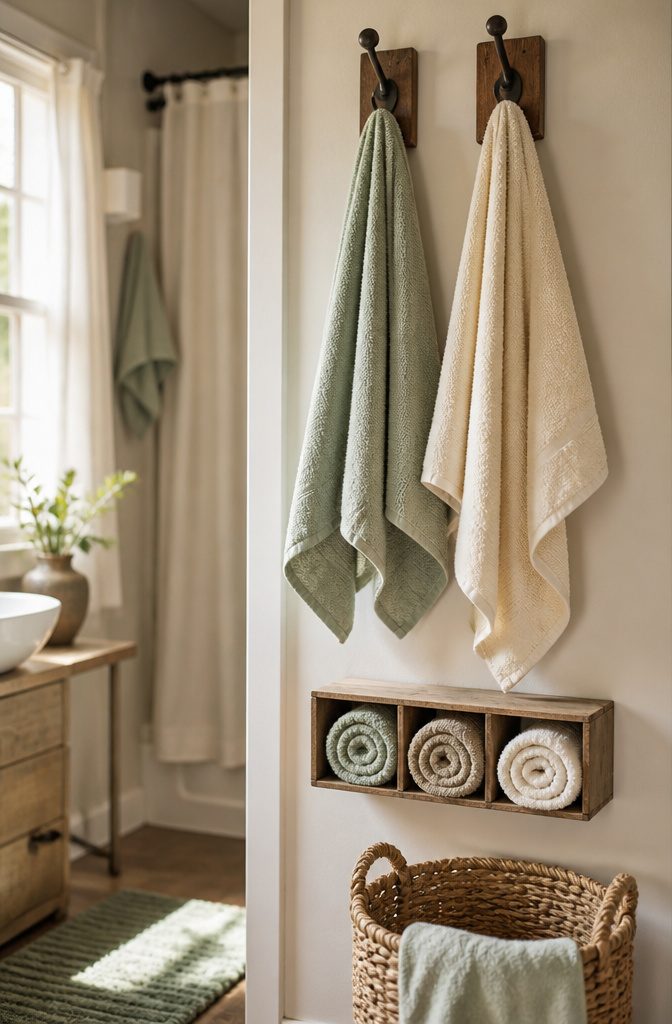
Wall-mounted hooks gave me back the six inches a towel bar ate on the only usable wall in my last rental’s bath.
A pair of simple hooks holds two towels where a 24-inch bar would have crowded the door swing, and the towels dry by morning if the hook is spaced so the fabric hangs in open air, not bunched against the wall or another towel.
Hooks meant for damp storage sit an inch or two off the wall; flat-backed robe hooks trap moisture against the plaster and the fold stays wet.
Showroom photos hang them at eye level for a clean sight line, but actual humans reach for towels with wet hands and dripping arms. Mount the hook at about 48 inches, or where your wrist naturally lands without lifting your elbow.
The back of the door works when walls are truly gone; slim profile racks 1–2 inches thick clear the jamb and hold three to four towels without preventing the door from closing fully.

【NO DRILLING, NO DAMAGE】 Perfect for bathrooms and rental apartments, this over the toilet shelves cabinet requires no drilling or wall damage. The sleek black design complements any home décor while the compact footprint maximizes storage in small spaces throughout your home

[Utility Design] Our over the toilet storage shelf features three open shelves and 1 storage basket, along with 3 removable hooks and a toilet paper holder, providing ample storage space. The compartment below the basket helps organize your toilet, washing machine, dirty clothes cart, and other large items.

[Utility Design] Our over the toilet storage shelf features three open shelves and 1 storage basket, along with 3 removable hooks and a toilet paper holder, providing ample storage space. The compartment below the basket helps organize your toilet, washing machine, dirty clothes cart, and other large items.
6. Rolling Carts
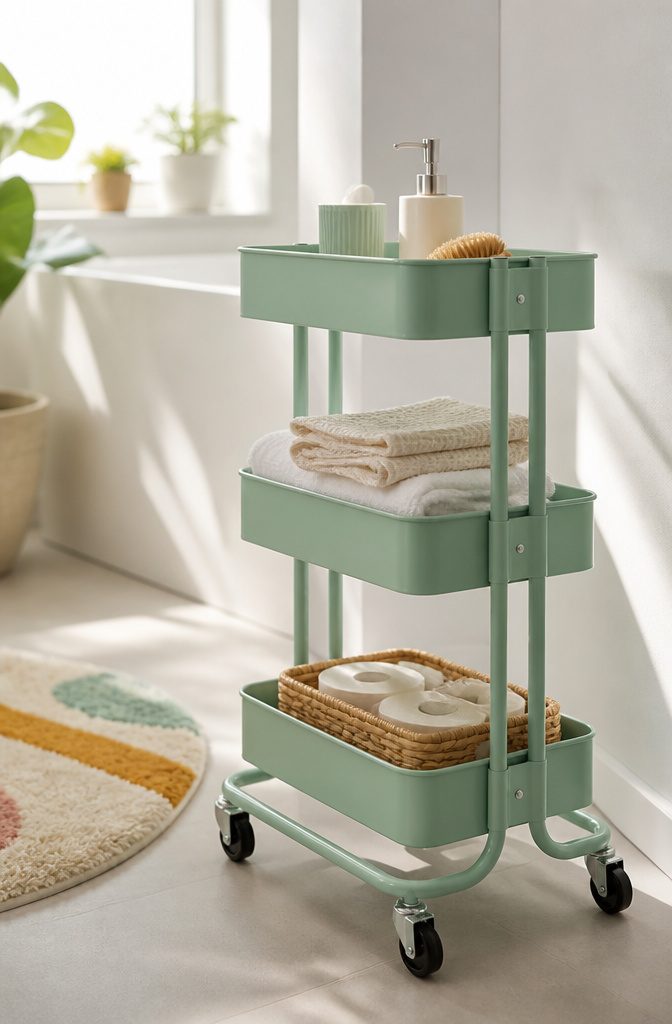
Wheels solve the problem of a bathroom with no built-in storage and no wall you are allowed to drill into.
The IKEA Råskog runs about $30, takes roughly fifteen minutes to assemble, and holds up better than its price suggests in humid air thanks to an epoxy-coated steel frame.
Three 11-by-15-inch trays fit rolled towels, a stack of toilet paper, or the bottles that otherwise colonize the edge of your sink.
The slotted trays allow water to drain through, so no mildew can collect from the wet toys between bath times.
That drainage detail matters for anything damp, not just bath toys. I keep my hair dryer and a few washcloths on the top tier, cleaning supplies below.
The lockable wheels are the real feature: roll it to the tub when you need everything at hand, lock it when you step out so it does not skate across wet tile.
In a shared bathroom, one cart per person ends the morning counter fight without installing a thing.
The liability is obvious once you have mopped.
A cart left in a puddle will sit in that puddle. Slimmer rolling units, the kind built six to ten inches wide to squeeze beside a toilet, tip more easily on uneven floors and rarely drain as well.
For a wet room, the Råskog’s weight and footprint trade some floor space for stability.

Multi-functional Design: This shelf consists of a towel rack and three laminated panels. You can use a towel rack to hang your towels, which will dry them faster. And the laminate can hold the bottles and cans

MAXIMIZE BATHROOM SPACE - This 3-tier over the toilet storage rack transforms wasted vertical space into organized storage. Includes 4 removable hooks and a built-in paper towel holder, providing complete bathroom organization in one sleek unit. Perfect space-saving solution for small bathrooms, apartments, and dorms.

【Over Toilet Storage】The bottom shelf can easily fits into space behind your toilet. Featuring three mesh shelves, it provides ample storage for bathroom accessories, shampoo, shower gels, towels, and hair dryers. Keep daily necessities organized and easily accessible.
7. Medicine Cabinets

The medicine cabinet I took out of my last rental was a surface-mounted box from the seventies, maybe three inches deep inside, and most of what I owned rattled around or tipped out onto the sink.
I assumed every replacement would hold the same amount.
That was the mistake. Standard cabinets run 3 to 4 inches deep; deep-profile models give you 5 to 7 inches, which is the difference between a tube of toothpaste lying flat and standing upright in rows.
Recessed cabinets sit back into the wall cavity and keep your tight walkway clear, but they need wall you can open up. Surface-mounted ones project outward, install in an afternoon, and work where plumbing or studs block a recess.
The shallow units suit daily toiletries you grab fast. Deep-profile cabinets swallow bulkier bottles, backup supplies, the things that otherwise colonize a linen closet two rooms away.
Small bins or magnetic containers inside either type stop the avalanche when the door swings open, and keeping medications on the top shelf gets them above both steam and small hands.
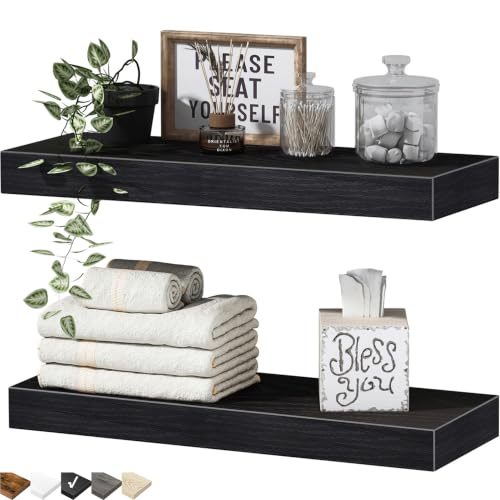
Maximize Your Space: 6.7"D x 15.7"W x 1.5"H. 6.7" depth, ideal for books, baskets, toilet paper, or towels. Includes 2 shelves for optimal use of space

𝐌𝐨𝐝𝐞𝐫𝐧 𝐚𝐧𝐝 𝐕𝐞𝐫𝐬𝐚𝐭𝐢𝐥𝐞 𝐒𝐭𝐲𝐥𝐞: The hidden bracket design gives a clean, floating look that works beautifully as home decor wall shelves in modern, farmhouse, rustic, or industrial decor styles. Adds warmth and style without overwhelming your space for bedroom decorations, farmhouse living room decor, office wall decor, nursery, entryway, kitchen, and more

Well-designed Floating Shelves: Our white floating shelves for wall are made of MDF Laminate. These wall shelves can organize daily sundries to tidy your space, display your art pieces on the wall to decorate your home, and make it full of aesthetic flare.
8. Shower Caddies

Shower caddies live in the worst conditions any storage faces: hot, wet, and coated in soap film that traps moisture against metal.
The first one I bought was a wire tension-pole model with chrome plating that looked solid in the store.
Within eight months the finish flaked and the welds bloomed with orange corrosion. I replaced it with a nearly identical unit from a different brand.
That one lasted a year before the same failure, because chrome-plated steel is still steel underneath, and once water reaches it through a scratch, the rust runs under the plating like a stain spreading in fabric.
The third caddy was stainless steel with an open-wire basket design, and the difference was immediate.
Water drains through instead of pooling, the alloy resists corrosion without relying on a surface coating, and the welds have held clean for three years now.
Tension poles work well if your shower has a flat ceiling and tub edge to press against.
For angled ceilings or fiberglass surrounds, a single corner shelf with adhesive mounting keeps the footprint small without the wobble. Suction cups are fine for a spare razor, but a full bottle of conditioner will test them eventually.
If you own the place, a built-in niche set away from the direct spray keeps bottles cleanest and eliminates hardware entirely. Renters rarely get that option, which makes the material choice on a removable caddy the decision that actually matters.
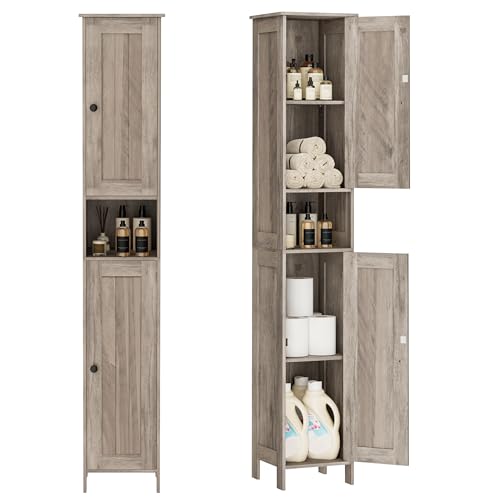
Vertical Space Savior: Maximize small bathroom/laundry room spaces with this 65.4" height tower cabinet. Its ultra-narrow 11.8" depth fits perfectly beside toilets, in corners, or tight apartment spaces where every inch counts.
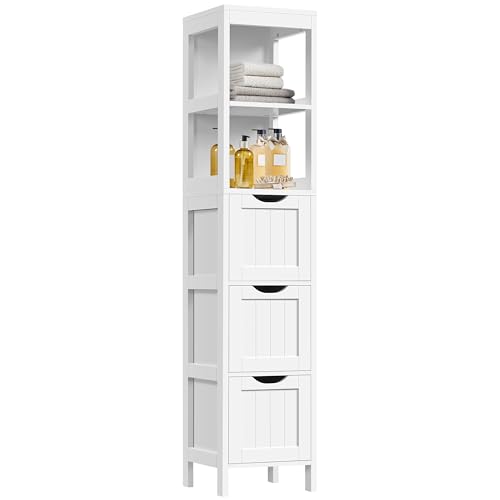
Easy Care, Lasting Freshness: Made with moisture-resistant spray-painted MDF, this wooden storage cabinet stands up to humid bathrooms and busy mornings. A quick wipe keeps it spotless, ensuring your space stays clean, bright, and ready for everyday life

Slim Yet Spacious: With a narrow footprint, this tall floor cabinet fits effortlessly into tight bathroom corners or beside the sink, offering enough tabletop and four smooth-gliding drawers to keep your daily essentials neatly tucked away and within reach
9. Baskets and Bins
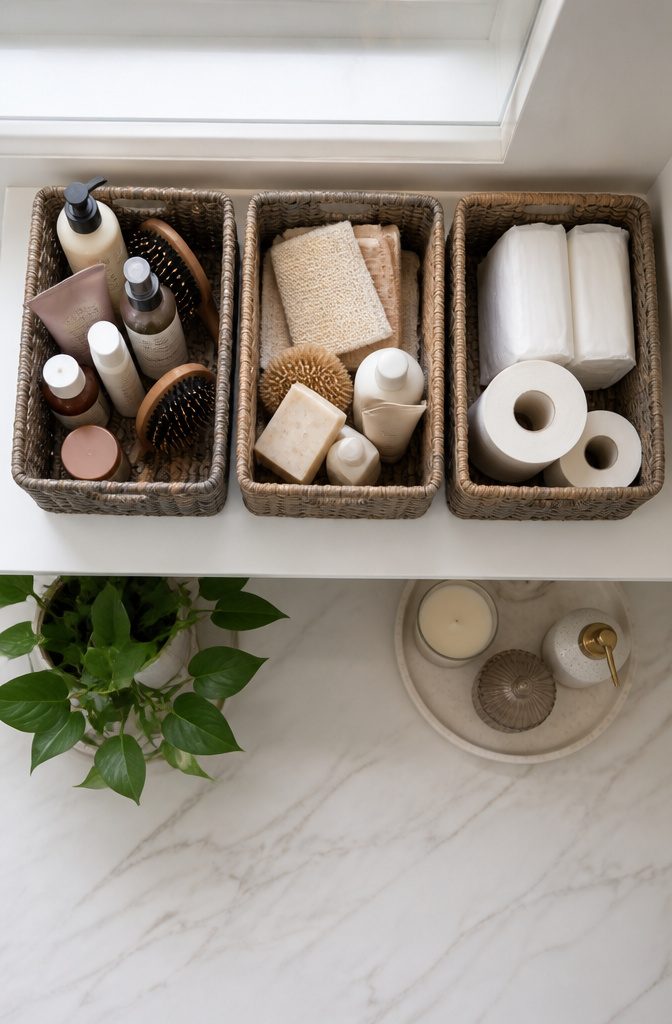
Open containers are the fastest way to turn chaos into order, but the look of them matters more than most people plan for.
Woven baskets especially read as decor whether you meant them to or not, so the texture and tone you choose becomes part of the room’s finish.
I learned the hard way that a basket that looks right-sized on the store shelf can hold about half what you expect once you get it home and try to fit actual bottles inside.
The sides slope, the weave has give, and suddenly your hair products need a second basket.
Grouping by category keeps the system working past the first week. One basket for hair care, one for body care, one for the backup supplies that used to live in a grocery bag on the closet floor.
Labels help, but the real discipline is pulling the whole bin out to use it, then sliding it back. What breaks the habit is a bin too heavy to lift one-handed or too deep to see the bottom of.
The Brooklyn setup that worked had a few shallow woven baskets across an open shelf, nothing stacked, everything visible at a glance.
That visibility is the trade: the room stays tidier because the storage itself is part of the design, but you commit to keeping the contents presentable.
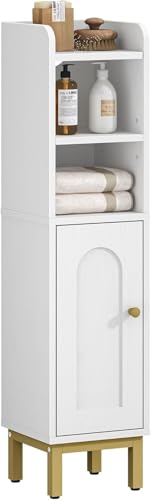
【Fit for Narrow Space】Please Note the Size. This space-saving bathroom cabinet measures 7.9" D x 7.9" W x 32.7" H, ideal for narrow space, arched door design and metal base not only add beauty to your bathroom but also easy to clean, no fear of soaking, no need to worry about cracked wood panel
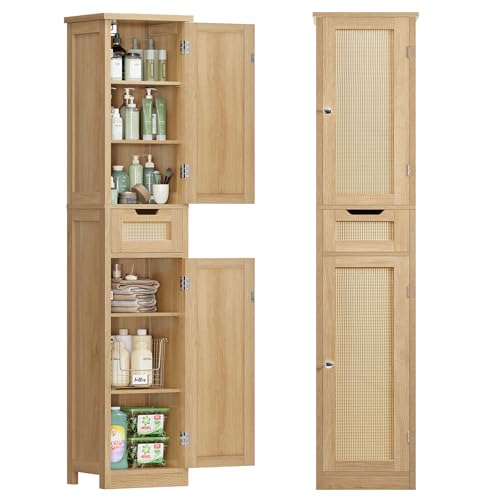
【Perfect for Tight Spaces】It is 66.9" tall so is a great vertical storage solution, while taking very little floor space. Measuring just 11.8"W x 11.8"D at the base, it easily fits into narrow nooks. With 4 hidden shelves and a spacious drawer(store all your movies, CDs, photos, different sized trophies and collections) , this storage cabinet provides plenty of some eye level storage.

【Narrow Unique Design】Our 3 tier narrow ladder shelf measures only 9.85 inches in length and 11.65 inches in depth. Ideal for placing in corners or any narrow location to make the most of limited space, it's a perfect standing shelf option that maximizes vertical space.
10. Tension Rods for Hanging Items

A spring-loaded rod wedged inside a narrow cabinet or between wall and toilet tank turns dead air into storage for spray bottles, loofahs, or a lightweight caddy.
The bottles hang by their triggers, heads down, labels readable at a glance, which beats rooting through a basket every morning.
I learned the hard way that tension only holds where both ends meet solid, flat surfaces. The painted drywall beside my pedestal sink looked flat enough at ten at night.
At six the next morning, the rod, three spray bottles, and a full bottle of glass cleaner launched across the tile in a chain reaction that woke half the apartment.
Now I test the fit with a hard shove before I hang anything, and I skip tension rods entirely on textured walls or anywhere the span exceeds two feet.
For heavier items, a screw-mounted bar takes ten minutes and removes the suspense.

【Fit for Most Toilets】This over-the-toilet-storage use a tension style of floor-to-ceiling rod structure, you can fit this over the toilet storage cabinet virtually anywhere though you have a small and tight bathroom. This bathroom storage rack is very space-saving, so you don't have to worry about plumbing facilities.

3 Tiers of Open Storage: Provides ample space for towels, toilet paper, and bathroom essentials; keeps everything organized and within easy reach

[Utility Design] Our over the toilet storage shelf features three open shelves and 1 storage basket, along with 3 removable hooks and a toilet paper holder, providing ample storage space. The compartment below the basket helps organize your toilet, washing machine, dirty clothes cart, and other large items.
Vertical Storage in a 5-by-8-Foot Box

A 5-by-8-foot bathroom leaves about forty square feet of floor, and most of that is spoken for by the door swing, the toilet’s clearance zone, and the path to the shower.
The walls carry almost every storage decision once you map what’s actually left.
In that footprint, the ten ideas stack vertically by priority. Over-the-toilet shelving and floating shelves grab the upper wall space that no fixture uses.
Slim cabinets, six to twelve inches wide, fit the narrow gaps beside vanities or between walls. Behind the door and inside cabinet doors add layers without stealing square footage.
Under-sink organizers and wall hooks handle the stuff you touch daily. Rolling carts, baskets, and tension rods fill the leftover corners and vertical lines.
If I could only pick two, I’d start with floating shelves above the toilet and the narrow cabinet beside the vanity.
The shelves cost a weekend and keep daily supplies in sight; the cabinet hides what looks messy and slides into dead space that already exists. Everything else is refinement once those two are in place.
What Multi-Functional Actually Means
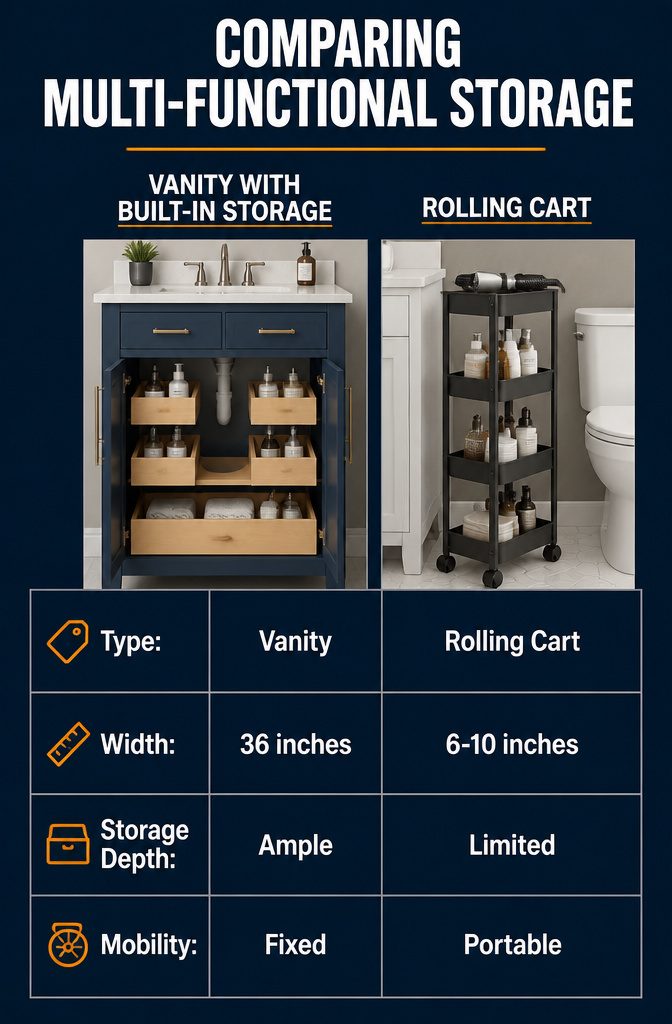
A vanity with built-in storage sounds obvious until you realize how many builders treat the cabinet as an afterthought. Drawers that jam on plumbing, false fronts with no depth behind them, shelves cut around traps so nothing square actually fits.
The good ones run the drawer box around the drain with a U-shaped notch and give you full extension so you can reach the back corner. Check for that before you buy, because the spec sheet rarely warns you.
Rolling carts advertised as counter extensions are narrower than they look in photos.
Most run 6 to 10 inches wide with three or four tiers, which is enough for a hair tool and some bottles but not for spreading out a makeup routine.
In a shared bathroom, the mobility helps: roll it out for morning traffic, park it beside the toilet after.
In a primary bath, measure your knee clearance if you plan to sit and use it as a temporary vanity. A cart that tucks neatly beside the toilet can still block your legs when pulled up to a mirror.
The storage mirror I bought was mostly mirror. The frame depth looked generous in the product image, but the interior cavity was shallow, angled back from a slim bezel so only flat items, pill bottles and contact cases, sat flush.
Tall skincare bottles had to lie down, which wasted the vertical space the mirror promised.
A recessed medicine cabinet, mounted into the wall rather than on it, buys you actual depth without the protrusion, though it costs more in labor or in hiring out the drywall patch.
The test for any dual-purpose piece: does it do the harder job well? Storage is always the harder job.
A mirror that reflects your face is easy. A mirror that swallows your toiletries without turning them into a jumbled shelf you dread opening, that is the piece worth the premium.
Magnetic Strips and Repurposed Kitchen Tools

Magnetic strips read like a clever trick until you test what actually stays put.
A 12-inch strip inside a medicine cabinet door grips tweezers and nail clippers without issue, but bobby pins slide unless the magnet is strong enough to hold them through paint.
Makeup with magnetic packaging works better in theory than practice; the backing on most drugstore brands is too weak to trust at that angle.
Small magnetic containers stuck to a metal vanity side or cabinet door solve this, since gravity quits being the enemy.
Kitchen organizers migrating to the bathroom run into their own mismatches.
Spice racks do fit small toiletries, and plate organizers separate makeup palettes or hair tools cleanly. The real test is drawer depth.
Those iDesign Linus Shallow Drawer Organizers sit at just 2 inches deep, which slides into most bathroom drawers, but a 3-by-3-inch compartment that corrals sample eye creams will not stretch to fit a standard toothpaste tube laid flat.
The non-skid rubber feet keep compartments from drifting, yet the size you need for utensils rarely maps to what you actually store in a bathroom.
I measured my own vanity drawer after reading the dimensions, 12–18 inches wide and 2–4 inches deep, and found a 6-by-6-inch organizer that held headbands perfectly left no width for the hairbrush beside it.
Suction-cup sponge holders on a mirror or backsplash work for easily lost small items, though anything with expiration dates needs rotation before it turns into clutter you forgot to use.
What I Store Where

Most small-bathroom layouts force a choice between keeping daily essentials within arm’s reach and hiding the rest out of sight.
The under-sink zone works best for the second tier: cleaning supplies, extra toilet paper, and backup toiletries stacked in drawer-style organizers so you’re not crouching every morning. Daily-use items belong anywhere you can grab them standing up.
- Daily essentials — toothpaste, face wash, medications, and the one hair product you actually use need a shelf or medicine cabinet at counter height or above, away from the humidity that collects lower down.
- Backup supplies — bulk shampoo, backup razors, and that extra floss live under the sink in labeled bins; if the stack rises above the pipes, a vertical organizer keeps categories from collapsing into each other.
- Cleaning products — also under the sink, but on the side closest to the plumbing where drips won’t ruin anything; never mixed with anything that touches skin.
- Towels — the one that stumps everyone in a no-closet bath. The towel in use hangs on a bar or hook; extras go vertical on a wall-mounted ladder leaning at about 75 degrees and eating only 8–10 inches of floor, or rolled tight in a basket on a shelf where they take 30% less space than folded. Over-door racks work for three to four towels if the rack stays under 2 inches thick so the door still closes. The vanity itself is the wrong home for towels; that space is too scarce and too damp.
A Weekend and a Few Hundred Dollars

Most of the ten ideas here cost between $30 and $70, which is where the real work gets done without denting a weekend budget.
The over-door organizers and basic tension pole shower caddies sit at the low end, around $20 to $40, while quality under-sink organizers and bathroom storage carts land in that $40 to $80 range.
I would not chase the premium tier unless you own the place; custom built-in shelving at $300 to $800 is not built for a lease.
The Simplehuman 4.5L Round Step Can is the piece I keep pointing people toward when they ask where the money actually went.
It runs about $30, stands roughly a foot tall and 10 inches across, and reads as a small trash can rather than storage.
The steel body and soft-close lid make it feel like something that cost more, and the white version disappears against white tile so it does not add visual noise.
The inner bin lifts out for cleaning, which matters more than it sounds in a space where everything touches everything else.
Where I mis-spent was on a mounted shelving system that looked right in the product photo but needed anchors my landlord would not have wanted and tools I did not own.
That $90 stayed in the box. For renters especially, the $30 solutions that stand on their own or hang over a door tend to outlast the ones that demand permission.
Frequently Asked Questions
What is the best storage solution for a very small bathroom?
Over-the-toilet storage units are the best starting point.
They run 24–27 inches wide and 60–70 inches high, borrowing vertical space you already own while leaving the floor untouched. Open shelves with a few woven baskets handle extra toilet paper, skincare, and hand towels without crowding the room.
How do you maximize storage in a narrow bathroom?
Focus on vertical solutions that keep the floor line open. Floating shelves mount flat against the wall without the visual bulk of cabinets, and wall-mounted hooks hold towels in the six inches a bar would waste.
The inside of cabinet doors and the area above the toilet are prime spots most people underuse.
Where should I store towels in a small bathroom?
Hang the towel in use on a bar or hook mounted about 48 inches high, where your wrist naturally lands.
Extras go vertical on a wall-mounted ladder leaning at about 75 degrees and eating only 8–10 inches of floor, or rolled tight in a basket on a shelf where they take 30% less space than folded.
Over-door racks work for three to four towels if the rack stays under 2 inches thick.
How can I organize bathroom counter clutter?
Limit counter items to daily essentials only and move everything else to closed storage.
Tiered organizers or small trays corral what stays out: toothbrushes, hand soap, and two or three frequently used products. The rest belongs in a medicine cabinet, floating shelf, or under the sink in labeled bins.
What should I store under my bathroom sink?
Reserve this zone for the second tier: cleaning supplies, extra toilet paper, backup toiletries, and bulk shampoo.
Use stackable bins or a two-tier sliding organizer to split by category, but check for your P-trap first; U-shaped or side-mounted units work around plumbing without forcing a rebuild.