

The right dressing table for a bedroom in 2026 depends on whether you need it to disappear into the wall or hold your whole morning routine.
A floating setup keeps the floor clear at 28 to 30 inches high, but one shallow drawer will not contain a hair tool collection without overflow.
Measure your alcove depth before you buy; my own chimney breast left only fourteen inches, and a standard console would have blocked the walkway entirely.
1. Floating Wall-Mounted Dressing Tables
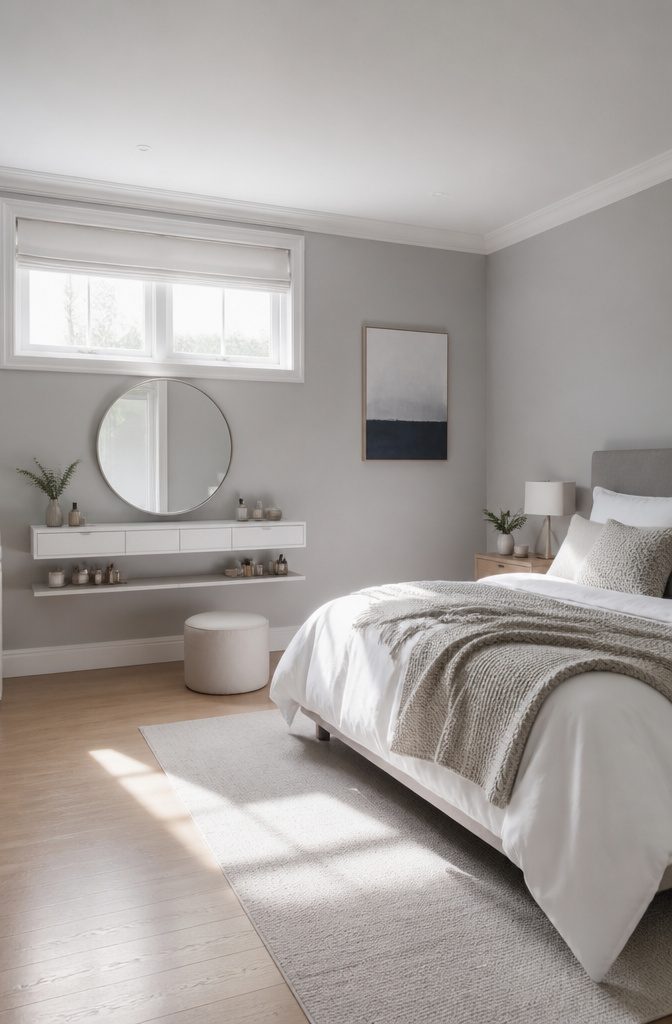
A floating wall-mounted dressing table keeps the floor completely clear, which matters in a small bedroom where every square foot has to work. Without legs or a base, the wall carries the weight and you pick the height yourself.
Most dressing tables sit 28 to 30 inches high, and that range still holds when you mount one yourself; pair it with a stool around 17 to 19 inches tall and you will have room to sit without your knees knocking wood.
The real advantage is flexibility.
A narrow shelf or wall-mounted drawer underneath the tabletop gives you storage without the bulk of a full dresser, and slim shelves above handle the rest. The floor stays visible, so the room reads as lighter than it is.
This is the setup I would choose for a rental where you cannot commit to built-ins but still need a dedicated spot to sit and finish your morning.
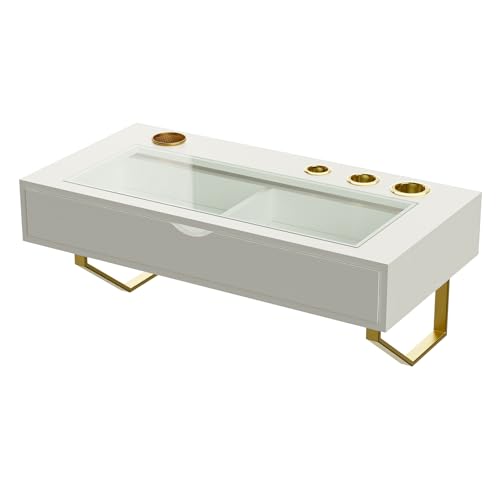
Versatile Design: This desk combines modern and classic design elements, functioning as either a writing desk or dressing table to suit various styles of home decoration
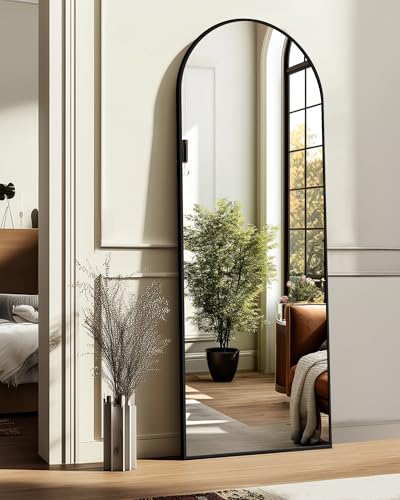
Wall mirror has a classic arch shape with a shatterproof design. It can be hung on the wall or stand on the floor and is suitable for a variety of home styles such as modern classical boho. Product size is 56'' x 15''.

【100% FULLY ASSEMBLED & READY TO USE】 - Stop worrying about complex assembly instructions and missing parts. This premium floating makeup vanity arrives 100% fully pre-assembled and ready to mount. It is the perfect choice for shoppers looking for "no assembly required" furniture, allowing you to set up your beauty station in under 5 minutes right out of the box.
2. Built-In Alcove Dressing Tables

A shallow wall recess or the gap between wardrobes can become a fitted vanity nook with nothing more than a tabletop, mirror, and a drawer unit slid inside.
The walls do the framing, so the built-in look arrives without the built-in price.
I measured my own alcove three times before buying anything. The depth was the surprise: only fourteen inches before hitting the chimney breast.
A standard console table would have jutted into the room like a shelf at a store. A twelve-inch-deep top with a small overhang left just enough knee room and kept the walkway clear.
The hiding is half the point. Recessed sides mean bottles and brushes sit below sightline from the bed, so the clutter disappears even when you have not tidied.
One mirror and one wall light keep it from feeling like a cave. More than that, and the narrow space starts to feel like a corridor with accessories.

Ample Storage Space: This compact dressing vanity comes with 5 open storage shelves, 2 sliding drawers, 2 hidden storage shelves behind mirror, providing ample storage space for all your cosmetics, jewelry, hair dryer, curling iron and other beauty essentials.

【Vanity Table With Charging Station】This makeup vanity features a charging station, includes 2 standard plug sockets and 2 USB ports, which can be more convenient to connect your hair dryer, and curling iron, and it can also charge your phone,tablet or other mobile devices,Nice make up vanity for dressing room, salon or Bedroom.
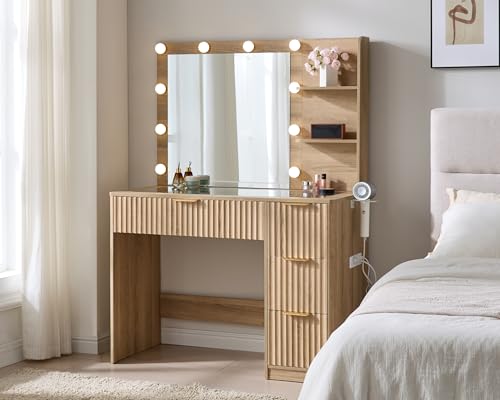
All-in-One Makeup Vanity Desk: This multifunctional vanity table integrates a tri-tone lighted mirror with stepless dimming, 4 spacious drawers, built-in charging ports, and a hair dryer holder for a seamless beauty experience
3. Minimalist Dressing Tables
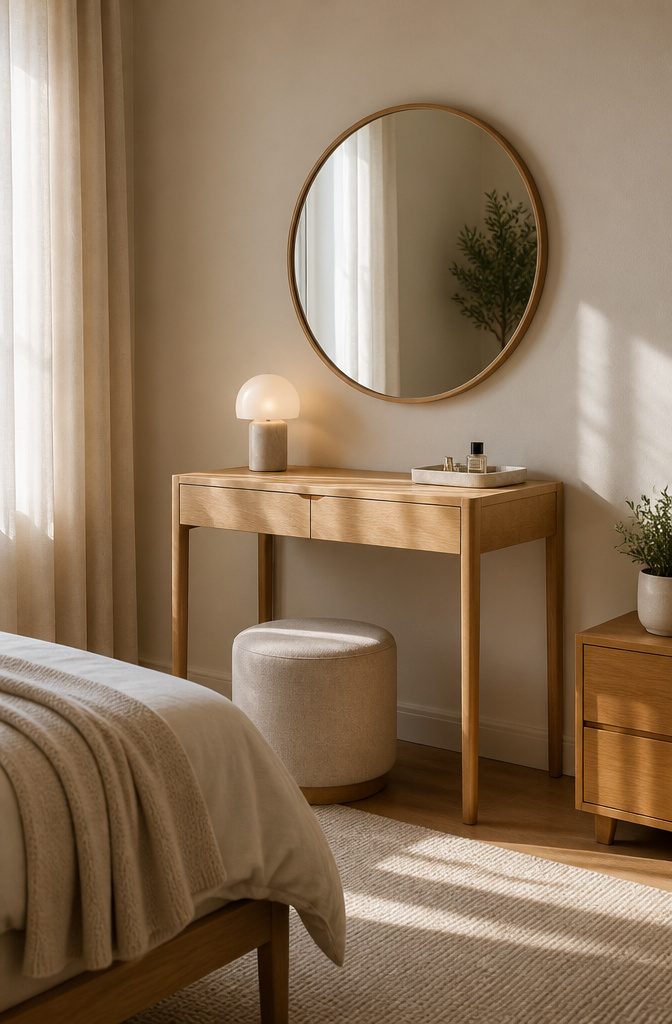
Clean-lined tables with little visible hardware tend to come in white, natural oak, or matte black, and the discipline is really in what you leave off.
I keep mine to one mirror, one light source, and a single tray; anything more starts to inch toward clutter that a small bedroom cannot absorb.
The standard dressing table height runs 28–30 inches, which matters more than people think: too low and you hunch, too high and the proportions fight the stool.
A floating or wall-mounted version keeps the floor visible, which reads as extra square footage in tight quarters.
That said, be realistic about what one floating drawer can hold. If your makeup and tools overflow it, add a hidden-storage stool or a slim drawer unit nearby rather than letting the surface become a pile.
Mounting hardware needs to be solid, not the weak brackets that come in the box; a dressing table that shifts under elbow weight is worse than no table at all.

Stylish Industrial Sofa Table: Perfectly blending elegant metal with a rustic wood finish, this industrial console table combines functionality with a sleek appearance. Plus, the harmonious mix solidifies the table as a focal point in your living room.

Semi-Open Compartments: Easily organize your keys, umbrella, earphones, and more. Side panels keep items securely in place, while the open design ensures quick access

Modern Form, Lasting Appeal: Clean lines and balanced simplicity define this BARNET Collection entry table, combining a steel frame with rustic panels to create visual depth and pair effortlessly with matching storage units for a cohesive, modern interior
4. Vintage or Antique Dressing Tables
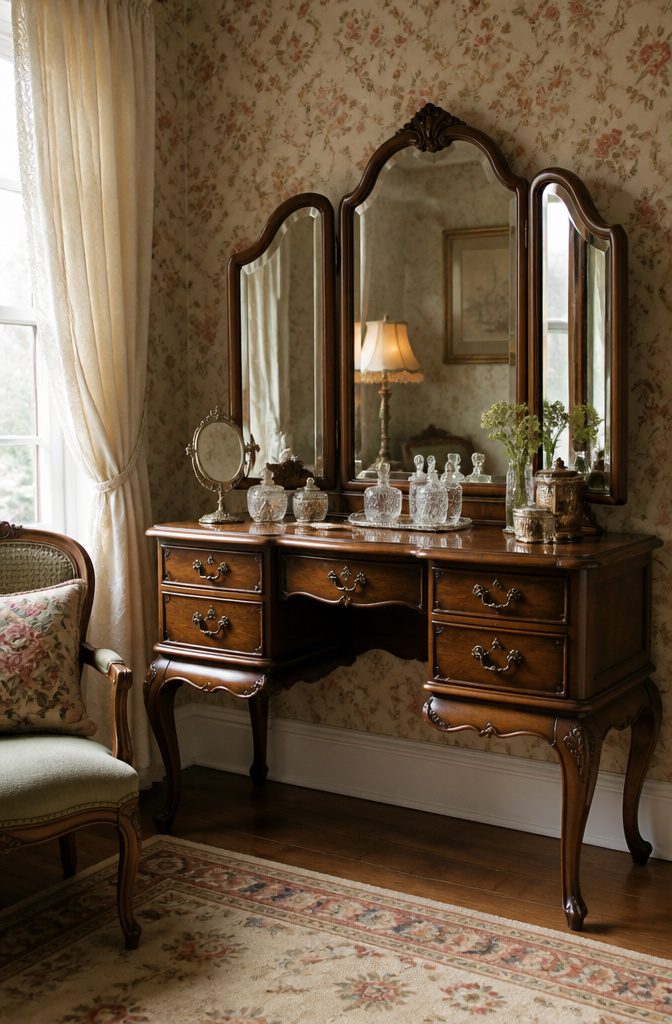
Estate sales and flea markets are where the details that factories stopped making turn up: cabriole legs that taper to a scroll, dovetailed drawers with porcelain pulls, tri-fold mirrors hinged so the side panels angle in.
The trade-off is condition. Drawers stick because humidity swells the wood runners; a few passes with paraffin or beeswax on the contact surfaces usually frees them without planing anything down.
Wobbly legs often mean a loose stretcher joint or a foot that has been shortened unevenly, and both are fixable with glue and clamp time rather than money.
A finish with honest wear, what dealers call patina, is part of the appeal. What you want to avoid is active damage: veneer lifting from moisture, or a mirror backing that has gone spotty and loose.
Flip the glass and check that the silvering is still firmly attached to the glass, not flaking onto your fingertips.
If the backing board is new plywood screwed over old cardboard, someone already replaced it once; that is not a defect, but it is a sign to look closer at everything else.
New dressing tables with applied "antique" distressing cost more and still miss the proportions, the slight asymmetry of a hand-cut mortise, the way a century of opening has worn the drawer front smooth in exactly one place.

Eco-Friendly and Durable Material : This vanity stool is crafted of high-quality oak wood and processed with exquisite craftsmanship, which is sturdy for long-time use.

𝗦𝗢𝗟𝗜𝗗 𝗔𝗖𝗔𝗖𝗜𝗔 𝗪𝗢𝗢𝗗, 𝟯𝟬𝟬 𝗟𝗕 𝗖𝗔𝗣𝗔𝗖𝗜𝗧𝗬 — Real solid acacia hardwood, not MDF or particle board. The sturdy frame supports up to 300 lbs, giving adults a stable step to reach upper kitchen cabinets, closet shelves, or a high bed.

Oak Wood: Crafted from FAS grade oak wood, this wooden stackable stool ensures stability up to 350 lbs and long-lasting durability.
5. Multi-Functional Dressing Tables
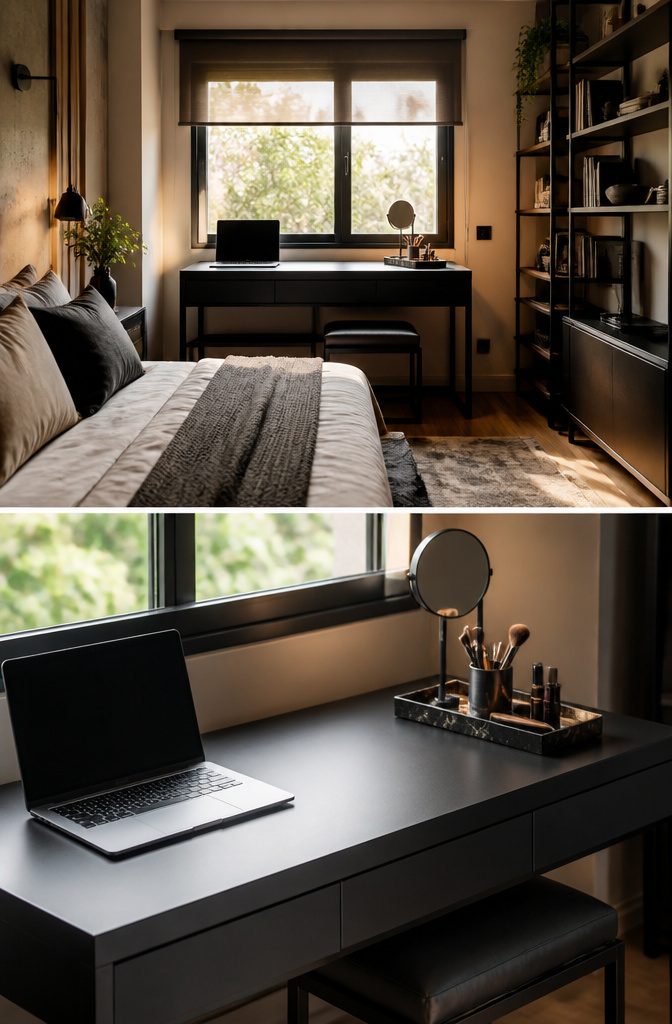
A desk at standard desk height, 28 to 30 inches, already sits where a dressing table should.
That overlap is what makes the double-duty setup work without awkward compromises. The same surface holds a laptop at noon and a mirror and makeup tray by evening; the switch stays clean only if each side keeps its own zone.
The stool matters as much as the table. A seat around 17 to 19 inches tall leaves enough legroom to sit comfortably, and one that tucks fully underneath disappears when the bed is the only path through the room.
In a rental with one usable wall, that few inches of recovered floor space is the difference between flowing traffic and a shin-bruising obstacle course.
Storage needs to hold both roles without mingling them. Drawer organizers keep office supplies and makeup in separate territories; a wall mirror instead of a tabletop one frees the surface entirely.
The real payoff comes morning and night: no migration of stuff, no ten-minute reset, just a slide of the tray and the same table wearing a different job.

Chic Arched Design : Enhance the elegance and sophistication of your bathroom with our chic arch mirror. Its unique design effortlessly catches the eye and adds a touch of class to any space. This wall mounted mirror not only adds a stylish element but also makes the room appear brighter and more spacious. A perfect addition to any bathroom decor, our arched-top mirror is an ideal choice for those who seek both functionality and aesthetic appeal

[Lighted Mirror Inside, Super Handy] The LED lights illuminate the area surrounding the interior mirror when you open the door of the jewelry cabinet, making a light-up vanity for you to apply your makeup and put on jewelry with ease

✨ 2-In-1 Full-Length Mirror & Hidden Jewelry Storage: This sleek jewelry cabinet doubles as a crystal-clear full-length mirror and a secret storage organizer. Check your outfit from head to toe while keeping all your accessories neatly tucked away—no more cluttered dressers or lost jewelry! The minimalist design adds a modern touch to any bedroom, dressing room, or entryway, saving you valuable floor space.
6. Dressing Tables With Integrated Lighting
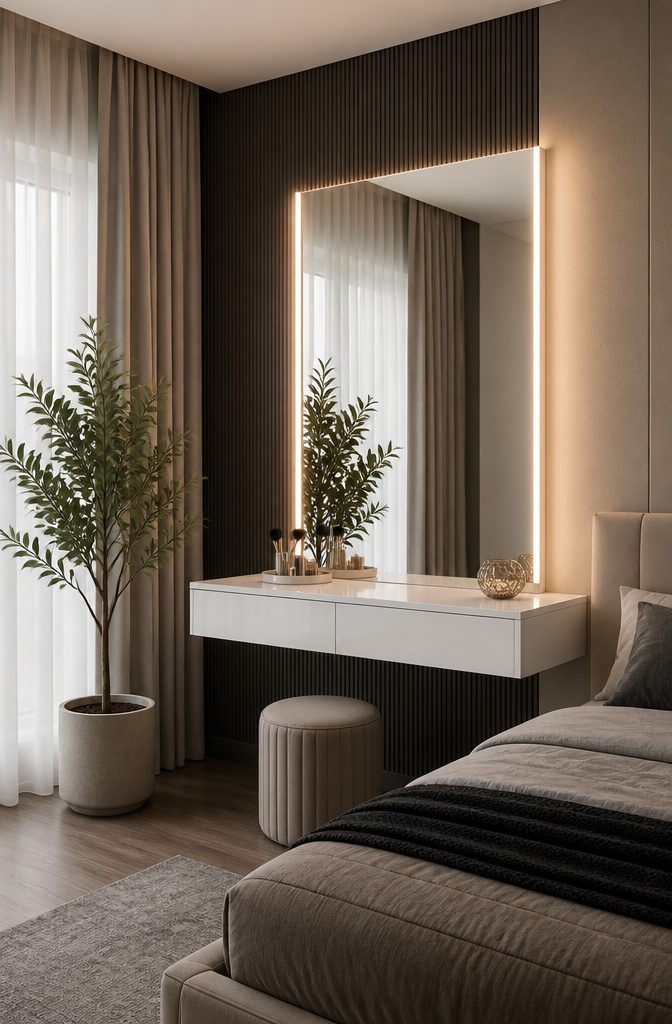
LED strips built into the mirror frame or tucked along the table edge give the even, diffused light that makes the actual difference between a dressing table you use and one you avoid.
The sweet spot for color temperature sits between 2700K and 3000K, warm white that flatters skin rather than the blue cast daylight bulbs leave on your face.
Adjustable brightness matters more than I expected going in; dimming for evening skincare versus bright for detail work keeps the same setup useful across the day.
Some mirrors now let you shift color temperature too, though I find myself leaving it at the warmer end. The real practical win is surface space.
A separate lamp eats six to eight inches of tabletop you do not have in a small bedroom, and the cord is one more thing routing behind the table. Integrated lighting removes both problems entirely.

Space-Saving Floating Design: The Floating Dressing Table with 2 Drawers features a wall-mounted design that maximizes floor space and allows for customizable height adjustments to fit any room. Ideal for small bedrooms or compact apartments, it’s a perfect addition where space is limited. (Mirror and stool not included)

[Wall Mounted Floating Design] – Homary floating makeup vanity saves valuable floor space and brings a sleek, modern touch to your bedroom or dressing area. Ideal for small spaces, it creates a minimalist aesthetic without compromising functionality
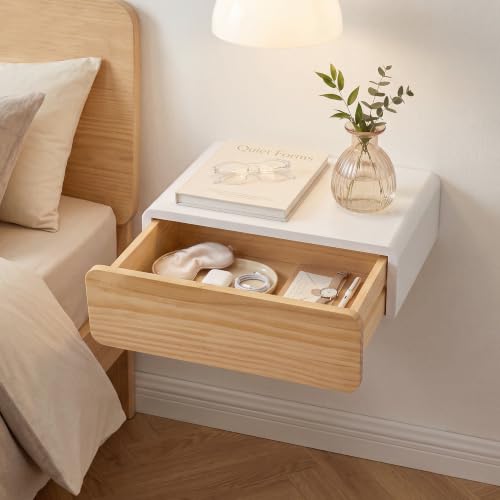
𝑴𝒊𝒍𝒅 𝑨𝒓𝒄 𝑳𝒊𝒏𝒆 𝑫𝒆𝒔𝒊𝒈𝒏: The gentle curves of the arc line design enhance the visual appeal while ensuring safety by eliminating sharp edges, creating a soft, inviting atmosphere in your bedroom. This design perfectly complements the sleek white and natural wood finish for a modern yet cozy aesthetic
7. Corner Dressing Tables
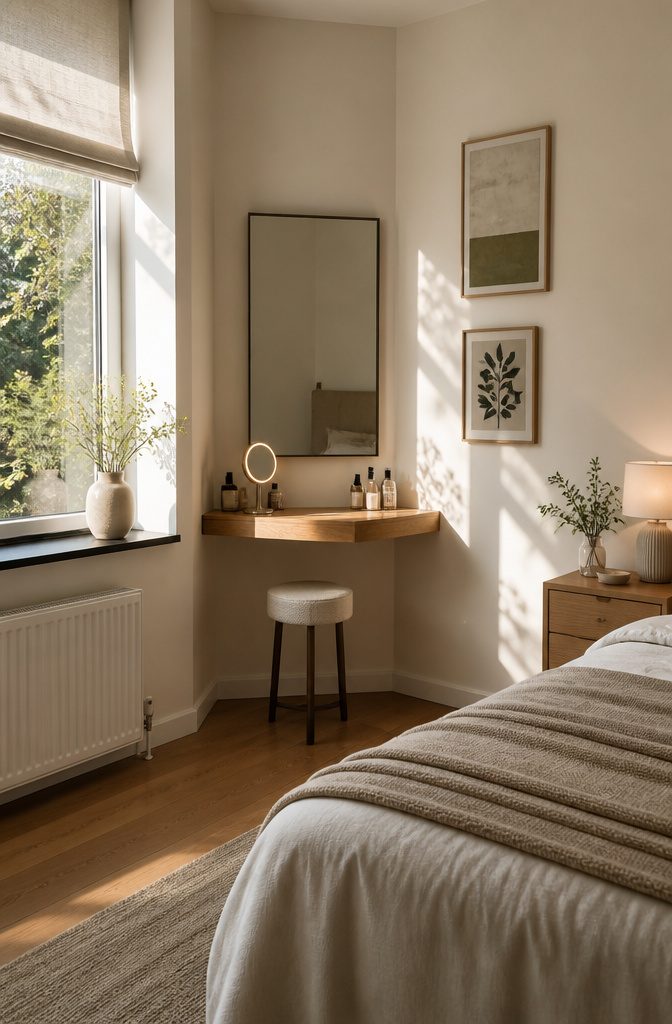
A corner dressing table claims the dead space where two walls meet and leaves the middle of the room open for the bed or a real dresser.
The footprint is small, but the shape costs you: a triangular or pie-cut top fits the geometry and a mirror wider than about 24 inches will overhang the sides or force an awkward offset.
That matters more than it sounds, because corners are already hard to light. Wall sconces need flat mounting surfaces, and a ceiling fixture aimed into that angle throws shadows across your face from both sides at once.
Natural light from a nearby window helps enormously when it reaches the corner; without it, you are relying on whatever lamp you can squeeze onto the narrowed surface.
I have seen renters solve this with a slim vertical LED bar clamped to the mirror frame, though that only works if the mirror itself is small enough not to block the beam.
"Locating a dressing table by a window or a source of natural light is always preferable for the best light quality."
For a corner setup, this means testing the spot at your usual getting-ready hour before you buy anything; morning sun that hits the adjacent wall may not bend deep enough into the angle to do you any good.

Modern and Minimalist: Explore the KAILYN Collection! A clever blend of bright white finish, smooth surfaces, and handleless drawers. Pair this makeup desk with the matching furniture to create a harmonious interior

Large Mirror with 3 Color Lighting Modes: The HD large mirror of the makeup vanity with 3 different color modes: warm yellow, warm white and cold white, can adjust the brightness according to different scenes and makeup needs by press the switch

Vanity Desk
8. Dressing Tables With Ample Storage
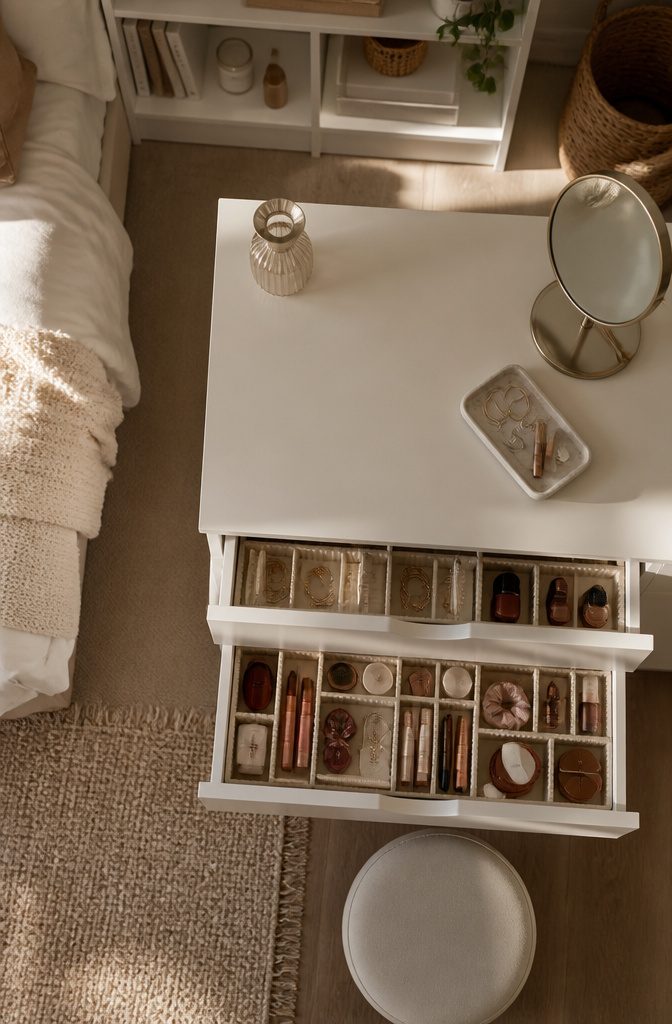
A dressing table without storage becomes a dumping ground faster than you’d think.
One day the top holds a candle and two perfume bottles; by Friday there are hair ties, lip balm, three moisturizers, and a knot of jewelry you don’t have time to untangle.
Storage beats surface area for daily use because the surface is what you actually see.
Shallow drawers work for makeup, where you want to scan everything at a glance. Deep drawers with cord holes handle hair tools; nothing kills a morning like untangling a curling iron from its own cable.
Felt-lined small compartments keep jewelry from becoming a single metallic nest. Pull-out trays add adjustability, and dividers let you change the layout when your routine does.
The top itself should hold almost nothing.
One mirror, one light, one tray, one decorative piece. That is the limit.
The tray catches whatever lands there that morning; everything else belongs in the drawer it was designed for. A table that looks good only before anyone touches it is a table that will stress you out by Tuesday.

MODERN CONSOLE TABLE - The combination of faux marble tabletop and black metal frame shows a charming industrial retro style. The elegant entryway table can decorate your home beautiful and show the master's refined taste.

Solid Rubberwood Build: Crafted from selected rubberwood, this console table offers high strength and a splinter-free surface. The 2" thickened tabletop supports up to 165 lbs, making it ideal for everyday items or heavier decorative pieces.
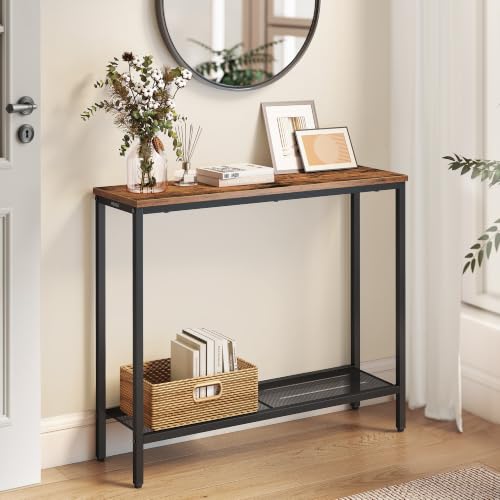
Modern Form, Lasting Appeal: Clean lines and balanced simplicity define this BARNET Collection entry table, combining a steel frame with rustic panels to create visual depth and pair effortlessly with matching storage units for a cohesive, modern interior
Lighting That Actually Works
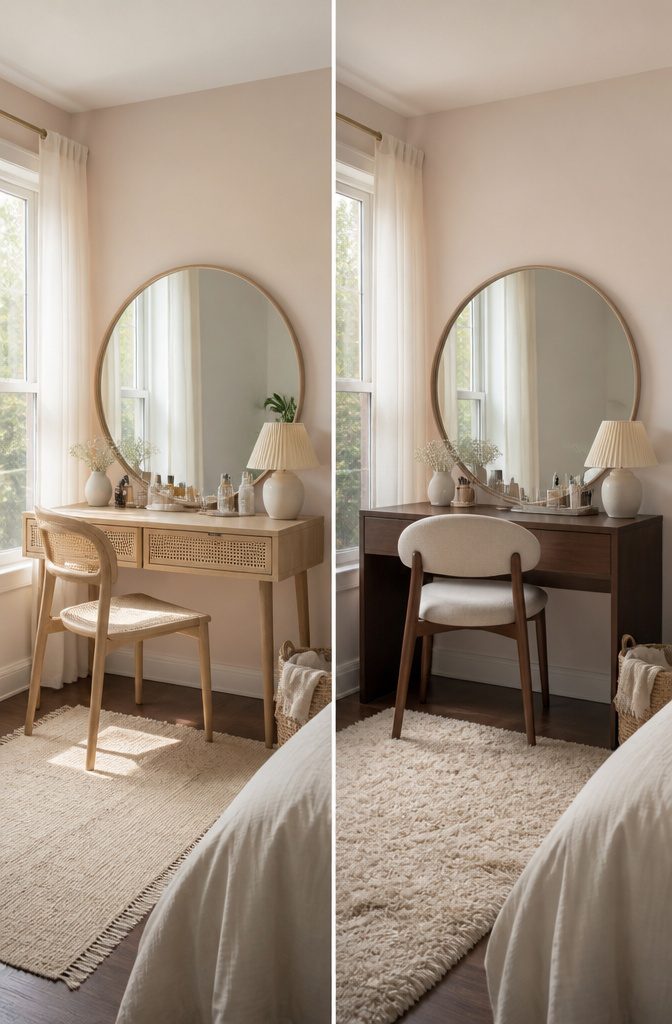
Morning light gives the most accurate reflection for makeup and skincare, so a dressing table parked near a window wins before anything else is plugged in.
The mirror becomes the second light source: angle it to catch that daylight and throw it back into the room, which softens the whole corner without adding a fixture.
The mistake most people make, including me on my first setup, is trusting the bedroom’s overhead light.
Downward light carves shadows under the eyes and across the cheeks. A cute lamp on the table helps the mood but does not fix the problem; the light needs to sit close to the mirror and hit the face evenly.
Wall sconces on both sides of the mirror solve this, or a small LED mirror if drilling is not an option.
For bulb temperature, warm white at 2700K to 3000K flatters skin without turning the bedroom into a dressing room backstage. Anything harsher and the colors in your foundation start lying to you.

No Assembly Stress – Ready To Use:No frustration. No missing screws. No complicated instructions. This floating makeup desk arrives fully assembled – just mount it to a solid wall using the included hardware and you're ready to go. Spend less time building, more time using.(Mirror and stool not included)

【10 Studio LED Vanity Lights】Homkdom makeup vanity is equipped with 10 professional bulbs with 3 brightness modes (cool/natural/warm light). Large mirror provides soft even light for flawless makeup, suitable for home, beauty salons and hair studios

【Taller and Wider Upgrade】Wider seat and taller 18.5" height deliver better comfort for adults. The upgraded size adapts to more scenarios, making this stool more versatile than the original design
Mirror Size and Shape
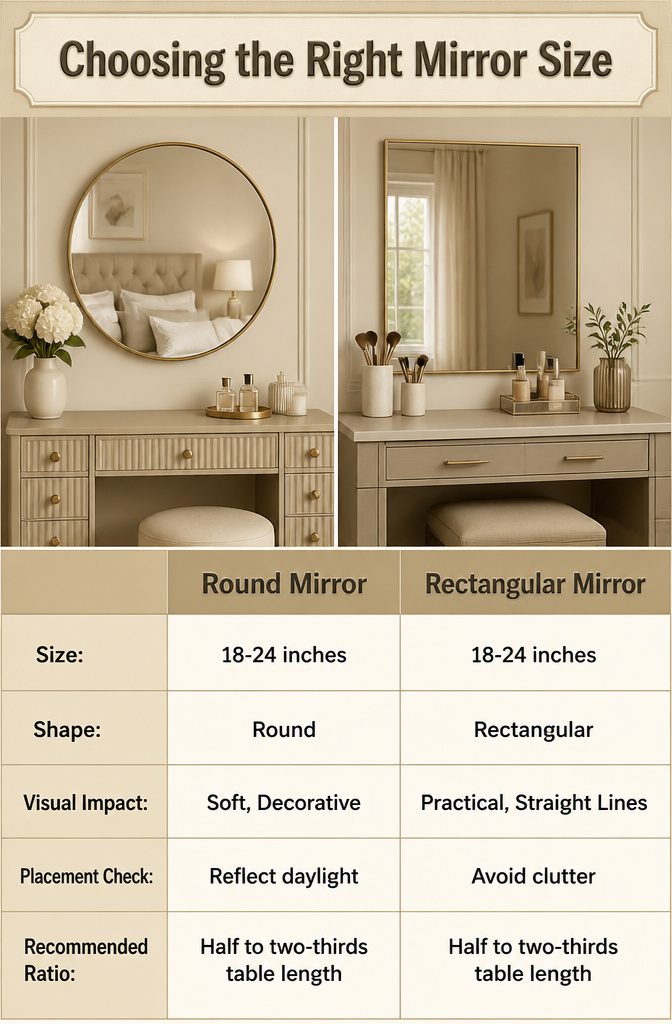
A mirror should be half to two-thirds the length of the dressing table or it throws the whole proportion off.
I learned that the hard way with a 36-inch table and a 24-inch mirror that read as top-heavy until I swapped it for an 18-inch round frame.
Round mirrors read softer and more decorative, which works if your dressing table ideas for the bedroom lean modern or you want the vanity to feel like a pause in the room rather than a workstation.
Rectangular mirrors read more practical, and that is the right call if you are doing makeup or detail work where you need straight sight lines.
Shape matters less than placement, though. Sit where the stool will go and check what the mirror actually reflects.
A window brings in daylight and a view; an unmade bed, an open closet door, or a laundry basket becomes your morning backdrop every single day. That reflection is what you will live with, not the frame style.

Sturdy & Safe: Built with 5mm tempered glass, OLIXIS round rectangular bathroom wall mirror is 5 times stronger than standard bathroom wall mirrors. It resists strong impact without shattering into sharp pieces—so you can enjoy both durability and peace of mind

✨ 2-In-1 Full-Length Mirror & Hidden Jewelry Storage: This sleek jewelry cabinet doubles as a crystal-clear full-length mirror and a secret storage organizer. Check your outfit from head to toe while keeping all your accessories neatly tucked away—no more cluttered dressers or lost jewelry! The minimalist design adds a modern touch to any bedroom, dressing room, or entryway, saving you valuable floor space.

Sturdy & Safe: Built with 5mm tempered glass, OLIXIS round rectangular bathroom wall mirror is 5 times stronger than standard bathroom wall mirrors. It resists strong impact without shattering into sharp pieces—so you can enjoy both durability and peace of mind
Seating That Tucks Away

A stool that slides fully under the table keeps the walkway clear, which matters more than most people guess until they are brushing past a protruding chair back every morning.
The standard dressing table runs 28 to 30 inches high, so the seat you pair with it needs to land around 17 to 19 inches tall. That leaves enough leg clearance without perching too low to see your mirror straight on.
I have watched friends buy beautiful upholstered dining chairs for their vanities, then keep them pushed eight inches past the table edge because the legs or the arms hit the apron.
The chair becomes a permanent obstacle in a narrow bedroom.
An upholstered mini stool or a simple backless seat solves this, though the cushion is where cheap versions fail. Foam that flattens in six months leaves you sitting on a wooden disc.
Test the combination before you buy, and sit in it for more than a polite showroom minute. The seat plus your leg clearance should align with that 28–30 inch table height so your knees do not bang or dangle.
Smart Features Worth the Price

Built-in power outlets and USB charging stations only earn their keep on a dressing table that doubles as a work surface.
The morning routine of hair tools and phone charging makes sense there; a purely cosmetic setup with perfume bottles and a single jewelry tray has no use for cords at all.
What convinced me, reading through a dozen of these configurations, is that cord management decides whether the feature looks clever or cluttered. A table with a discreet gap at the back beats one with outlets bolted to the front panel.
Most rental leases treat hardwired furniture modifications the same as wall outlets, meaning you need permission and often an electrician, so a plug-in power strip routed through that back gap keeps your deposit safe and your options open when you move.
What I Measure Before Buying Anything
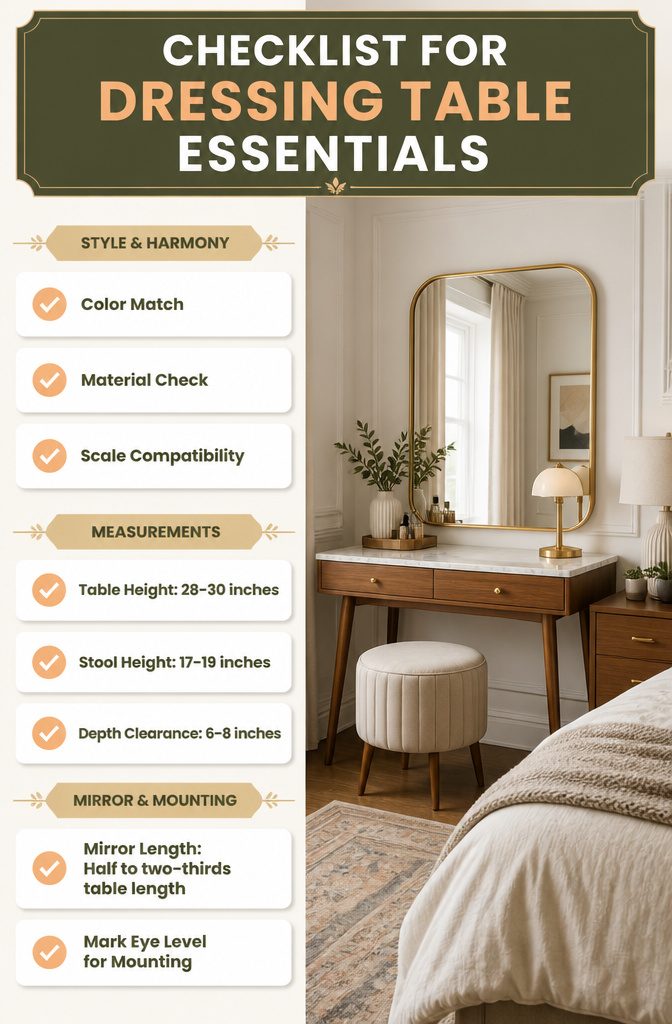
A dressing table that clashes with your nightstands reads like an afterthought, no matter how pretty the mirror.
I check three things before I even open my wallet: the color, the material, and whether the scale matches what I already own.
A mid-century piece with tapered legs will fight a chunky farmhouse bed. A gold-framed mirror and marble top need at least one echo in the room, a light fixture or hardware pull, or they float untethered.
The numbers matter more than the style. Table height should land at 28–30 inches, paired with a stool around 17–19 inches, or your knees hit the apron and your reflection shows your collarbone.
Depth is where I have personally mismeasured: the table itself may be 18 inches deep, but add a tilting mirror and you need another 6–8 inches of clearance or the glass raps the wall every time you lean in.
The mirror itself should sit at half to two-thirds the table’s length.
Anything wider looks like a headboard that lost its way; anything narrower shrinks your face into a porthole. Wall-mounted setups give more flexibility, but only if you mark your seated eye level on the wall before you drill.
Frequently Asked Questions
What are the best dressing table ideas for small bedrooms?
The best options are floating wall-mounted tables, built-in alcove vanities, corner setups, and desk-style tables that double as workspaces.
A floating table keeps the floor completely clear, while a corner unit claims dead space where two walls meet. In every case, pick a stool that tucks fully underneath so the walkway stays open.
Where should I place a dressing table in the bedroom?
Put it near a window or natural light source when you can.
Morning light gives the most accurate reflection for makeup and skincare. If that is not possible, use fixtures that cast even light on your face, like wall sconces on both sides of the mirror or a vertical LED bar.
Before you buy, sit in the spot at your usual getting-ready hour to check what the mirror actually reflects; an unmade bed or laundry basket becomes your daily backdrop.
How do I decorate a dressing table without clutter?
Limit the surface to one mirror, one light source, one tray, and one decorative piece. The tray catches whatever lands there that morning; everything else belongs in a drawer.
Storage beats surface area for daily use, because the surface is what you actually see. A table that looks good only before anyone touches it will stress you out by Tuesday.
Is a dressing table with storage better?
Yes.
A table without storage becomes a dumping ground fast. Shallow drawers let you scan makeup at a glance, deep drawers with cord holes handle hair tools, and felt-lined compartments keep jewelry from tangling.
The top itself should hold almost nothing; the clutter disappears into the drawers even when you have not tidied.
What mirror is best for a dressing table?
A round mirror reads softer and more decorative, which works for modern bedrooms or when you want the vanity to feel like a pause in the room.
A rectangular mirror reads more practical, the right call for makeup or detail work where you need straight sight lines.
Size matters more than shape: the mirror should be half to two-thirds the length of the table, or the proportion throws the whole setup off.