

Most closets can hold twice what they currently do without construction or custom systems, but only if you stop treating the floor as overflow and the upper third as unreachable.
The mistake happens before anyone buys a bin: clothes pile up because there’s no sorting system, and adding storage to an unsorted closet just organizes the clutter instead of clearing it.
Switching to slim velvet hangers alone reclaims up to 50% of your rod space, and a second rod installed below the first doubles hanging capacity in the same vertical footprint.
1. Declutter and Sort Before Adding Storage
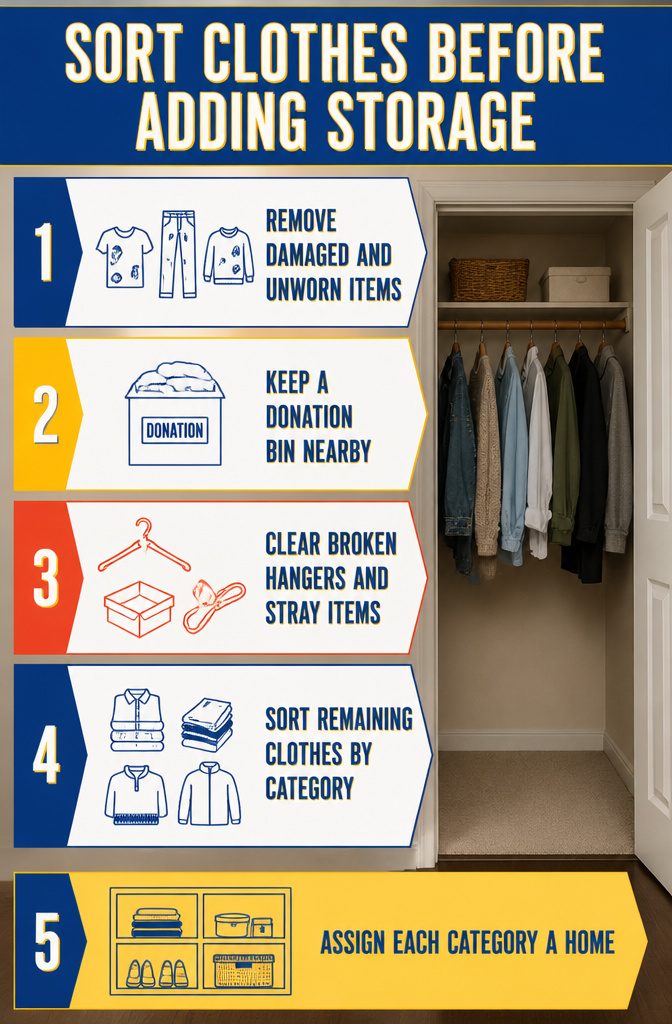
Remove anything damaged, unwanted, or unworn before you even think about bins or hangers. That means clothes with holes or permanent stains, pieces that no longer fit, and items you haven’t reached for in the past year.
Keep a donation bin in the closet year-round so you can toss things in as you find them, then take it to a consignment store or donation center at the end of each month.
You’ll also want to pull out broken hangers, empty shoeboxes, and anything else that wandered into the space without a reason to stay.
Once the obvious culprits are out, sort what remains into categories: workwear, casual tops, pants, outerwear. This step surfaces duplicates you didn’t notice when everything was crammed together.
If you have three similar tote bags but only grab one, keep that one. Assign each category a home so retrieval stays easy.
Put daily-use items up front and visible; long-term keepsakes can sit in the back. Keep what fits the closet you actually have, not the one you wish you had.
2. Use Vertical Space With Higher Shelves and Stackable Storage

Most closets waste the stretch between the top shelf and the ceiling. Installing a second row of shelves or stacking storage bins above your existing rods pulls that dead zone into rotation without any structural work.
Stackable clear acrylic bins work well for handbags you need to see at a glance, while baskets with labels handle the things you toss in without ceremony: belts, small clutches, workout clothes, swimwear.
If you want visibility without putting everything on display, bins with windows split the difference.
Measure the vertical clearance between shelves before you buy anything.
A bin that doesn’t fit wastes the trip and leaves the problem unsolved. For items you reach for only once or twice a season, sturdy opaque bins up high keep the everyday layer within arm’s reach.
Hanging fabric shelves work when adding permanent brackets isn’t an option. Stop treating your closet like a single plane and start seeing it as a cube that goes all the way up.
3. Increase Hanging Capacity With Slim Hangers or a Second Rod
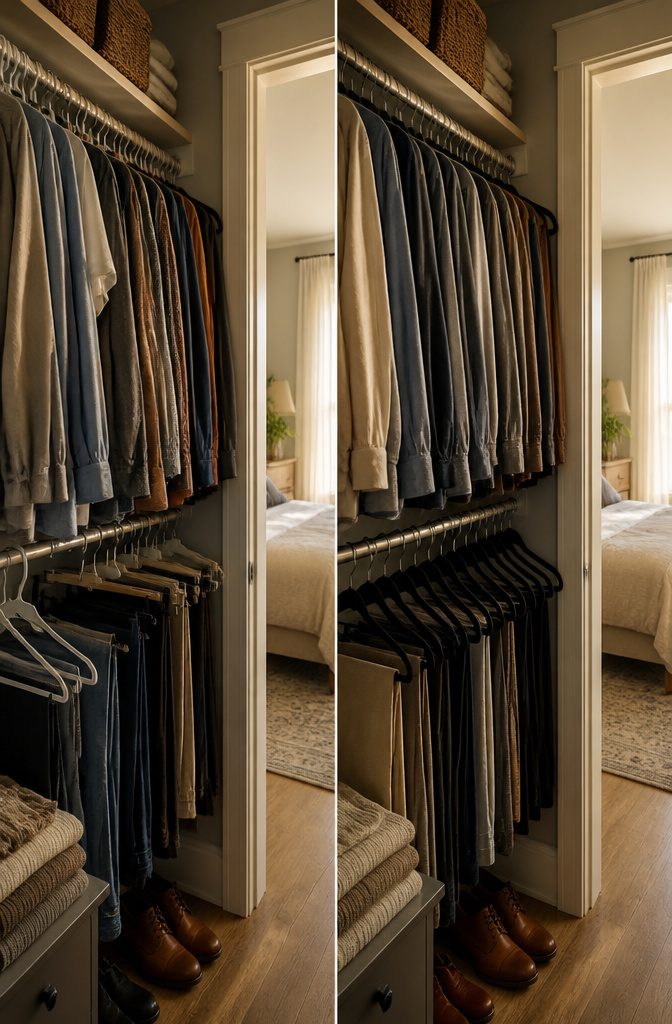
Switching to slim velvet hangers can reclaim up to 50% of your rod space, and the difference is visible the first time you open the door. Thick wooden hangers and bulky plastic ones crowd the rod fast.
Velvet hangers are thin, non-slip, and they keep clothes from sliding off. Some versions come in ten color options and include a 360° swivel hook, which makes it easier to hang and retrieve items without catching on neighboring hangers.
Matching hangers throughout the closet create a streamlined look and prevent clothes from tangling or being overlooked. When every hanger is the same width and shape, you can see exactly what you have instead of digging through a mismatched jumble.
A second rod installed below the first one doubles your hanging capacity in the same vertical footprint.
Tiered hangers do something similar but work for pants and skirts specifically: four or five pairs hang in the slot one would have taken.
Cascading hangers link vertically and let you group full outfits together while using only a fraction of the horizontal space. Rod doublers and tiered systems are both faster than a full closet rebuild and cost less than adding square footage.
4. Add Hooks and Organizers to Doors and Walls

The back of the closet door holds shoes, scarves, and daily accessories without claiming floor space you need for bins or boots.
I hang an over-the-door organizer there—most fit standard residential doors and keep small items visible instead of buried in a drawer. Shoes stay paired, belts stay untangled, and jewelry stays where you can see it in the morning.
Wall-mounted pegboards work the same way but give you more control over layout.
The NCLY 70-piece metal pegboard kit lets you move hooks and shelves around as your storage needs shift, which matters if you rotate seasonal gear or share the closet.
I mount pegboards on any wall that isn’t already doing work: the side wall inside a reach-in closet, the short wall under a sloped ceiling, or the strip between the door frame and the corner.
Command hooks go up fast on walls or door edges when you need one or two spots for a robe, a hat, or tomorrow’s outfit.
They pull off clean when you move, which renters care about. For holding paper—receipts, tags, returns—a mounted magnetic file pocket keeps it contained and off the shelf where it spreads.
5. Store Shoes and Bins on the Closet Floor

The floor beneath your hanging clothes is working space, not dead space.
Most closets waste that zone entirely or let it become a pile of shoes that takes over. I put a dedicated shoe rack there instead, and it turns a problem into storage you can actually use.
The TJUSIG shoe rack from IKEA sits low enough to slide under hanging garments without blocking anything, and you can stack two if the floor-to-hem clearance allows it.
Beyond shoes, the floor holds bins, baskets, and a hamper without cutting into shelf or rod capacity. A shallow bin for scarves or accessories fits easily beside the shoe rack, and a narrow hamper keeps laundry off the carpet.
The mistake people make is treating the floor as overflow. When you organize it the same way you organize a shelf, with boundaries and categories, it stops feeling like clutter and starts earning its square footage.
6. Add Dividers and Baskets to Shelves

Shelf dividers stop folded sweaters from toppling sideways the moment you pull one out, and clear acrylic dividers let you see what is stacked without tipping the whole row.
I use them on most upper shelves where bags or sweaters live, because they hold each item upright and preserve the shape without compressing anything.
Adjustable dividers fit varying shelf depths, which matters in older closets where the builder used whatever lumber was left.
Baskets and bins add another layer when you need to corral smaller things that would otherwise scatter.
Water hyacinth baskets work well on top shelves for napkins or accessories you grab less often, and fabric storage bins with pulls turn cube organizers into drawers without installing tracks.
I choose bins for items I toss in without folding—belts, small clutches, workout clothes—and clear stackable boxes for things I want visible, like shoes or nice handbags.
Hanging wire baskets attach under existing shelves and catch socks or underwear that does not need a full drawer.
7. Move Seasonal Items Elsewhere or Higher Up

The twice-a-year seasonal swap is the fastest route to usable closet space without buying a thing. Pack winter coats, chunky knits, and thermal layers when spring arrives, and store tank tops, sandals, and swimwear when fall rolls in.
That biannual rotation doubles as a quick declutter pass: if you didn’t wear a sweater once all last winter, it probably doesn’t need to come back down.
Out-of-season items belong on upper shelves, in under-bed bins, or inside suitcases that would otherwise sit empty.
I reserve mid-height hanging and reachable shelves for what I actually wear each week, and stack wicker bins near the ceiling for the rest.
A storage ottoman or a bed with built-in drawers can hold linens or off-season clothing and free up closet real estate you’d lose to bulky winter gear in July.
Most closets can’t comfortably hold a full year’s wardrobe. Rotating twice gives you room to see what you own and dress faster in the morning.
8. Choose Clear or Labeled Storage to Fit the Space
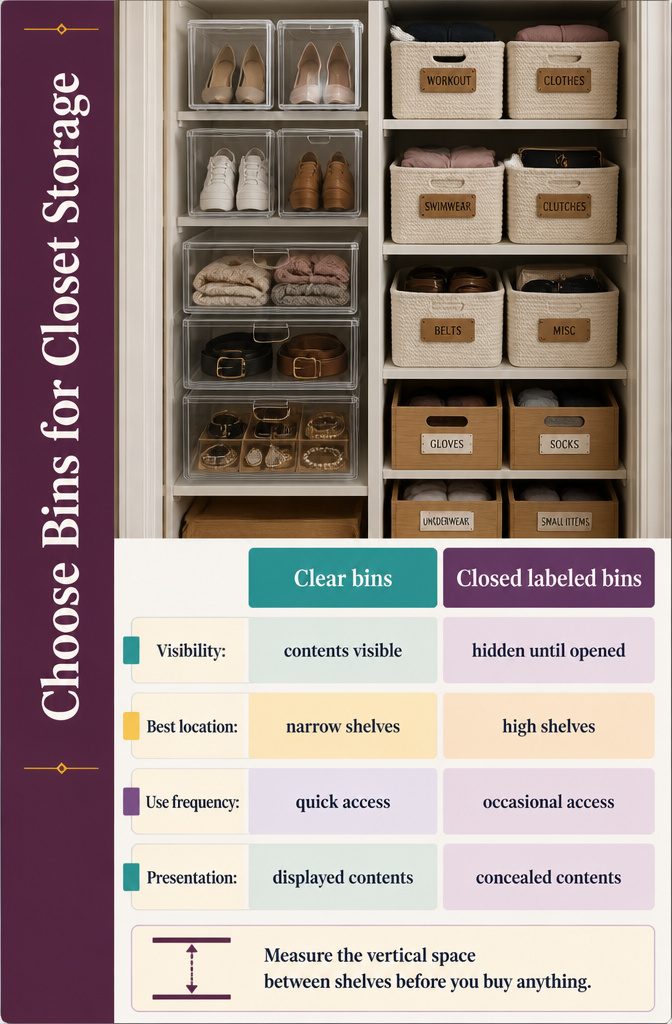
Clear bins work best when you need to grab something fast. I use them for shoes and small accessories—scarves, belts, jewelry—because you can see what’s inside without opening anything.
Stackable clear boxes protect shoes from dust and let you build up instead of spreading out across the floor, which matters when the closet is narrow.
For items you don’t need to display, bins with windows give you visibility without showing everything off.
Closed bins with labels belong on high shelves or anywhere you’re storing things you won’t touch daily. Workout clothes, swimwear, small clutches and belts sit fine in labeled baskets, especially if you tend to toss things in without folding.
The label keeps you honest. Decorative wood bins work for smaller daily items like gloves, socks or underwear if the closet is visible from the bedroom.
Measure the vertical space between shelves before you buy anything.
A bin that’s an inch too tall wastes the shelf it won’t fit under, and stacking only works when the height of two units clears the gap above them. I fit storage to the space, not the other way around.
9. Create Zones by Category and Frequency of Use

I arrange closet items by how often I reach for them, keeping the things I wear weekly front and center while pushing long-term storage back or up where it takes more effort to get.
The logic is simple: if you have to move three boxes to grab your work jacket, something is placed wrong.
Put regular-use clothing at eye level on the first rod, daily shoes on the floor where you step in, and bags you actually carry on a low shelf.
Keepsakes, formal wear you touch twice a year, and off-season coats go in the back of the top shelf or behind the current rotation.
Sorting by category first helps spot duplication before you commit space to it.
If you line up all your tote bags at once, you’ll notice three that are the same size and realize only one leaves the house. That clarity makes it easier to decide what earns accessible space and what doesn’t.
I keep workout clothes together on one shelf, work pants on another, and anything sentimental in labeled bins where I won’t trip over it looking for a sweater.
The system works because it mirrors how you actually move through the closet, not how it looks in a catalog.
10. Add Furniture Inside or Outside the Closet

A dresser or bookshelf inside the closet can replace a set of built-in drawers for a fraction of the cost and no measuring for custom work.
One bedroom closet about 4 feet wide by 6 feet long holds a MALM 3-drawer chest with room left over for hanging clothes on either side.
The chest keeps folded items in view without stacking them so high that the bottom layers disappear.
Cube organizers work the same way but hold more categories at once.
An 8-cube organizer fits dinner plates when the depth is right, and adding H cube storage shelves inside individual squares gives you separate compartments instead of one tall stack.
That setup replaced a $1,000 closet system quote in one case and left hanging space open on the opposite wall.
Outside the closet, a storage ottoman or a bed with built-in drawers takes linens and out-of-season clothes so the closet itself can hold what you actually wear this month.
11. Improve Visibility With Lighting or a Mirror
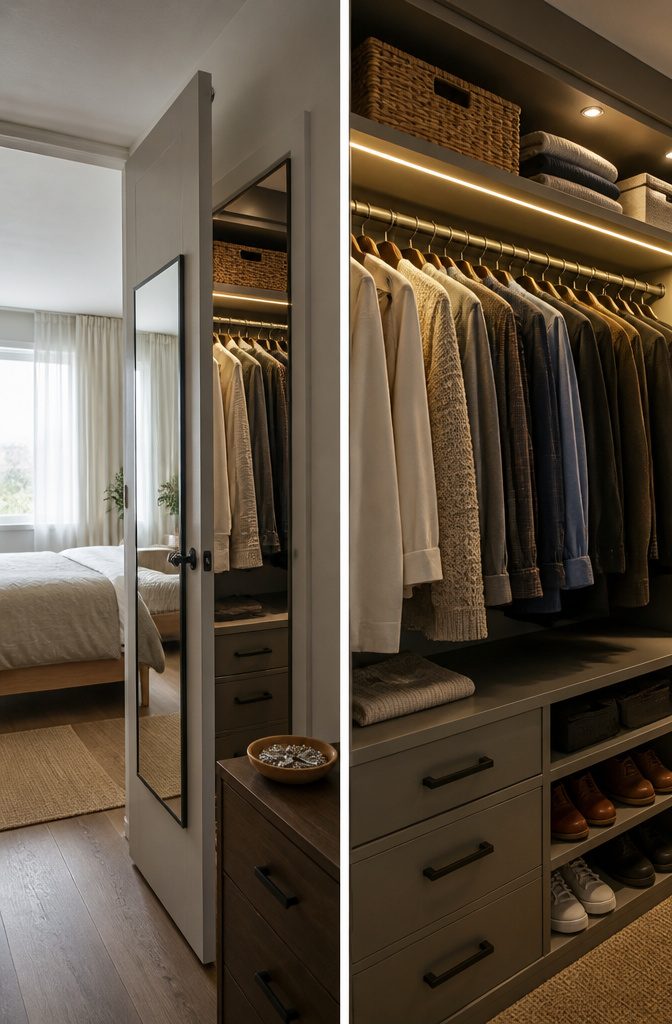
Adding LED lighting inside the closet makes every piece visible without squinting into dark corners.
I usually suggest battery-operated LED strips along the closet rod or small LED pucks on each shelf, so colors actually look like what they are and matching an outfit becomes straightforward instead of a guess.
The difference shows up immediately on darker fabrics and anything tucked toward the back.
A mirror changes how the space reads, especially in a small closet. Mounting one over a dresser or on the inside of the door reflects light back into the room and makes the whole area feel less closed in.
I’ve seen it work particularly well when the mirror doubles as a vanity spot for jewelry or makeup, which keeps that task out of a shared bathroom and gives the closet a second function without taking up more floor space.
12. Maintain the System With Periodic Clean-Outs

The system only stays clear if you protect it once a month or so.
A monthly reset catches the pile before it turns into a problem: spend ten minutes checking which shelf is starting to collect catch-all clutter, hang up anything draped over a chair, and put shoes back where they belong.
If you see papers creeping onto the floor or a stack forming in the corner, deal with it now instead of waiting until the whole closet tips back into chaos.
Some people prefer a weekly ten-minute tidy instead, especially if the closet serves more than one person or if mornings leave clothing scattered.
Pick a consistent time, Sunday evening or whenever the week resets, and return everything to its designated spot. That small routine keeps the order you built from disappearing under daily wear.
Twice a year, when seasons shift, spend longer reassessing what you actually use.
Donate what no longer fits the rotation, swap heavy coats for lighter jackets, and reorganize based on what the current season demands. Regular clean-outs like this stop the closet from drifting back toward overflow.
Limit Finishes and Hardware to Three

A closet that works well can still look like a storage unit if every bin, hanger, and shelf finish is different. The fix is stricter than most people think: no more than three different finishes in a single space.
That means if you’re using white wire shelving, matte black bins, and wood hangers, you’re at the limit. Add chrome hooks or wicker baskets and the space starts to fragment visually, even when everything is perfectly organized.
The brain reads repetition as order, so choosing two coordinating bin styles in light colors—which also brighten a windowless closet—creates the shop-like harmony that makes the system feel intentional rather than improvised.
I keep this count in mind anytime I’m adding hardware or containers, because the fourth finish is where cohesion usually breaks. It sounds restrictive until you realize most successful closets use even fewer.
Use the Four-Box Method to Decide What Stays

Before you add anything new, sort what you already own. The fastest way to gain space is to clear out what you no longer need, and the four-box method keeps the decisions moving.
Set up four boxes and label them clearly:
- Keep: items you wear regularly and still fit your life now
- Donate/Sell: anything in good condition that someone else can use
- Store: seasonal pieces that belong somewhere else until you need them again
- Trash: worn-out clothing, broken hangers, items beyond repair
Add a fifth box if you get stuck on uncertain items. Label it with a date six months out, seal it, and put it away.
If you haven’t opened it by that date, donate the whole thing without looking inside. It takes the guilt out of letting go and keeps you from stalling on every maybe.
You’re aiming for a functional closet, not an empty one. It’s a closet where every piece earns its spot.
Frequently Asked Questions
How often should I reorganize my closet?
Do a quick 10-minute weekly tidy to return items to their spots, a monthly reset to catch clutter before it spreads, and a full seasonal swap twice a year when you rotate winter and summer clothing.
The twice-yearly clean-out is when you reassess what you actually wear and donate what no longer fits your routine.
In what order should I hang my clothes in my closet?
Arrange clothes by how often you reach for them, keeping daily-use items at eye level on the first rod and long-term storage back or up high.
Sort by category first (workwear, casual tops, pants, outerwear) so you can spot duplicates, then place what you wear weekly front and center while formal wear and off-season pieces go to the back of the top shelf.
Is it cheaper to build or buy a closet system?
A dresser or cube organizer placed inside the closet costs a fraction of custom built-ins and requires no measuring or installation work.
An 8-cube organizer with added shelf inserts replaced a $1,000 closet system quote in at least one case and still left hanging space open on the opposite wall.
What is the 3-3-3 rule for decluttering?
Add a fifth box for uncertain items, date it 6 months out, and if you haven’t opened it by then, donate the whole thing without looking inside.
How to organize a bedroom closet?
Start by decluttering anything damaged or unworn, then sort what remains by category and assign each a home based on how often you use it.
Use slim hangers or a second rod to increase hanging capacity, add shelves or stackable bins above your existing rods, and place shoes and baskets on the floor beneath hanging clothes to turn every zone into working storage.