

A full-length mirror can lean against the wall, mount flat to clear floor space, hang on a door, or stand on built-in legs.
The right method depends on whether you’re working around a landlord’s rules, how often you rearrange, and whether the floor is already spoken for.
Leaning works in a rental where you can’t drill drywall, but every leaning mirror needs anti-tip hardware to keep it from falling when someone walks past.
1. Place It to Reflect Light and Open Up a Room
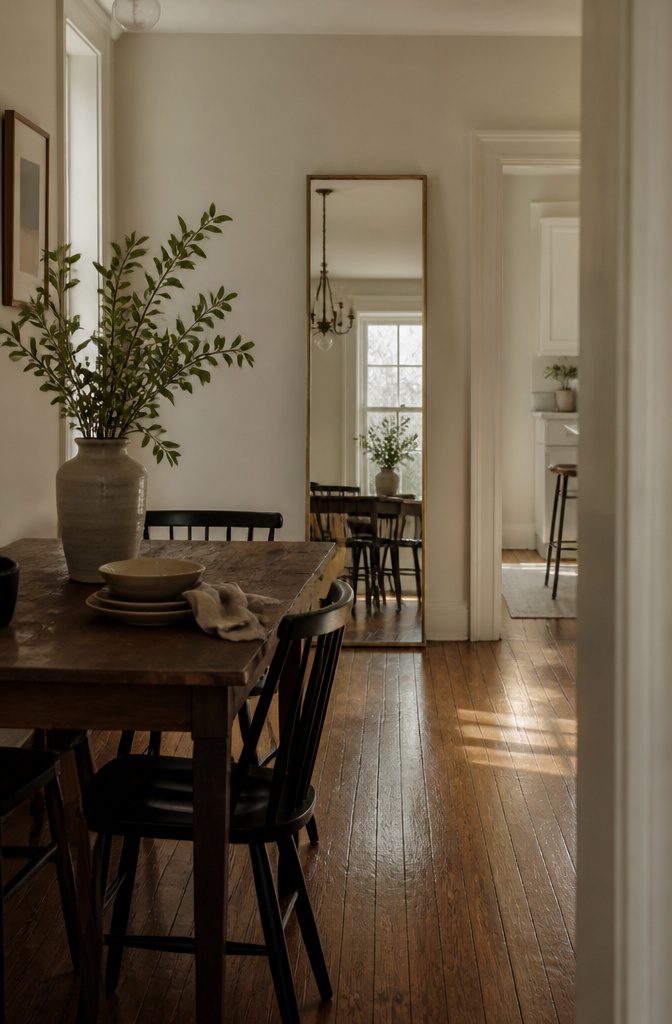
Positioning a full-length mirror opposite or beside a window bounces natural light through the room and makes the space feel brighter and more open.
This works especially well in smaller or dimly lit rooms, where maximizing available light changes how the whole area reads. I’ve seen it make the biggest difference in narrow hallways and apartments that don’t get much sun.
You can also place a mirror between windows if the wall allows it, which amplifies the light from both directions. In the dining room, a large floor mirror reflects chandelier light and creates the illusion of an extra window.
The same principle applies in the bedroom: hanging two mirrors behind nightstands on either side of the bed reflects soft light throughout the space without taking up floor area.
The effect shows up right away. The room feels larger, the corners stay brighter later in the day, and you get more use out of the natural light you already have.
2. Lean It or Mount It According to the Space and Look

The choice between leaning and mounting comes down to how you use the floor and whether you want the option to move the mirror later.
Leaning a full-length mirror against the wall gives you flexibility if you rearrange often, and it reads more relaxed than a fixed mount.
The look is less formal, but you give up floor space and need to anchor it properly so it doesn’t tip.
Wall mounting clears that floor area completely and locks the mirror at the height that works best for how you check yourself before leaving. It feels more streamlined, but repositioning means new holes.
Door mounting is the move when wall space is already spoken for. You can hang it on the back of a bedroom or closet door, or use it decoratively on the front if the room allows.
Instead of leaning your full-length mirror against a wall near the door, try putting it on a door.
That works especially well in a rental where you can’t drill into drywall but the door is fair game.
Freestanding mirrors sit on the floor with short support legs built into the frame, or they come with a foldable stand.
They’re easy to relocate, which I appreciate when a room’s purpose shifts, but they take up more square footage than a wall-mounted option.
3. Use It in a Bedroom or Dressing Area

A full-length mirror near your wardrobe or closet door is the most practical spot in a bedroom, because you can check your outfit from head to toe without leaning or guessing.
I like placing one where it catches decent light rather than hiding it inside the closet itself, since most closets are too dim to see color accurately.
If you have a chair or chaise in the corner, a gold floor mirror behind it adds a romantic touch and keeps the reflection functional without making the room feel like a dressing room in a department store.
Another option I see work well is hanging matching mirrors behind both nightstands, flanking the bed.
This brings soft light into the room and keeps the symmetry clean. The setup doubles the natural light without the bulk of a single oversized piece, and it makes smaller bedrooms feel airier.
For renters or anyone covering wall damage, a well-framed full-length mirror does the job without patching paint or losing your deposit.
4. Put It in an Entryway or Hallway

Put It in an Entryway or Hallway
A full-length mirror near the door gives you one last outfit check before you leave, and in a narrow hallway or small entryway, it stretches the space visually instead of closing it in.
I put the mirror at the end of the hall whenever the layout allows it, because the reflection adds length in a way that feels deliberate rather than decorative.
Pairing the mirror with a console table underneath turns the spot into a drop zone for keys and mail, and you can layer in small lamps or vases if the surface feels bare.
A wooden-framed mirror that matches the console keeps the look clean without crowding a small entry.
If you skip the console, mount coat hooks beside the mirror instead. The mirror still does its job, and you reclaim the floor space.
5. Use It in a Living Room
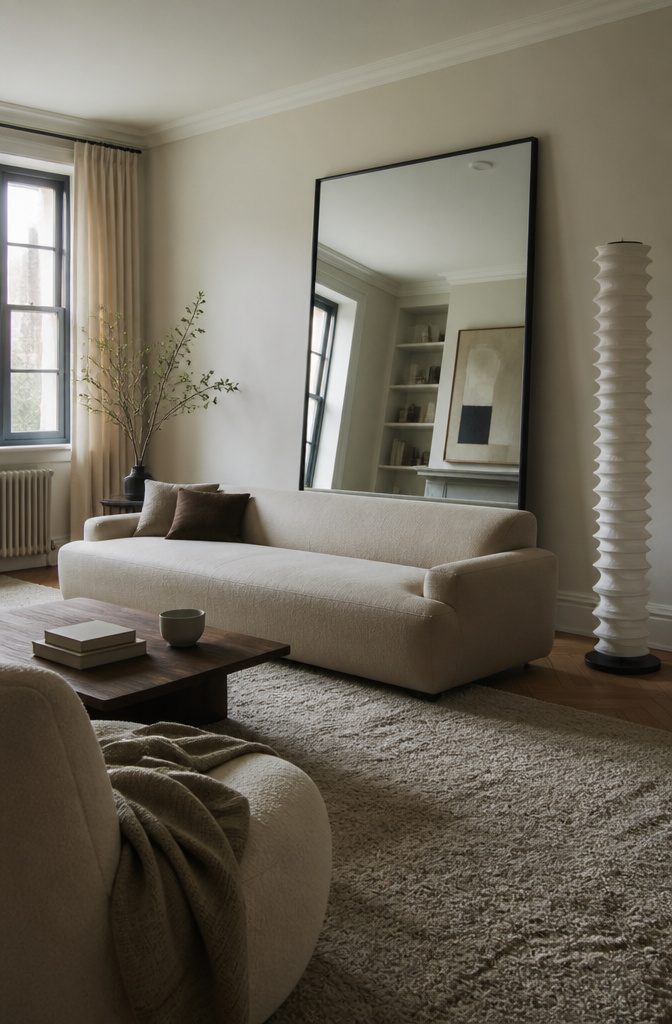
A full-length mirror behind the sofa gives a living room architectural weight without adding furniture. The reflection doubles whatever sits on the opposite wall—artwork, built-ins, a window—so the room reads as larger and more deliberate.
I put one behind a low-back sectional in a narrow living room last year, leaning it rather than mounting it, and the setup worked because the sofa was already pulled a few inches off the wall.
That gap matters: a mirror flush behind a sofa back looks cramped, and anyone sitting down sees their own head instead of the room.
An empty wall between windows takes a mirror better than most people expect. The glass picks up light from both sides and sends it back across the room, which helps in a space that doesn’t get strong sun.
I’ve also seen mirrors used in place of a TV, mounted at the same height you’d hang a screen, and the effect works when the opposite wall has something worth reflecting—a fireplace, a set of framed prints, or trim detail that deserves the attention.
6. Include It in a Gallery Wall or Mirror Grouping
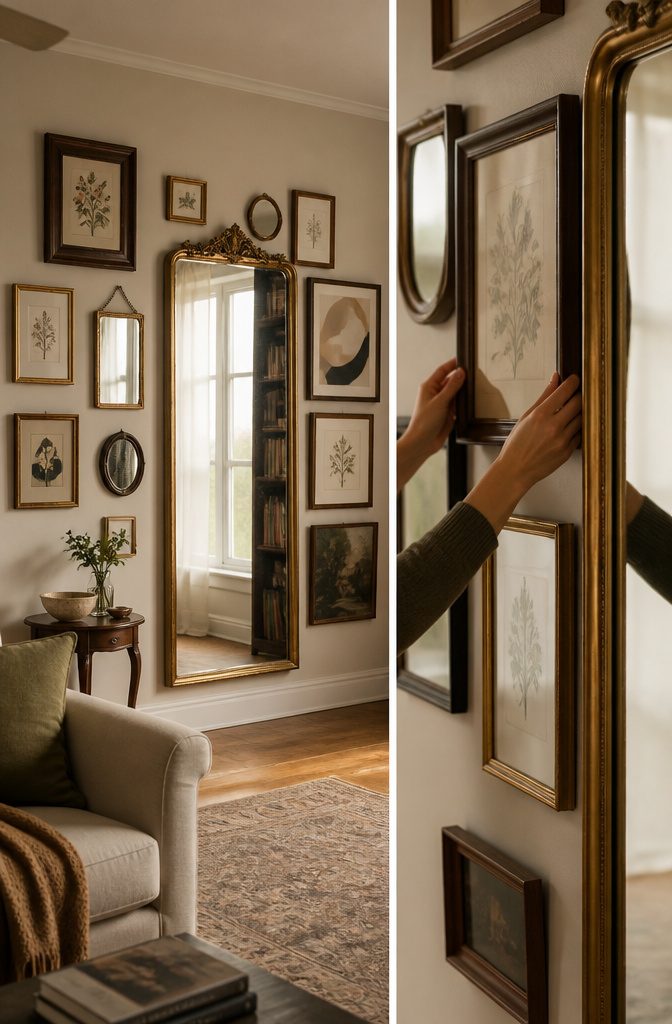
A full-length mirror sits well inside a gallery wall instead of standing alone. Mix it with framed art, photographs, or smaller mirrors — the arrangement adds layers to a flat wall and bounces light around the room at the same time.
Choose a mirror with a frame that holds its own as a focal point, then build the rest of the wall outward from there.
I like pairing different finishes: a gilded mirror next to dark wood frames keeps the wall from reading too matched.
You can also group mirrors together without any artwork.
A bedroom wall lined with refurbished mirrors in varied shapes reflects enough light to lift a dark paint color, and the repeated frames give the space more weight than a single piece would.
In a living room, place the full-length mirror at the center of the gallery and gather smaller prints around it — it becomes a conversation piece that does more than decoration.
7. Choose a Frame and Shape That Fit the Room

The frame either blends or it takes over, and both work if you mean to do it.
Match the frame style to the room’s existing materials and metals when you want the mirror to sit quietly in the space — wooden frames if the room already has wood trim or furniture, metal if the hardware leans industrial or modern.
The Destiny mirror brings wooden edges that read warm next to natural-finish furniture. The Orbis mirror uses a gold-plated brass frame that works in rooms where the lighting fixtures or cabinet pulls are already warm metal.
When the frame matches what’s there, the mirror reads as part of the room rather than dropped into it.
A contrasting frame pulls focus and makes the mirror the thing you notice first.
The Cay Rectangle Mirror has gold-toned edges that stand out against white walls or dark paint. The Sweetcrispy arched mirror, at 64 by 21 inches, reads vintage and becomes the anchor in a bedroom or living room.
Arched designs soften square rooms and mimic arched windows when those are already present. Ornate frames add weight to minimalist spaces; minimalist frames calm down rooms with patterned wallpaper or busy decor.
8. Use It to Echo a Window or Architectural Feature
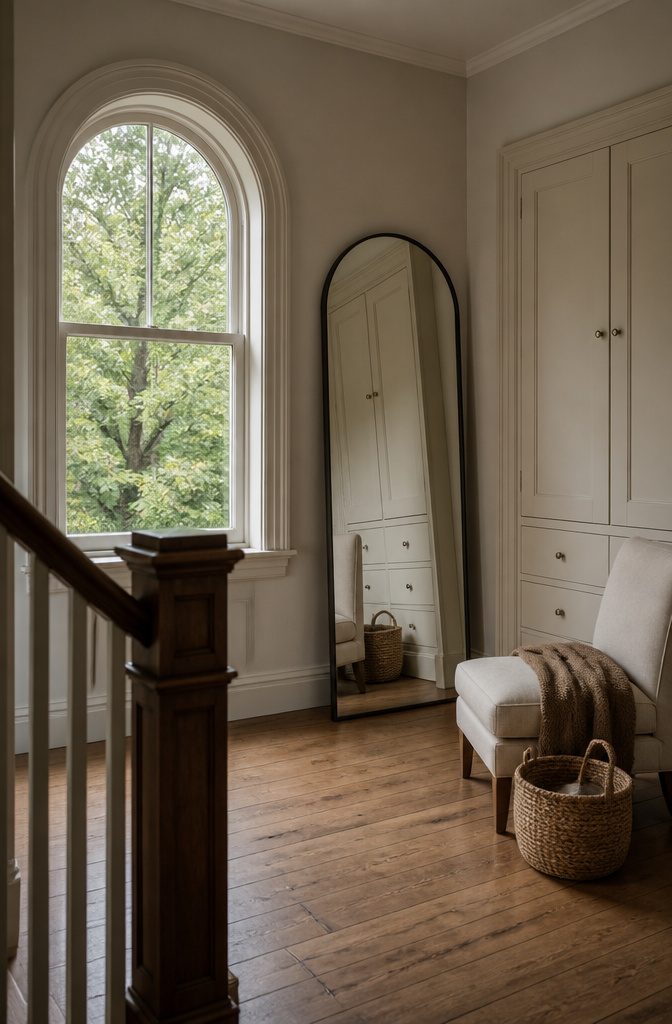
An arched mirror can resemble an arched window without cutting into the wall, which is useful when the room lacks architectural detail or when you want symmetry without construction.
I’ve noticed this works best when the mirror shape matches something already in the room. If the space has arched windows, an arched mirror continues that line and makes the room feel more cohesive.
The same principle holds for other architectural elements: a tall rectangular mirror can echo a doorway, and positioning it near millwork, header caps, custom doors, stair railings, ceiling details, shiplap, or built-in cabinetry pulls the eye toward those features instead of leaving the mirror isolated on the wall.
You’ll need to position it carefully.
A mirror that reflects attractive architectural features or well-designed furnishings adds depth. One that catches clutter or awkward sightlines does the opposite.
9. Place It Above a Vanity or Dresser
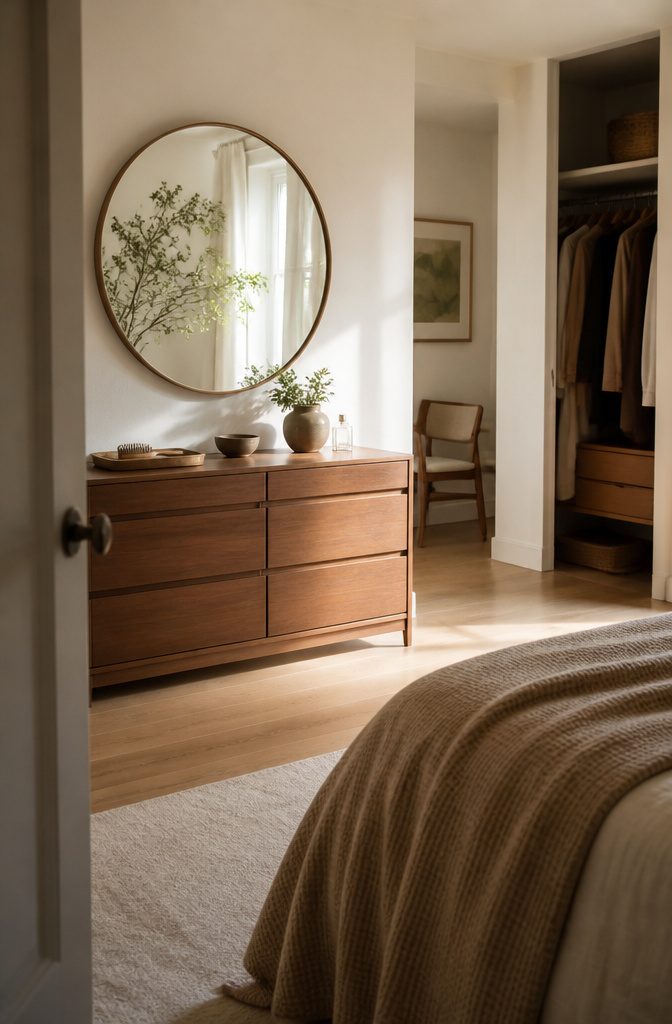
Hanging a full-length mirror above a vanity or dresser gets the mirror off the floor when space is tight, and the look can go vertical or horizontal depending on the wall dimensions.
In a bathroom, mounting the mirror above the vanity makes it both functional and a focal point.
A vertical orientation fits well above single-sink vanities, while a horizontal hang works better when the vanity stretches wider or the wall is low.
In a bedroom short on floor area, a large mirror above the dresser fills the same role.
A round mirror is a strong choice here because the shape softens the rectangular furniture below and the diameter can be generous without the mirror feeling too tall for the wall.
10. Pick a Mirror with Extra Functions

A full-length mirror with built-in features does two jobs at once, and in a small bedroom or dressing area that efficiency matters.
Mirrors with LED lighting solve the problem of getting dressed in a room where overhead light never quite reaches the closet—the Aperture Mirror, designed by Karim Rashid, adds edge lighting and a motion sensor, and comes in polished black, white, or pink.
The Dooors Mirror by Matteo Ragni takes a similar approach with LED backlighting.
Storage is the other function worth considering.
The FANYUSHOW mirror at 59 by 16 inches opens to reveal compartments for jewelry and accessories, which keeps a dresser top clear and puts earrings and bracelets within arm’s reach while you’re deciding on an outfit.
The Sammukhin Mirror, made from reclaimed teak, includes a small shelf—useful for the things you reach for every morning without wanting to walk across the room.
I lean toward mirrors with storage in rentals and starter homes, where square footage is tight and combining two pieces of furniture into one makes the layout work better.
Choose by Room, Space, and Purpose

Available space and the room’s purpose should decide which mirror type you choose.
Measure the wall or floor area before you buy anything, because a mirror that’s too large can overwhelm a room, and one that’s too small loses its effect entirely.
Standard full-length mirror heights run from 48 to 72 inches, with slimmer profiles working better in narrow spaces and oversized styles making sense in larger rooms where they can anchor a wall.
The mounting method matters as much as the size. Wall-mounted mirrors free up floor space and sit at a fixed height, which works well in tight quarters or high-traffic areas.
Leaning mirrors against the wall adds a relaxed look and lets you reposition them easily, but they take up floor space and need anchoring to stay secure.
Freestanding mirrors with their own support structure sit directly on the floor and offer the most flexibility if you have the room for them.
Pick the style that fits the available square footage and how you plan to use the mirror day to day.
Secure a Leaning Mirror
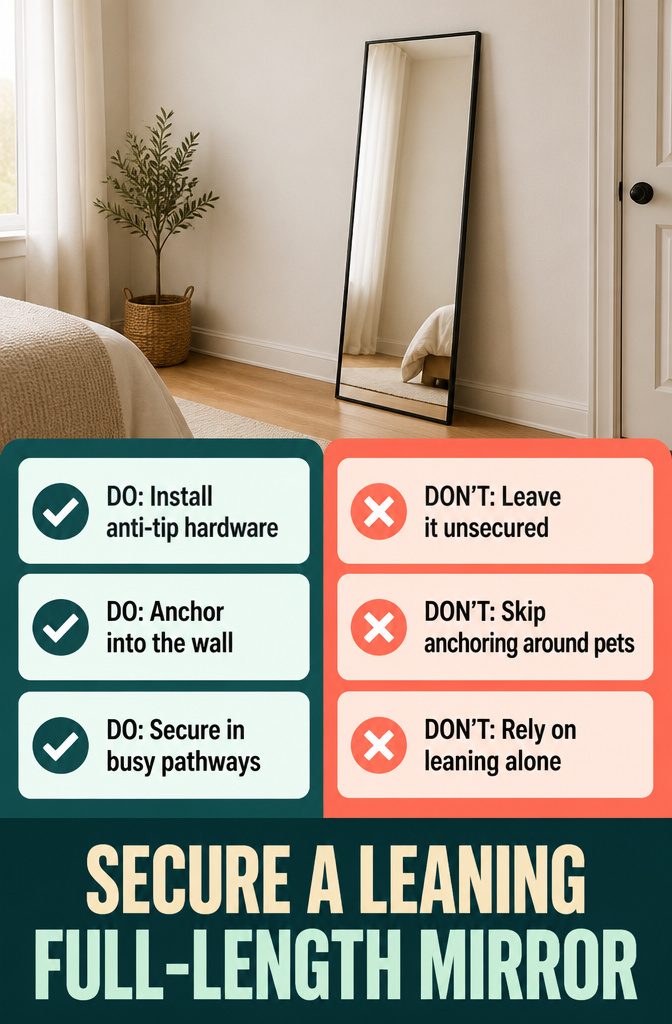
A leaning mirror looks effortless until it falls, and anti-tip hardware is what keeps that from happening.
Wall anchors or brackets take ten minutes to install and hold the mirror stable even when someone bumps it or a pet runs past.
I anchor every leaning mirror in a space where children or animals move through, and I recommend the same in any household where the mirror sits in a high-traffic path.
The hardware mounts to the wall behind the top edge of the frame, so it stays invisible once the mirror is in position.
Leaning gives you the flexibility to move a mirror without patching screw holes, but only if you secure it first.
Frequently Asked Questions
What size full-length mirror should I get?
Standard full-length mirrors range from 48 to 72 inches in height. Slimmer profiles work better in narrow spaces, while oversized styles suit larger rooms where they can anchor a wall.
Measure your available wall or floor area before buying, since a mirror that’s too large overwhelms a room and one that’s too small loses its effect.
Where should you put a full-length mirror?
Bedrooms near the wardrobe or closet door, entryways for a last outfit check, living rooms behind the sofa or between windows, and hallways to stretch the space visually all work well.
Position the mirror to reflect natural light or architectural features rather than clutter or awkward sightlines.
How do I clean a full-length mirror?
Use glass cleaner and a microfiber cloth to avoid streaks. Spray the cleaner onto the cloth rather than directly onto the mirror to prevent the solution from seeping behind the glass or into the frame.
Are full-length mirrors safe to lean against a wall?
Yes, but only if you anchor them with anti-tip hardware. Wall anchors or brackets mount behind the top edge of the frame and keep the mirror stable when someone bumps it or a pet runs past.
The hardware takes 10 minutes to install and stays invisible once the mirror is in position.
Does a large mirror look good in a living room?
A full-length mirror behind the sofa or on an empty wall gives a living room architectural weight without adding furniture.
The reflection doubles whatever sits on the opposite wall, making the room read as larger and more deliberate. An empty wall between windows takes a mirror better than most people expect, since the glass picks up light from both sides.