
A home library can cost as little as a few floating shelves or as much as a full room of built-ins, and the deciding factor is whether you own the wall.
Renters get full use of the ideas below, but every decision changes once you are allowed to cut into studs and paint the rail for a rolling ladder.
The 10–12 inch shelf depth that handles most hardbacks stays the same either way; it is the ladder, the hidden door, and the recessed television cavity that separate the permanent installations from the ones that move with you.
1. Floor-to-Ceiling Bookshelves
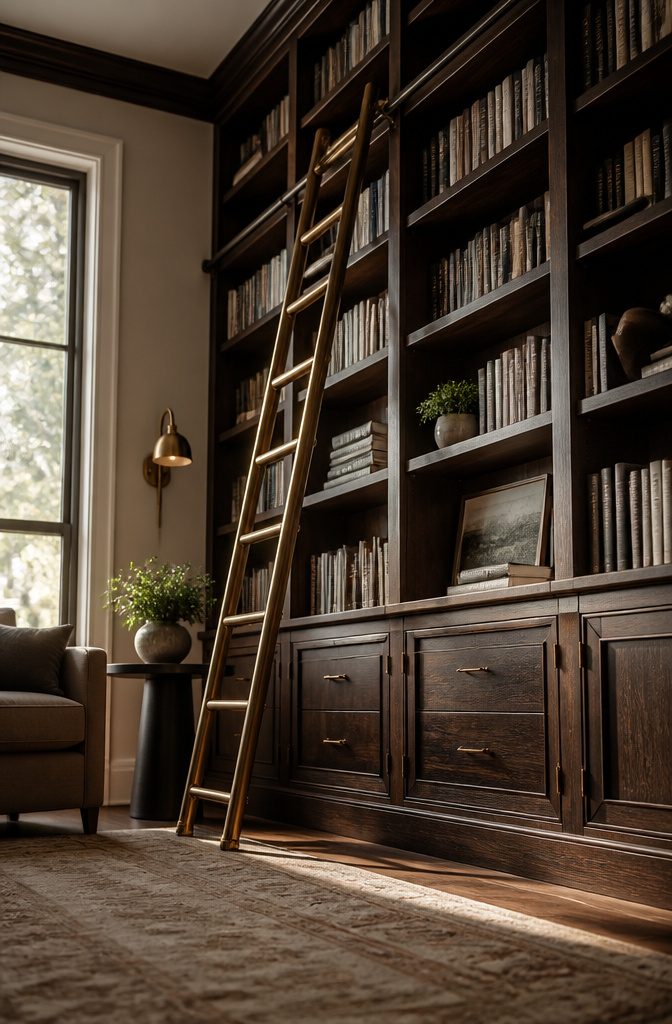
Standard book depth runs 10–12 inches, which covers most hardbacks and paperbacks without wasting floor space.
My shelves are right at 11 inches, and even my chunkier art books sit flush without tipping. If you collect oversized volumes, 14–16 inches gives that extra room and a small overhang for displaying objects in front of the row.
Dark wood shelves can feel heavy fast. Brushed bronze or aged brass hardware warms the whole wall without reading as flashy.
I almost went with black iron on my built-ins and I’m glad I didn’t; the softer metal catches afternoon light and keeps the mood inviting instead of institutional.
A library ladder looks romantic, but only plan for one if your ceiling height and shelf depth leave clear passage for the rail.
Shallow shelves or a standard eight-foot ceiling can make the hardware fight itself. Measure twice before you commit; retrofitting a rail onto filled shelves is a project you do not want mid-install.
2. Cozy Reading Nooks and Alcoves
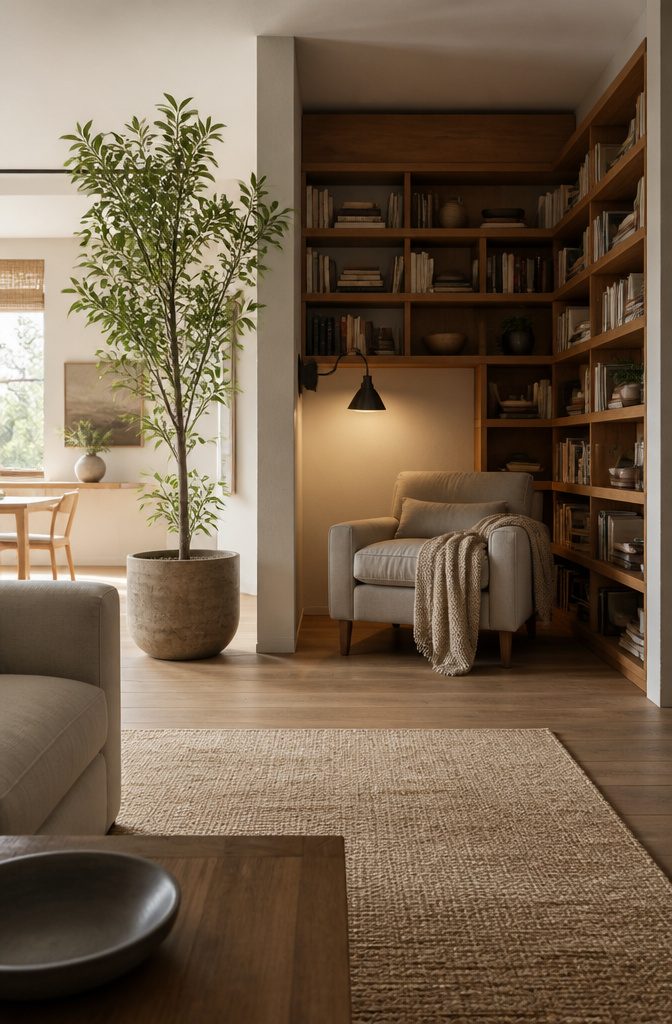
The smallest alcove can become a reading retreat if you treat it as a destination rather than leftover space.
Built-in shelving that wraps the walls creates depth without eating floor space, and a single lounge chair or built-in bench works fine provided it is genuinely supportive.
I have sat in too many "cozy" chairs that felt fine for five minutes and miserable by chapter three; seat depth and lower-back support matter more than how the chair photographs.
Wall-mounted sconces or integrated shelf lighting keep the footprint tight where a floor lamp would trip someone. Position the chair to catch natural light during the day, but plan for the same spot after dark.
A tall green plant beside the seating creates a soft visual boundary between the nook and whatever room opens into it, which helps the space feel intentional rather than improvised.
Under-stair areas and other awkward corners share the same logic: frame the sightline with trim or cabinetry depth so the library reads as designed, not stuffed in.
Wood surfaces and leather seating absorb and soften light rather than bouncing it around, which reduces eye fatigue during longer reading sessions.
Textured finishes beat glossy ones in tight quarters; they catch light more quietly and keep the space from feeling like a display case.


【Stylish and Modern】: Our acrylic white floating shelves has a stylish and modern design that adds an elegant touch to any room. Its 12 inch floating shelf transparent picture ledge shelf construction provides a unique and sophisticated look that complements any décor. Invisible bookshelf and floating shelves acrylic are the epitome of modern design, and 12 inch floating shelves add clear floating shelf touch of elegance to any room. purchased a wall mount clear plastic shelf for you bathroom to create additional storage space.
3. Dual-Purpose Library Rooms
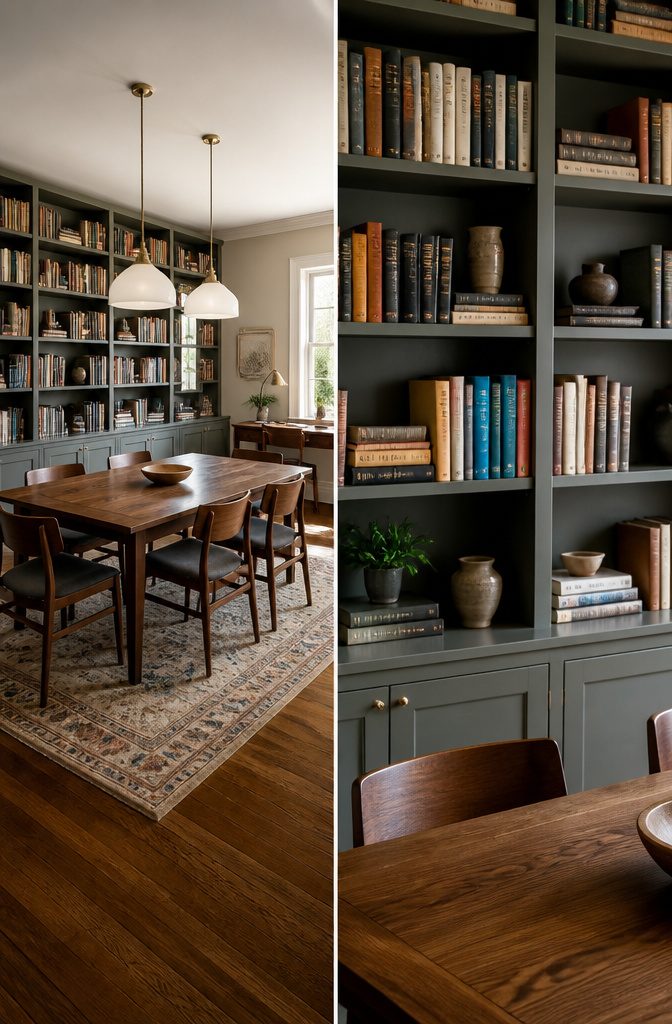
Most apartments do not offer a spare room for books, so the library ends up sharing territory.
In my own place, the shelf line runs behind the dining table, and that pairing works because the books stay on the wall while the table sits far enough forward to keep chair clearance open.
A home office follows the same rule: shelving acts as the backdrop, the desk faces into the room, and layered lighting shifts from ambient to task without rewiring anything.
Open-plan living rooms need stricter zoning since no walls exist to do the work for you. Freestanding shelving, a partial wall, or a glass partition can carve out a library area while sightlines stay intact.
CeCe Barfield Thompson took a darker route in a Manhattan apartment, merging dining and library into one nighttime space with paint that made the limited sun exposure feel intentional rather than cramped.
The method matters less than the boundary itself; without one, books and dinner plates start to read as clutter instead of two functions sharing a room.

【Four Standard Sizes】– Find your perfect match! This rolling library ladder is available in four versatile heights: 87”, 96”, 108”, and 120”, ensuring a seamless fit for various ceiling heights and spaces. The ladder features optimally spaced 11” step intervals and a 51-1/8” handrail, engineered for comfortable and secure climbing, reducing strain and enhancing user safety.
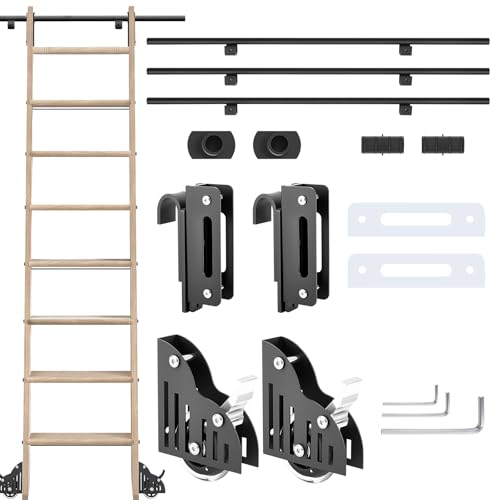
Multiple Size Options: this library ladder hardware kit is offered in three size variations: 6.6 ft, 8 ft, and 12 ft; Each complete set includes three 4 foot tracks, two retractable hooks, two end caps, two bottom rollers, and all required screws; The design accommodates ladders with a thickness up to 1 1/8 inches; The minimum ladder height is the track installation height plus one inch, with adjustable hook height for taller ladder configurations

Lightweight and durable: Crafted from aluminum alloy with a sleek black powder-coated finished, metal balck ladders was Beautiful and textured,lightweight, the bottom wheel with a brake for secure movement and stability.
4. Rolling Library Ladders
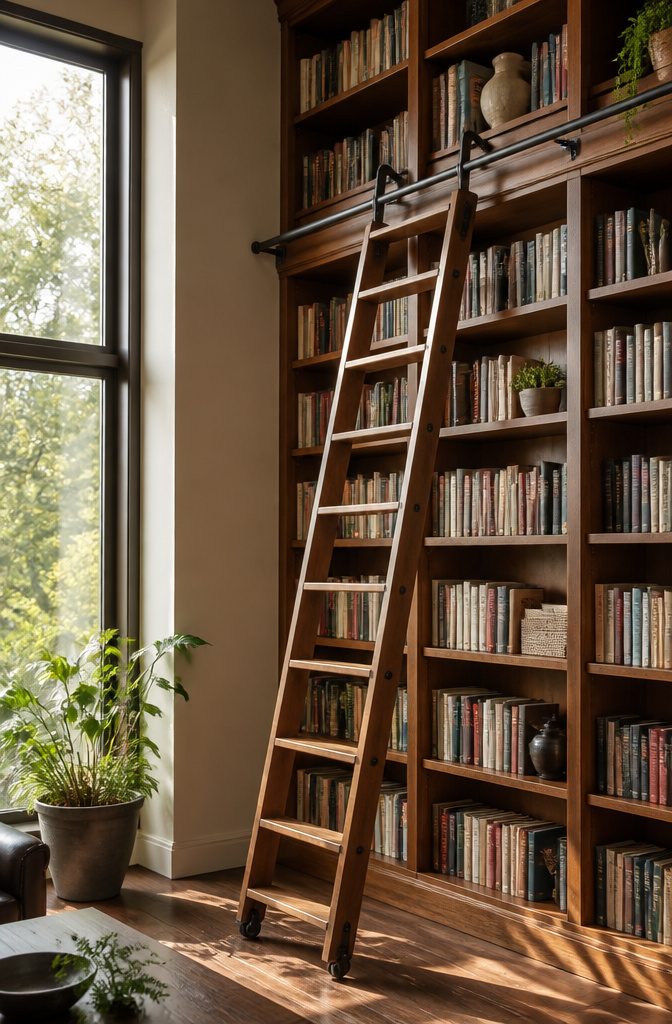
A rolling ladder turns tall shelving from a storage rack into a complete, usable system. The vertical rail draws the eye upward and gives the room a sense of intention that plain bookcases never quite reach.
Measure ceiling height and shelving depth first, then decide between rolling or fixed.
Rolling hardware needs enough wall length for the rail to track without blocking door swings or traffic paths; fixed ladders work better in tight corners where a rail would intrude.
Either way, the rungs should feel solid underfoot and the brackets need to match your other hardware finishes so the ladder reads as part of the frame, not an afterthought.
You do not need built-ins to make this work. A freestanding floor-to-ceiling shelving unit, something in the 84-to-96 inch range, pairs with a short rail mounted to the wall above it.
The ladder stores against the side when you are not reaching for the top shelf, and the whole setup moves with you when you leave. For a renter, that portability matters more than the bespoke look of a permanent installation.
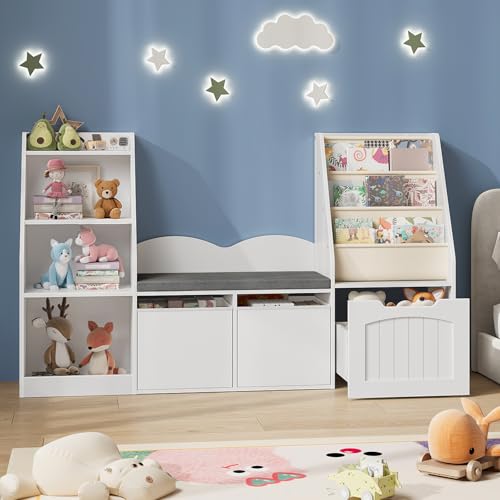
All-in-One Reading & Storage Center: This 53.1" kids bookshelf with reading nook integrates a cozy bench with a padded seat, 4-tier sling shelves, and versatile storage. The reading nook for kids creates a dedicated space for reading, playing, and organizing in your child's room


MADE OF WOOD & EASY ASSEMBLY: Reading nook is made of premium, sustainable materials for long-lasting play you can feel good about. With simple-to-follow instructions and minimal tools, one person can set up this item in approximately 2 hours or less.
5. Colorful and Themed Book Displays
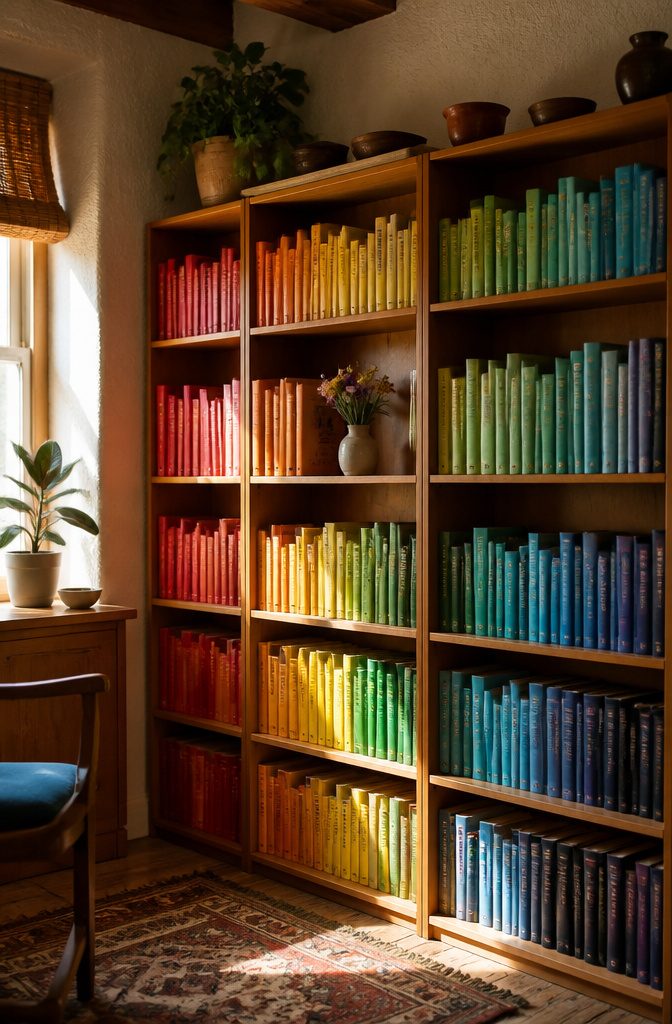
A shelf sorted by color reads faster than one sorted by title, at least to the eye.
The Seattle home that pulled this off kept its credibility because the owner shelved by hue only where the spine already matched, rather than buying books for their covers.
That difference matters: a rainbow wall built from what you own looks collected, not performed.
Genre grouping works the same way. Cookbooks cluster near the kitchen pass-through, essays live where the light is best for afternoon reading, and the stack of thumbed paperbacks stays within arm’s reach of the chair.
The theme can be as loose as "things I actually open" versus "things I mean to finish."
Decorative pieces need restraint to earn their spot. A single brass frame or a small ceramic catches the light against spines without turning the shelf into storage.
Ben Stokes at KAGU Interiors treats this as intentional spacing: some shelves stay partially open so an object has room to read as displayed, not parked.
Houseplants, vases, candles, the occasional vintage globe, each sits at eye level from where you actually sit, not crammed to fill a gap.
The rule I follow is one non-book item per two feet of shelf, which keeps the wall from becoming a mantelpiece and leaves the books central.
Gold accents against dark built-ins work because they repeat. A frame, a sconce, the lip of a shelf, the finish travels so no single piece shouts.
Sydney Manning used this in a Texas renovation to keep a moody room from going flat, and the same principle holds for a rental bookcase you paint yourself: pick the metal tone, use it three times, stop.

【FOLDABLE ERGONOMIC BACK SUPPORT】:CARHOME foldable lumbar support features a firm PP resin frame designed to provide stable ergonomic support and encourage a healthier sitting posture. Unlike soft seat cushions, the structured design helps maintain proper alignment during extended work, study, or travel sessions

𝐔𝐩𝐠𝐫𝐚𝐝𝐞 𝐋𝐨𝐧𝐠 𝐁𝐚𝐜𝐤 𝐒𝐮𝐩𝐩𝐨𝐫𝐭 𝐏𝐢𝐥𝐥𝐨𝐰:Are you suffering back pain from long time Office Sitting? Is your office chair back support too short to support your back? The long length design and curved structure of Teemour back support for office chair can provide comfort and the proper support for your lower, mid, and some upper back support to jointly keep your back and spine in good posture, reducing back pain on your back muscles while you are working or driving. with this chair back support, you will have a great time wherever you are.

Patented Bulge for Lower Back Targeted Support: AUVON Team has collaborated with physical therapists to innovate ergonomic office desk accessories with an innovative precision support design. Based on ergonomic theories, the scientific position and thickness of the bulge can offer a natural fit to the lumbar spine structure to relieve lower back pain from long sitting
6. Hidden Libraries and Secret Doors
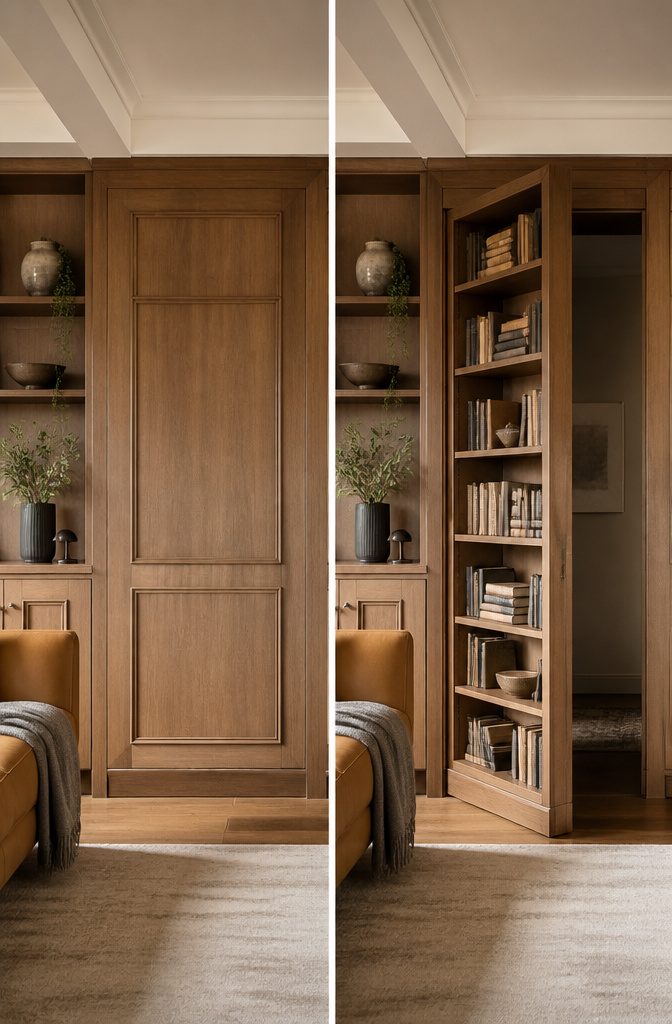
A bookcase that swings open on pivot hinges still reads as ordinary millwork until the moment it moves.
The surprise lands because the door keeps its secret: no visible pull, no seam that catches the eye, just flush panels and trim lines that match the wall exactly.
What convinced me, reading through the dozen or so examples that do this well, is how much work goes into making the hardware disappear.
The hinges and latches have to carry real load, books included, and still swing smooth enough that the reveal feels effortless rather than labored.
The tilt of a single book can trigger the latch, which is the kind of detail that turns a storage solution into a story someone tells at a dinner party.
One setup I kept returning to hides a full office behind its shelving; another tucks a closet-sized bar into restored paneling, the kind of layered use that makes a library feel less like a display room and more like a working part of the house.
Wall thickness and swing clearance are the details that make or break the illusion.
Gaps, uneven seams, or misaligned trim read as sloppy carpentry rather than intentional magic. The hardware costs more than standard hinges, and the install takes precision you cannot fake with shims.
For a renter, this is almost certainly out of reach. For a first-home owner staying put, it is the one library idea that nobody expects.

Use together or separately – When placed side by side, the two units form one tall, extra-large bookcase with generous storage space. or place them separately in different rooms or corners – adapts to any space. Flexible placement options for your choice!

7-Tier Shelves Capacity - This tall bookshelf maximizes storage by utilizing vertical space, offering ample room without occupying much floor area. Perfect for those with limited space but plenty of storage needs. Product dimensions: 82.7 x 23.6 x 9.3 in

7-Tier Shelves Capacity - This tall bookshelf maximizes storage by utilizing vertical space, offering ample room without occupying much floor area. Perfect for those with limited space but plenty of storage needs. Product dimensions: 82.7 x 23.6 x 9.3 in
7. Vintage and Eclectic Styling
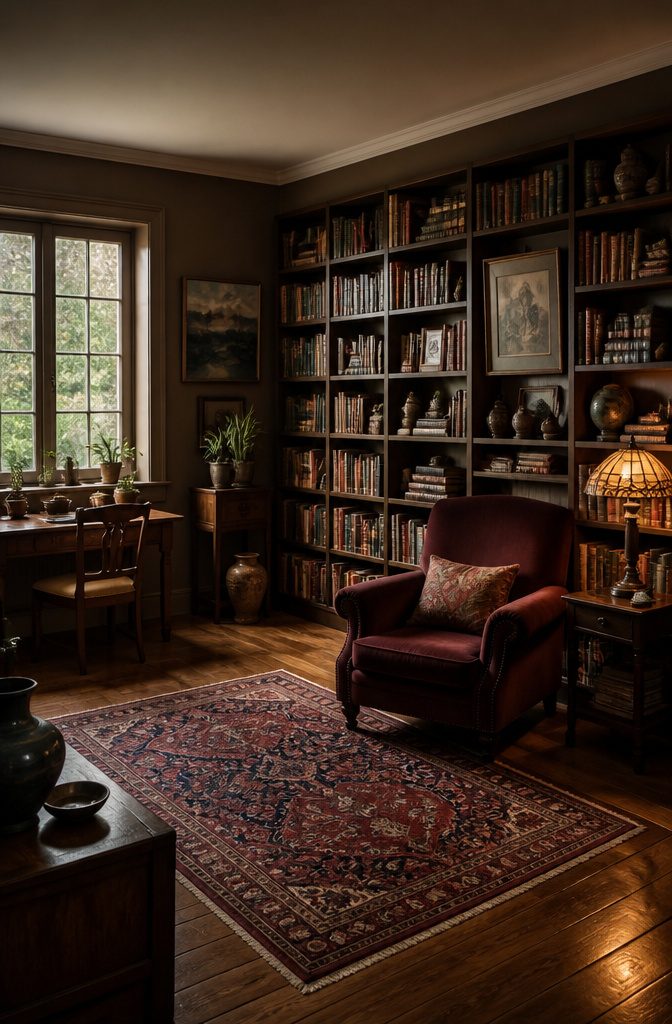
A library that looks collected rather than bought in one weekend takes patience, but the payoff is a room that actually feels lived in. Vintage finds and mismatched pieces carry the story a catalog shelf never will.
Start with what you already own. Heirloom photos, a ceramic you picked up somewhere, or a globe from an estate sale sit better among books than they do alone on a mantel.
Leave some shelves partially open so these pieces have room to breathe; an object crammed between tight rows looks stored, not displayed.
Odd-numbered groupings of smaller items, say three framed prints staggered at different heights, keep the eye moving without the stiffness of a symmetrical grid.
Secondhand furniture does the heavy lifting here. An antique chair beside the shelves, maybe a Turkish rug underfoot, gives the space the kind of warmth that built-ins alone cannot manufacture.
The trick is placing these pieces within your sightlines from where you actually read, not tucked behind the door where they become decoration for decoration’s sake.
If nothing in your family qualifies as an heirloom yet, that is the point.
The collection builds over years, not a single Saturday trip. One shelf holds the books, another holds the life that happened while you were reading them.

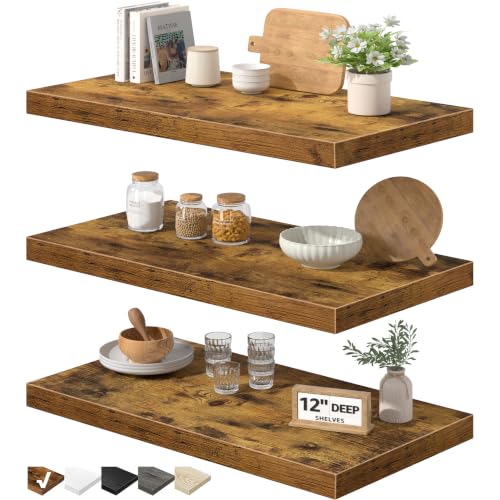
【Space-Saving Deep Wall Shelves】Our stylish deep floating shelves (Shelf Size: 16" x 12") look rustic yet modern, are a great addaition if you need extra storage space or if you want to add wall decor – indoor plants, artworks, picture frames etc. These deep wall shelves can free up floor & counter spaces and make places much tidier and neater in your Kitchen, bedroom, living room and laundry room.

【Space-Saving Deep Wall Shelves】Our stylish 12 inch deep floating shelves (Solid Wood Shelf Size: 16" x 12") look rustic yet modern, are a great addaition if you need extra storage space or if you want to add wall decor – indoor plants, artworks, picture frames etc. These deep wall shelves can free up floor & counter spaces and make places much tidier and neater in your pantry, closet, kitchen, bedroom and laundry room.

Deep Floating Shelves - Measuring 16 inches wide and 12 inches deep, our wall shelves are widened to add additional storage and display space, perfect for use as bookshelves or floating nightstands
8. Natural Light and Plants
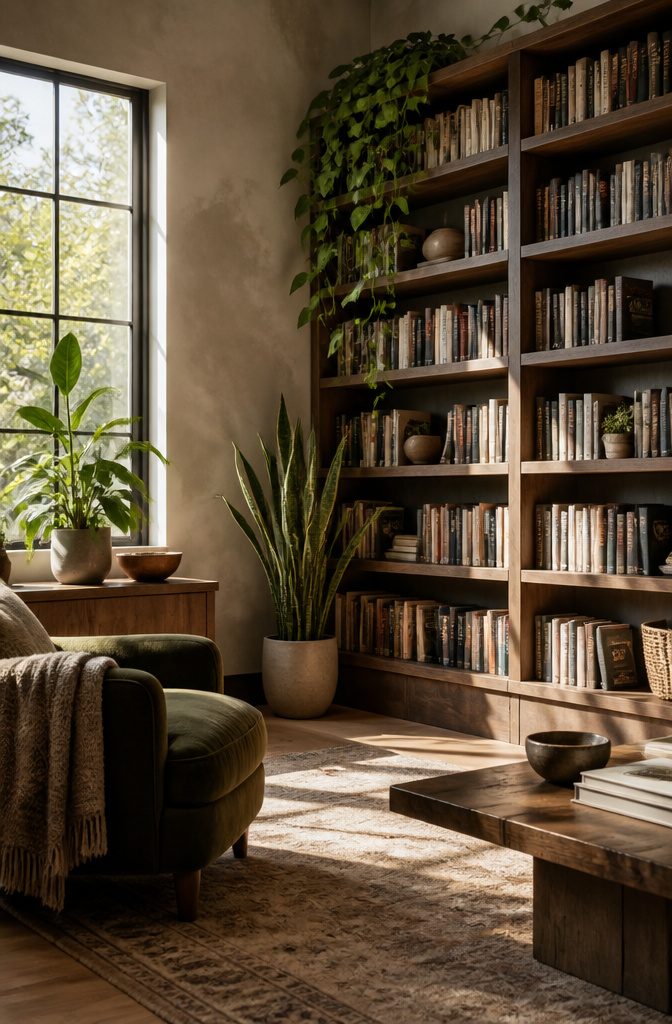
Daylight changes how a library feels more than any paint color. My own shelves sit perpendicular to a south-facing window so the light slides across the spines without hitting them directly.
Direct sun will bleach covers and dry out bindings over time, so position bookcases to catch reflected light rather than raw sun if the layout allows.
Where the room has only one window or faces north, a daylight-balanced LED bulb at 5000K behind a simple paper shade can fill the gap without the yellow cast that makes reading strain the eyes.
Plants soften the geometry of tall shelving, but book rooms swing between dry winter heat and humid summer air.
Pothos and snake plants handle both extremes without fuss, and neither minds the lower light that reaches the floor beneath full shelves.
A small pebble tray under the pot adds humidity only where the plant sits, not enough to risk the books.
I skip ferns entirely; the constant misting they want in dry months is more maintenance than a weekend project should demand.

Widely Used: The sliding track design allows ladders to slide easily without the need for manual labor. Wide range of uses: such as library,loft,bookshelf,attic,kitchen,warehouse etc.

LIGHTWEIGHT AND DURABLE: Made from sturdy iron with a sleek black powder-coated finish, this ladder hardware resists rust, while bottom brakes help ensure safer, controlled movement.

Widely Used: The sliding track design allows ladders to slide easily without the need for manual labor. Wide range of uses: such as library,loft,bookshelf,attic,kitchen,warehouse etc.
9. Technology in Library Spaces
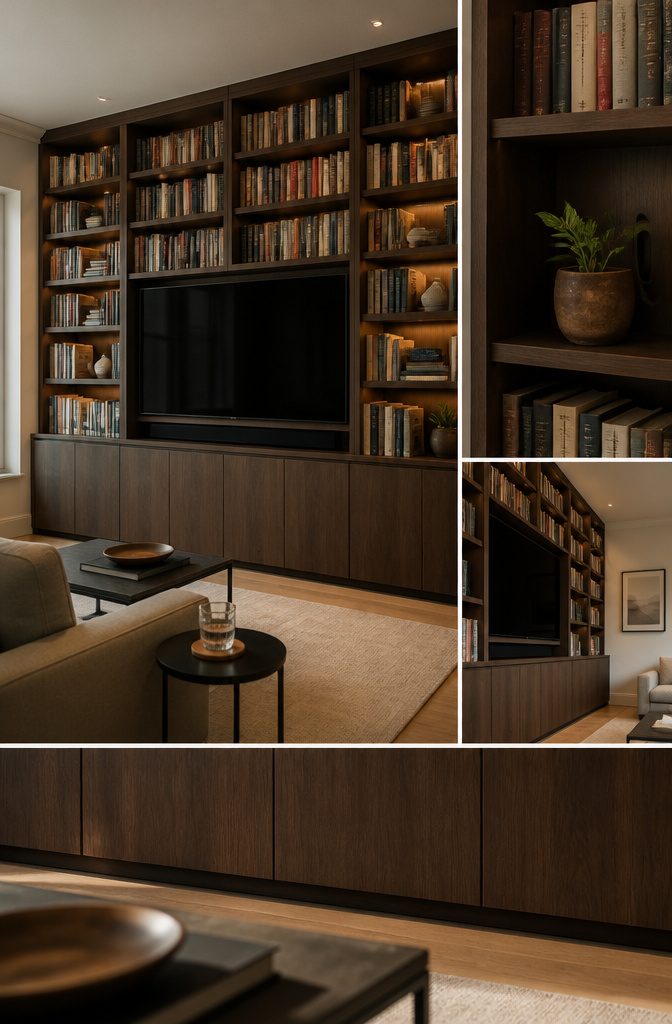
A television mounted between two tall bookcases reads as an afterthought unless the screen sits at the same visual weight as the shelves around it.
I learned this the hard way in my last rental, where a flatscreen floated above a low credenza and made every book below it look like clutter.
The fix was simpler than I expected: moving the TV to a recessed cavity built into the shelving unit itself, so the bezel and the book spines share one plane.
That single plane is what makes the room feel like a library that happens to have a screen, not a media room with books for wallpaper.
Cable management follows the same rule. Power cords and HDMI runs should travel inside the columns of the shelving, never down the face where they draw the eye away from the books.
If you are renting and cannot open the walls, a hollow column cover in the same paint as the shelves hides everything and reads as architectural detail.
I have used these twice now; they cost less than a mid-range area rug and take an afternoon to install with a miter saw and construction adhesive.
The harder part is behavior, not hardware. A charging station built into a side table invites the same endless scrolling that the room is supposed to escape.
What worked in my setup was keeping the charging point outside the main seating sightline, around the corner near the entry. The phone still charges, but it does not sit in my peripheral vision asking to be picked up.
The analog purpose of the room, the one that justifies all that shelving, survives only if the screen stays a guest rather than a host.

SMART & SPACIOUS STORAGE DESIGN: Featuring a left-side open-shelf unit for displaying toys and books, a right-side angled book rack for easy-access reading, and a smooth-gliding drawer below for hidden storage of small items or toys. Plus, open cubbies under the seat offer extra space for boxes, decor, or favorite plushies

Cushioned Seat: With couch cushions, this cube storage for kids offers a soft chair and spacious square shelving in a unit. The seat allows you to lean on the pillowy layers, providing a buffer for extra relaxed positions. With a reading and lounging spot, this cubby storage organizer gives the room a homey feel.

MADE OF WOOD & EASY ASSEMBLY: Reading nook is made of premium, sustainable materials for long-lasting play you can feel good about. With simple-to-follow instructions and minimal tools, one person can set up this item in approximately 2 hours or less.
Small-Space Library Strategies
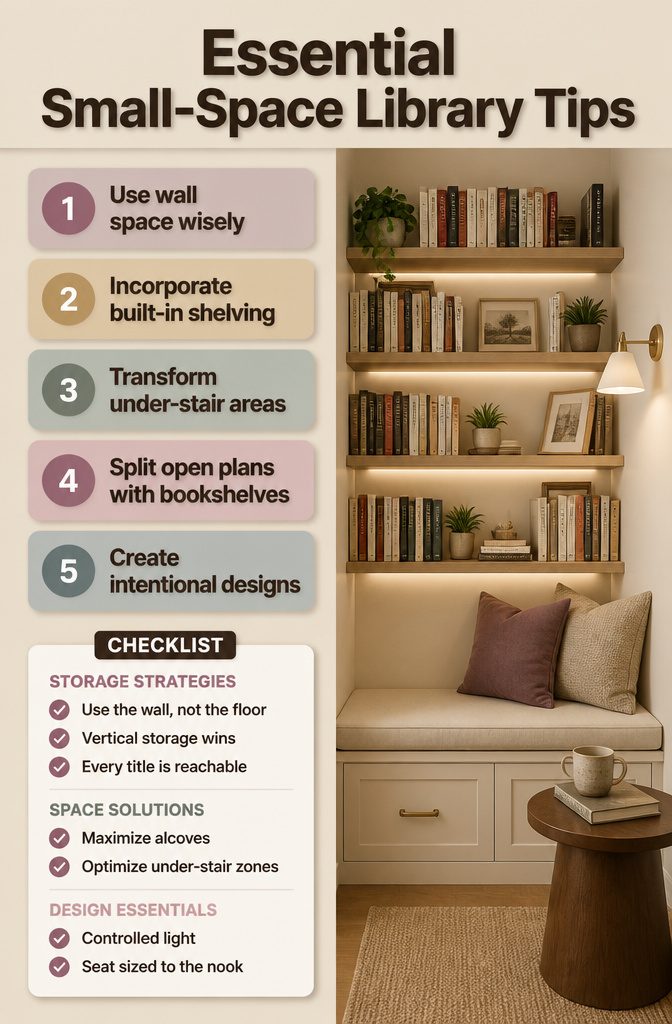
Small spaces reward the same move over and over: use the wall, not the floor.
In a 450-square-foot apartment, floating shelves carried an entire collection without sacrificing a single square foot of living area. The same principle scales up or down.
- Alcoves read as afterthoughts until built-ins wrap the walls and trim the sightline. Wall-mounted sconces or integrated shelf lighting finish the job; a single lounge chair or built-in bench, kept proportional, supplies the seat.
- Under-stair zones dead-end without purpose. Shelving that follows the angle turns them into destinations rather than storage dumps.
- Open plans need the book itself as a divider. A 480-square-foot studio used a pink bookcase to split living from sleeping areas; the shelves faced both directions, so neither side read as a wall’s back.
- Vertical storage wins when every title is reachable. Floor-to-ceiling runs work only if the upper third holds display or off-season items; daily reading stays between knee and eye level.
The common mistake is treating any of these as temporary.
A library that looks improvised stays improvised. Built-in or fitted, the space needs to read as intentional: finished edges, controlled light, a seat sized to the nook rather than the room it opens onto.

Chiropractor-Recommended Support: Ergonomic contoured design cradles the back, promoting spinal alignment and relieving lower back pain

𝐂𝐎𝐍𝐓𝐎𝐔𝐑𝐄𝐃 𝐃𝐄𝐒𝐈𝐆𝐍 – 𝐅𝐈𝐓𝐒 𝐘𝐎𝐔𝐑 𝐁𝐀𝐂𝐊 𝐏𝐄𝐑𝐅𝐄𝐂𝐓𝐋𝐘 This ergonomic lumbar support pillow for office chair aligns with the spine's natural curve to relieve pressure from extended sitting. Whether at work or in the car, its sculpted shape cradles the lower back for consistent comfort and proper posture throughout the day.

Air-Cloud Lumbar Cushion: Recommended by chiropractors for its ability to support posture and relieve lower back pain, this ergonomic lumbar cushion features a contoured design that cradles your back for optimal support
Lighting for Reading and Atmosphere
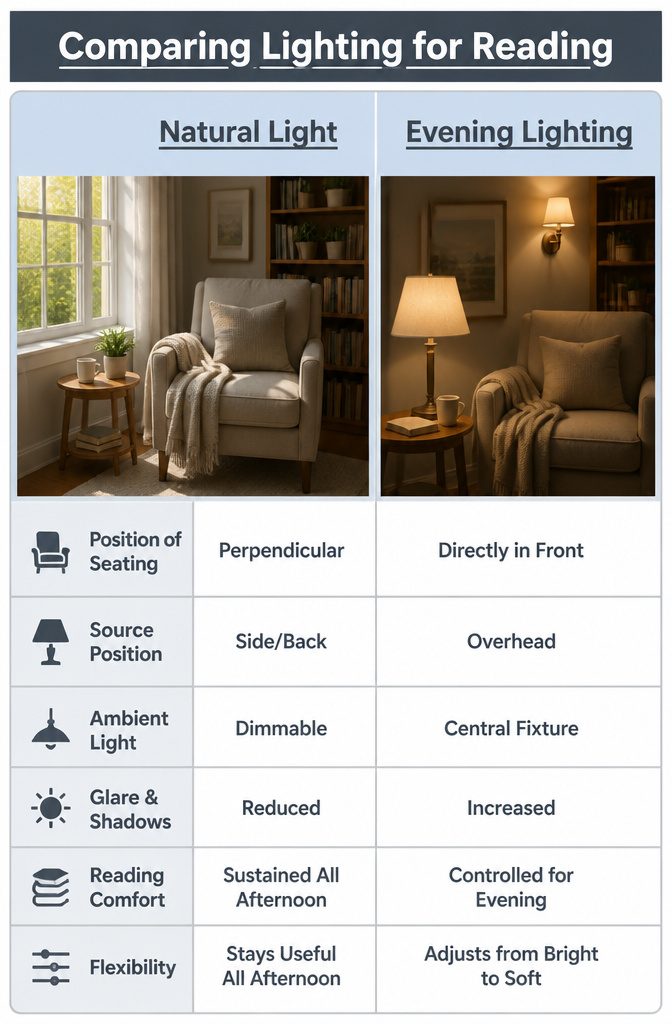
Natural light placement shapes where the reading happens. I learned this the hard way with a chair facing west; by four o’clock I was squinting at pages through heat and glare.
Position seating perpendicular to windows, not directly in front of them, and the daylight stays useful all afternoon without the headache.
For evening reading, task lighting needs to come from the side or behind, never straight overhead. A table lamp with a shade that angles light downward keeps the bulb out of your eyes and off the page’s reflective spots.
Wall sconces work the same way if you mount them at seated shoulder height or slightly above, spaced to kill the shadows a single source leaves across open spreads.
Ambient light fills what task lamps miss. A central chandelier anchors larger rooms with high ceilings, but the proportion matters: too small and it disappears, too large and the room feels like a lobby.
Dimmable controls let you drop from browse-the-shelves brightness to something softer when you’re settled in with a chapter.
The layering is what saves you from flipping one switch and living with whatever it gives. Two or three sources, each doing one job, beats a single fixture trying to do everything and failing at most of it.
What Built-In Shelving Actually Needs
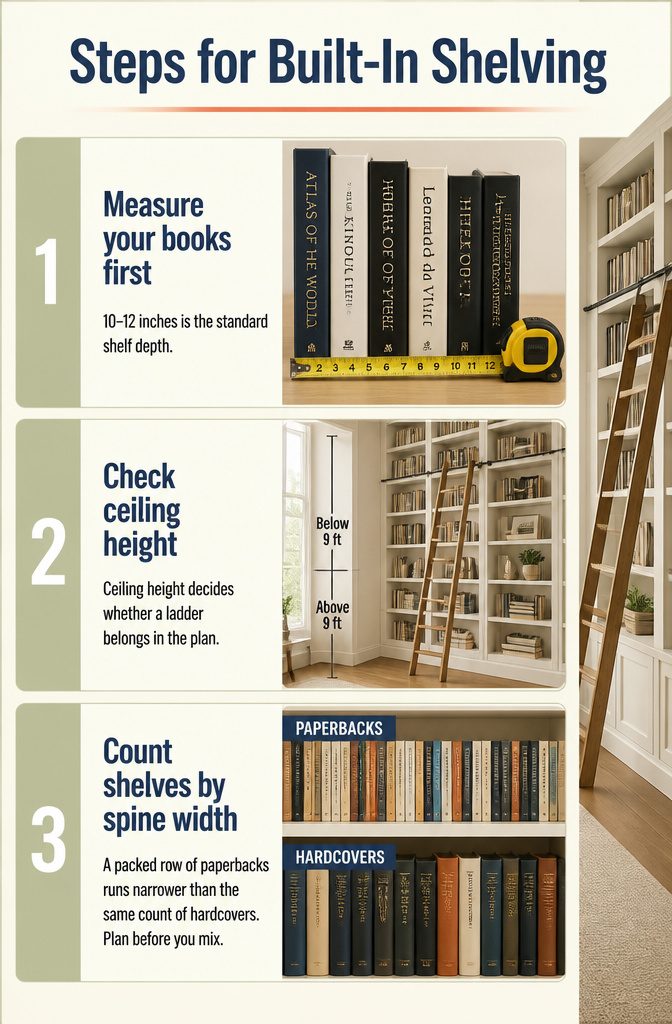
- Measure your books before you measure the wall. 10–12 inches is the standard shelf depth that handles most collections; oversized art books or binders need 14–16 inches, with a slight overhang for anything you want to face-forward.
- Ceiling height decides whether a ladder belongs in the plan at all. Anything below about nine feet and the top shelf stays reachable with a step stool; above that, factor in the ladder’s rail depth and swing arc so it does not block the walkway.
- Count your shelves by spine width, not by the number of books. A packed row of paperbacks runs narrower than the same count of hardcovers, and mixing the two without planning leaves you with either dead space or a second row hiding in back.
Comfort That Lasts Past the First Hour

The chair that looks plush in a showroom rarely stays comfortable once you are actually reading in it.
Seat height matters more than cushion thickness for a space surrounded by shelves. A seat too low forces you to reach upward for books, which strains the shoulder after twenty minutes.
A seat too high leaves your feet dangling, which cuts circulation. The right height lets your feet rest flat while your elbows stay near rib level, so you can hold a hardcover without lifting it.
Cushion density is where the showroom fools you. Foam that feels forgiving for five minutes collapses by hour one.
I look for cushions with a firm core wrapped in softer batting; they hold shape but do not feel like a bench. Seat depth under nineteen inches keeps shorter readers from slumping, while taller people still get thigh support.
Arm width is the detail I missed on my first pick. Narrow arms look sleek, but they do not hold a mug steady or support a paperback when you need both hands free.
Now I test by resting an elbow and a coffee cup simultaneously. If one slides, the chair stays at the store.
Frequently Asked Questions
How do I incorporate a library ladder in a standard room?
Measure your ceiling height and shelving depth before choosing between a rolling or fixed ladder.
Rolling hardware needs enough wall length for the rail to track without blocking doors or traffic; fixed ladders suit tight corners where a rail would intrude.
Either way, the rungs should feel solid underfoot and the brackets should match your other hardware finishes so the ladder reads as part of the frame.
What are the best finishes for dark wood library shelves?
Brushed bronze or aged brass hardware warms dark wood without reading as flashy.
These softer metals catch afternoon light and keep the mood inviting rather than institutional. Black iron, by contrast, can feel heavy fast and verge toward an institutional look.
How deep should library shelving be for custom built-ins?
Standard shelf depth runs 10–12 inches, which covers most hardbacks and paperbacks without wasting floor space.
For oversized art books or binders, plan for 14–16 inches with a slight overhang for face-forward display items. Measure your actual collection before finalizing the wall dimensions.
Can I install a home library in an open-plan living room?
Yes. Freestanding shelving, a partial wall, or a glass partition can carve out a library area while keeping sightlines intact.
The key is establishing a clear boundary; without one, books and living room functions start to read as clutter instead of two intentional zones sharing a room.