

A drawer organizer is only useful if it actually fits the drawer you own. The problem is that standard trays leave dead space along the sides, and dividers land where your silverware does not.
Expandable bamboo organizers solve the width problem by compressing to roughly 12 inches and extending past 20, with sliding dividers that rebuild around whatever you are currently storing.
1. Expandable Bamboo Drawer Organizers
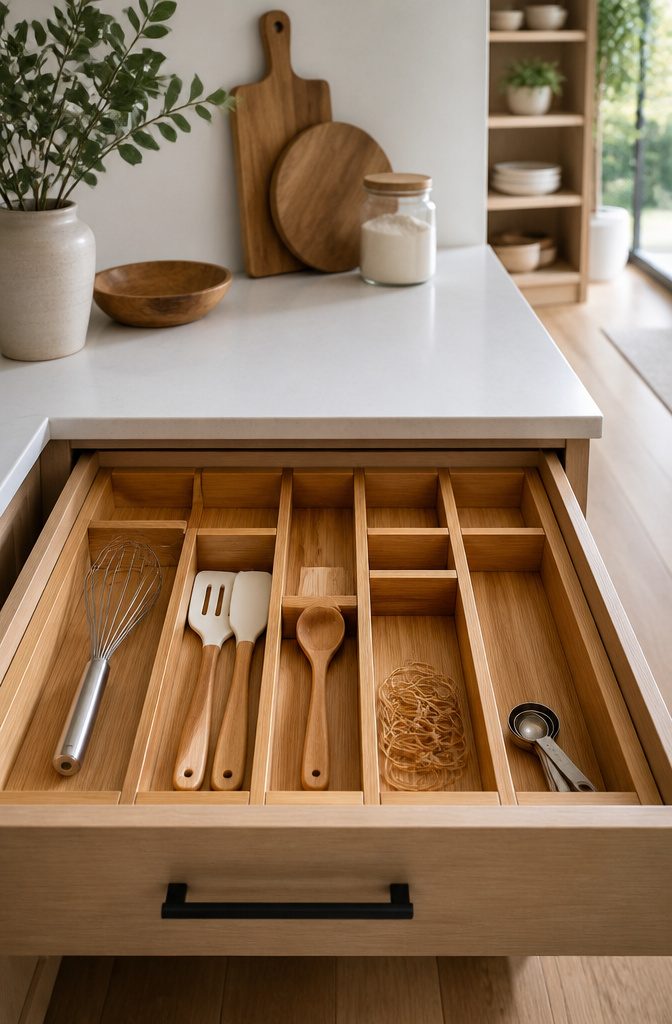
Bamboo organizers that expand to fit your drawer width have shown up in more of the research than almost anything else, and the appeal is obvious: one purchase covers the guesswork of measuring.
The typical unit sits anywhere from roughly 12 inches compressed to 20 or more extended, with front-to-back dividers that slide into slots to create compartments sized to whatever you are storing.
That adjustability is what separates them from fixed trays. You can set a narrow slot for pens, a wide one for tape dispensers, then move everything six months later when the contents change.
The expansion mechanism is usually a simple spring-loaded frame or interlocking slats that push outward until they meet the drawer walls.
It does not require tools, which matters for renters who cannot modify cabinets. These work best in kitchen drawers holding utensils or dish towels rolled upright, and in shallow desk drawers where the low profile keeps supplies visible.
The material itself is part of the draw: bamboo is a renewable resource and biodegrades where plastic does not, and the warmer tone reads as intentional rather than utilitarian.
Cost runs higher than plastic equivalents, but the lifespan tends to justify it if you move the organizer from drawer to drawer over years rather than buying new fixed trays each time.

Multipurpose Use: This utensil drawer organizer is perfect for storing a wide range of items beyond just silverware. It can neatly store cutlery, stationery, jewelry, tools, and even office supplies. Perfect for use in the kitchen, living room, bedroom, office, and utility room, this silverware drawer organizer offers versatile storage for multiple items across various settings.

[START YOUR KITCHEN ORGANIZATION]: The 10.04" - 15.5" wide, 13.98" long and 1.97" deep bamboo drawer organizer can tame your out-of-control kitchen drawers, to store and organize the cutlery and kitchen utensils according to your rules, and maximize the drawer storage. Keep everything accessible and organized, so that you don't have to rifle around for your cooking tools. Beautiful and practical kitchen drawer organizer turns the cooking and tasting into things of beauty and efficiency.
2. In-Drawer Knife Storage
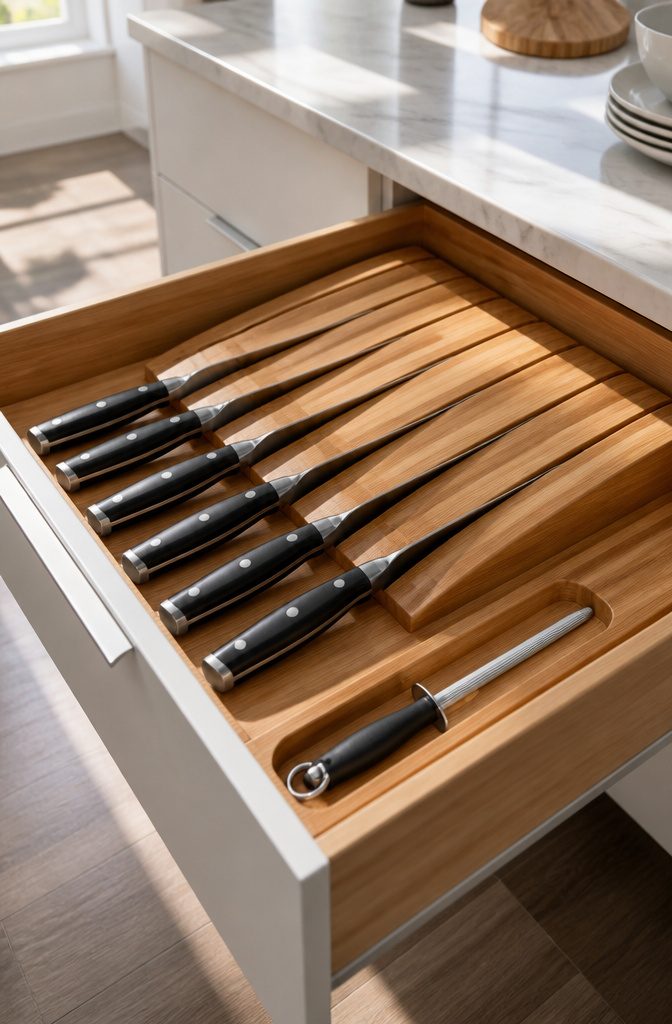
A knife block on the counter eats space and gathers dust, which is why an in-drawer knife holder works better for anyone trying to clear surfaces.
The bamboo trays with angled slots keep blades lying flat, handles up, each knife separated so edges do not dull against each other.
Most hold anywhere from seven to fourteen pieces, with a narrow channel sized for a honing steel if you keep one.
Safety matters more here than with forks or spatulas. A tray without a lid lets a reaching hand slide onto a blade; the better designs have the handles raised above the slot line so you grip handle first, never metal.
The block should fit your longest knife with an inch to spare at the tip, otherwise the point presses against the drawer face every time it closes.
I paired a seven-slot block with a fourteen-slot when my collection grew, and used expandable bamboo dividers to lock both against the drawer sides so nothing shifts when the drawer slams.
The dividers sit with their spring ends toward the back, which hides the hardware and reads as custom-fitted.

【Perfect for Makeup Drawer Storage】Versatile 10pcs drawer organizer can be combined in 9*12 and 9*18 inch drawer in vanity, they are perfect for organizing cosmetics like lipstick, hair accessories, eye shadow, makeup brush, beauty products, jewelry and more, keep your vanity drawer well organized.

Please Note: This storage tray fits drawers with a width of 16.92 to 27.95 inches. It supports hanging installation, and can also be placed inside drawers, on desktops shelf or cabinets.

Dustproof Storage Bins---The storage drawers help you to organize everywhere in your home. It is ideal for storing refrigerator food, snacks, medicines and office items. The storage bins has built-in removable dividers to achieve "one box for one thing" or "one box for one category".
3. Modular Drawer Organizers

Modular systems win the argument if your drawers change jobs every year or two.
Individual bins, trays, and linkable squares sit together without commitment; you can pull one piece to the bathroom, add a narrow strip for pens, or break the whole thing down when a drawer suddenly needs to hold batteries instead of silverware.
To get the most out of your organizers, they need to fit — ideally filling out all three dimensions of your drawer with minimal wasted space. Just make sure to leave at least a quarter inch of wiggle room to install them and avoid a too-tight fit, which can cause wear and tear over time.
That quarter inch matters more than it sounds.
A set that jams side-to-side will lift every time you open the drawer, and the plastic feet that looked grippy in the store skate across finished wood once dust settles underneath. Leave the gap, and the pieces stay put.
Kitchens get the most obvious use: measuring cups in one square, spatulas in a longer rectangle, shape cutters standing on end where you can actually see them.
The same logic moves to a bathroom drawer for skincare bottles that fall over in a tray too wide, or a desk where yesterday’s charging cables become this month’s receipt stash.
Look for sets that list external dimensions by the piece rather than promising "one size adjusts to all"; you need to know whether two smalls and a medium actually fill your depth or leave a useless canyon down the middle.
Check Your Drawer Dimensions: This product is suitable for drawers with an inner size larger than 17.1"D x 10.1"W and a height greater than 2.3"

Check Your Drawer Dimensions: This product is suitable for drawers with an inner size larger than 17.1"D x 12.7"W and a height greater than 2.3"

FLEXIBLE DIVIDERS - Made from cork and rubber composite, this in drawer knives drawer organizer holds knives up to 12" long in place for storage; SIZE: 15"L x 5.9"W x 2.5"H
4. Acrylic Drawer Organizers

Clear acrylic organizers earn their keep anywhere you open a drawer and need to know in three seconds whether you own a second tube of concealer or a backup phone charger.
The material itself is rigid enough to hold shape but light enough that it does not add noticeable heft to a cabinet the way wood dividers can.
In my bathroom, six-by-six-inch acrylic bins sit side by side to keep smaller items like nail supplies and hair accessories from migrating into a single pile at the back. Two of those three-part organizers lined up handle the rest.
The real advantage is seeing contents without pulling anything out. That matters most in deep, narrow bathroom drawers where bottles fall over and bury each other.
Acrylic cleans up with a wipe, and it does not absorb moisture the way bamboo can if something leaks. Plastic options exist at lower cost, but they tend to cloud faster and flex under weight.
For a few hundred dollars and a weekend, acrylic strikes the balance: durable enough to survive daily use, neutral enough to look finished if a drawer slides open when someone borrows your mirror.

Rotate to Reach Nine Slots: Keep a mixed knife collection organised in one countertop holder. The rotating body lets you turn the block towards the slot you need, while nine fixed openings keep storage positions clear during everyday meal prep

Safe, organized storage for up to 9 knives. Non-slip feet.

DRAWER KNIFE ORGANIZER: Keeps your kitchen knives sharp, safe, and organized with less effort
5. Bamboo Dividers
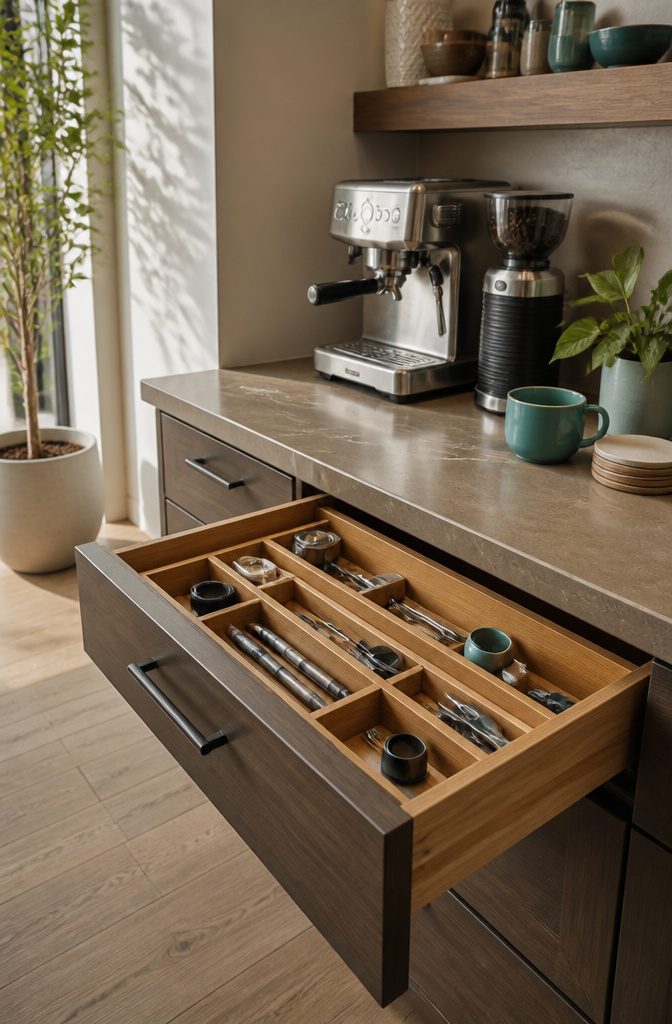
Bamboo dividers sit in the drawer like a separate piece of furniture rather than a dropped-in tray. That distinction matters when you own the home, or when you simply want something that reads as intentional.
The material itself, woods like bamboo and acacia, carries enough grain that it softens the look of a kitchen full of hard surfaces without going rustic.
I went with standalone dividers over a full organizer in my coffee bar drawer because the items kept changing.
One month it was six pens and a tape measure; the next, a deck of cheese boards and an electric can opener.
Expandable bamboo dividers with a spring-loaded end let me rebuild the layout without emptying the whole drawer. Place the spring-loaded end toward the rear so the expansion hardware hides against the back wall and the front looks built in.
The sustainability angle is straightforward: bamboo grows fast enough that harvesting it does not read like a tree falling.
For a first-home owner who wants the kitchen to feel finished but cannot yet replace cabinets, that small swap in material signals care without shouting it.

Drawer dividers are the perfect solution to organize open drawers to keep things from shifting.

2.5" HIGH - MORE CAPACITY: 0.5" higher than other 2" high boxes, Umilife Drawer Organizer Storage Boxes allow to gain 20% more storage capacity.

PERFECT SIZE OF 17” BY 12”: We highly recommend to measure your drawer before order. 2.5” deep, gains up to 20% more storage capacity than other 2” deep organizers. 4 horizontal slots for forks, knives, spoons, and 2 bigger horizontal slots for bigger kitchen utensils such as spatulas, tongs, ladles and more.
6. Drawer Liners
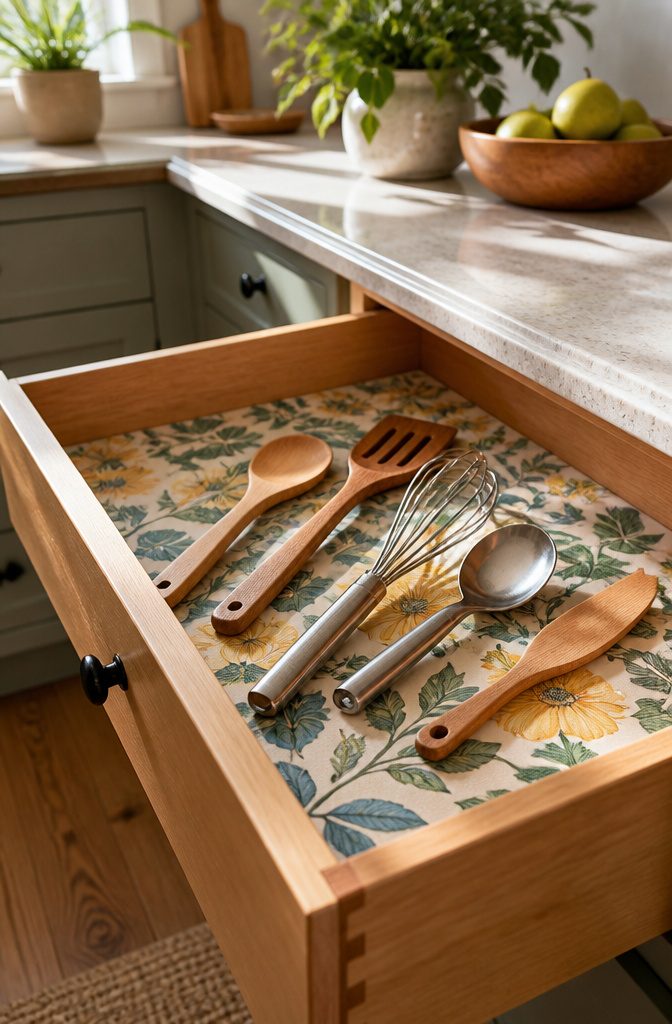
A drawer liner does two jobs at once: it keeps the wood or laminate underneath from picking up scratches and stains, and it gives you something pleasant to look at every time you pull the drawer open.
Paper liners are the cheapest route and fine for a dresser or desk where moisture is not much of a risk. Cork adds a little cushioning and a warmer look, though it will compress over time where heavy objects sit.
Rubber or silicone mats cost more upfront but wash clean in a sink and hold up against the damp spoons and spatulas of a kitchen drawer.
Peel-and-stick backing makes application quick, but a loose liner that lifts out is easier to replace when the surface underneath starts to show wear.
In a rental kitchen, removable liners also let you take the protection with you. Most paper and cork liners need swapping after a year or two of daily use; rubber can last several years before the surface texture wears smooth.
The telltale sign is the corner lifting or a stain that will not wipe away. Once that happens, the liner is no longer doing its job and it is time for a fresh cut.

🌿 𝐄𝐗𝐏𝐀𝐍𝐃𝐀𝐁𝐋𝐄 𝐓𝐎 𝐅𝐈𝐓 𝐌𝐎𝐒𝐓 𝐒𝐓𝐀𝐍𝐃𝐀𝐑𝐃 𝐊𝐈𝐓𝐂𝐇𝐄𝐍 𝐃𝐑𝐀𝐖𝐄𝐑𝐒: Our deep bamboo drawer organizer is ideal for saving kitchen storage space, thanks to its adjustable storage drawers that expand from 17”x13” to 17x19.6” wide with 1.9” deep slots. Easy to use and ideal for helping to maximize kitchen storage space, simply pull apart from the sides for additional storage space and a more secure fit for wider drawers. Different sized compartments allow for standard silverware and large utensil placement

Perfect Drawer Organizer: This is a simple and easy way to organize kitchen utensils or clothes; Keep everything neat, organized and access convenience

4 Drawer Dividers with 9 Inserts: Customize your drawer with our bamboo dividers and inserts; You can organize everything from silverware to utensils. The mini dividers can be easily inserted to make smaller or larger storage parts; LENGTH SIZE: Expandable from 17" to 22" Long
7. DIY Drawer Organizers
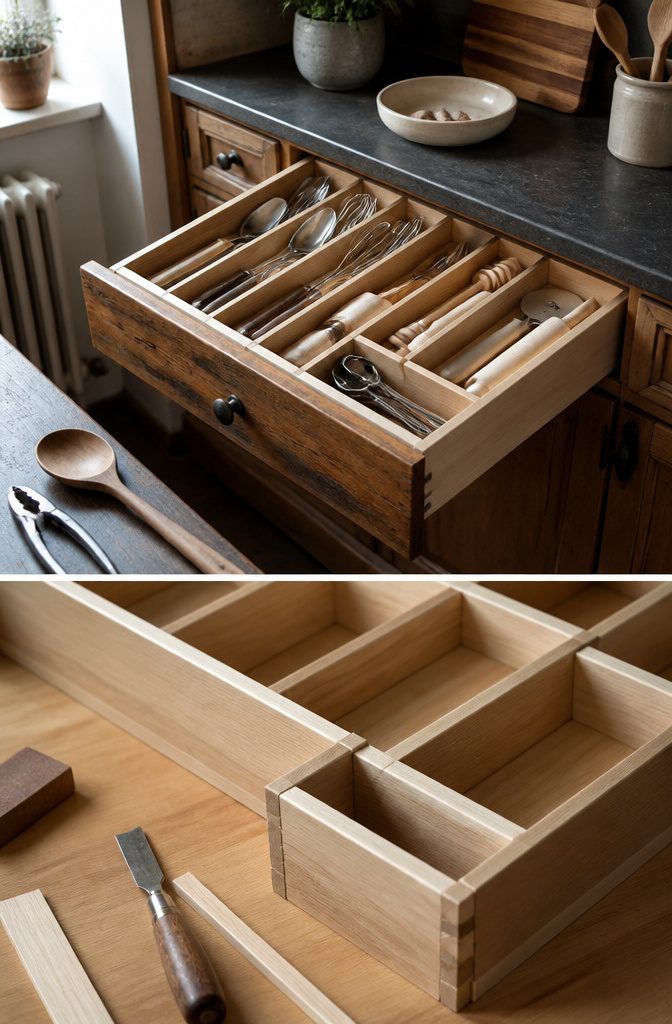
Custom drawer organizers start with the gap the store-bought ones miss. A standard bamboo tray leaves dead space along the sides of most drawers, and the dividers land where your silverware does not.
I built one for a junk drawer last spring from half-inch poplar strips, the same boards Fix This Build That uses, three feet long and two and a half inches wide.
A handsaw, drill, and sandpaper handled the cuts; no table saw required. The poplar ran about twelve dollars, against thirty-five for a comparable acrylic unit that still would have needed shimming.
Cardboard and repurposed boxes work for a trial run.
Kelley Nan’s approach of sorting first with what you already own applies here: an old shoebox with the lid torn off will show you whether three compartments or four actually fit your morning routine.
If the layout holds for a month, rebuild it in wood or keep the cardboard and spend nothing.
Where DIY wins is depth.
Store-bought organizers sit at a fixed height; a custom strip can run front-to-back at the exact height of your tallest utensil, leaving the front shallow for the things you grab daily. The tradeoff is time, not skill.
Poplar, bamboo, and acacia all stay light enough that the drawer glides do not strain, and they hold their shape under the weight of a full flatware load. Plastic deforms eventually; wood just scars.
The real test is whether you will finish the job in an afternoon. Two hours of cutting and gluing beats a lifetime of rattling around a tray that almost fits.

【Stackable Storage Drawers】The top of the drawer features a groove design that ensures secure stacking,saving space. You can place other items on top of the plastic bins to maximize tidiness in your under-sink or cabinet spaces.
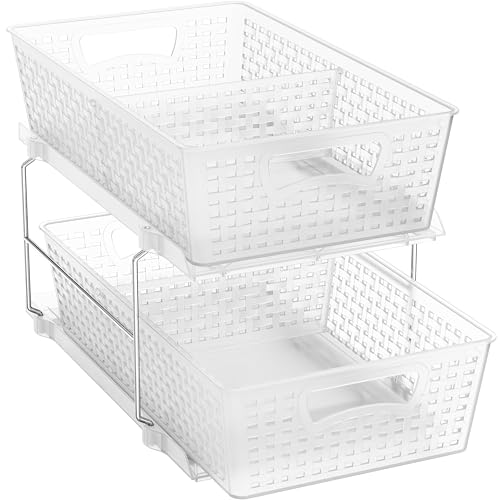
Great Bathroom Organizer Tray, Plastic Perforated Tray in Humid Places

2-TIER MULTIPURPOSE ORGANIZER: Offers a practical storage solution for kitchen cabinets or pantries, under bathroom sinks, on desks, or other areas to keep your home or office space clean and organized
Declutter Before You Organize
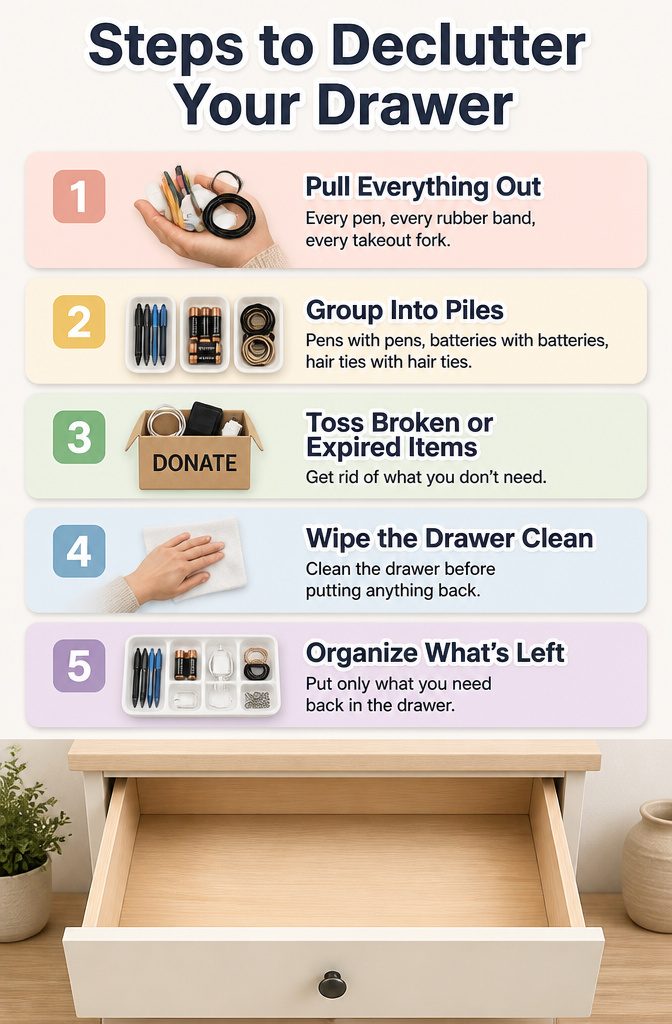
Emptying a drawer feels like wasted time when the organizer is sitting right there, but skipping this step is how you end up with a tray full of things you still do not need.
- Pull everything out. Every pen, every rubber band, every takeout fork you forgot was back there. Lay it on a towel so you can wipe the drawer itself clean.
- Group what is left into piles that make sense for how you actually reach for things: pens with pens, batteries with batteries, the three hair ties you actually use separate from the twelve that lost their stretch.
- Toss or donate what is broken, expired, or untouched in the last year. The spare charging cable for a phone you no longer own is not going to suddenly become useful once it has a divider around it.
The reason this step gets skipped is impatience. The organizer arrives, the weekend is short, and it feels productive to just start fitting things in.
What happens instead: the new tray holds the same clutter, only now it is compartmentalized clutter, and six months later you are pulling the whole unit out to hunt for what you need.

ORGANIZE UP TO 7 KITCHEN KNIVES – Transform any standard drawer into a premium drawer knife organizer with this durable knife organizer drawer insert. Store chef, bread, santoku, carving, utility, and paring knives in one convenient knife holder, keeping every blade organized, protected, and always within easy reach.

Check Your Drawer Dimensions: This product is suitable for drawers with an inner size larger than 16.7"D x 6.5"W and a height greater than 2"

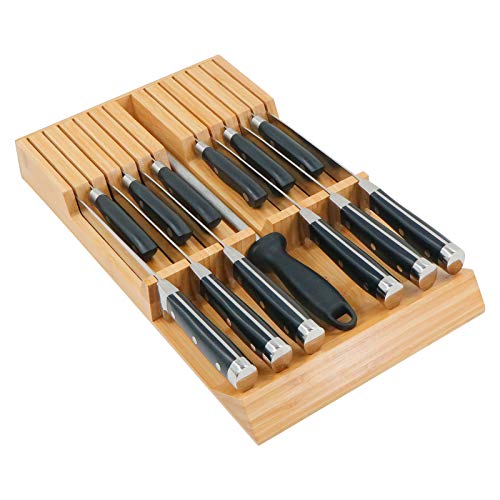
Standard Size:The bamboo kitchen knife organizer has 16 knife slots which can store 16 knives and a knife sharpener. Please measure your kitchen drawer before purchasing. The height of the knife block doesn't include the height of the knife handle, please consider the knife handle on the measurement data
Measure Your Drawers First
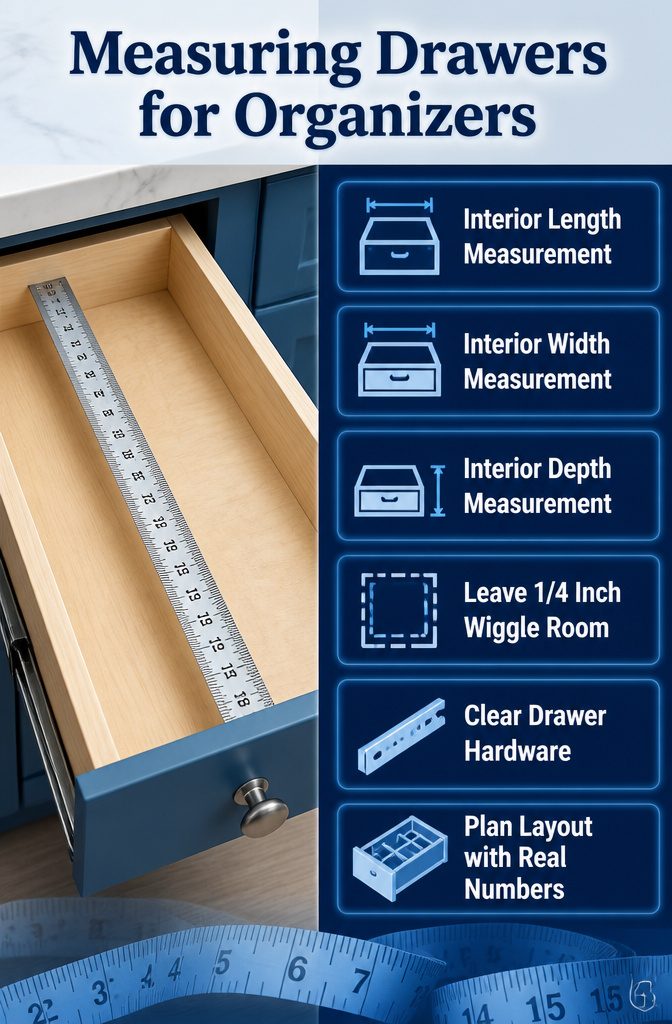
The quarter inch of wiggle room you leave around an organizer matters more than most people think.
A tray that sits flush against every wall of the drawer looks efficient on paper, but installing it becomes a fight, and the friction wears down both the tray edges and the drawer finish over time.
Measure the interior length, width, and depth, then subtract that quarter inch from each dimension before you shop.
Depth trips people up most often. The organizer has to clear the drawer’s own hardware, the slide rails or the corner brackets that hold the front panel square.
A tray that is perfect in length and width still fails if it sits too tall and the drawer cannot close.
I have watched people in store aisles with a measuring tape in one hand and a phone calculator in the other, and that is the right move.
Plan the layout right there, with the real numbers in front of you, because the container that looked right on the shelf often steals space you cannot afford to give away.

5-SLOT KNIFE HOLDER: Easily fits in most kitchen drawers to offer a practical solution for storing and organizing kitchen knives, keeping them easy to view and access
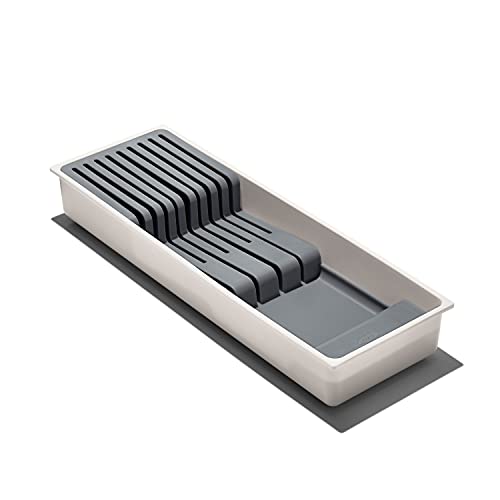
Safely and neatly store knives in drawers to save countertop space

FITS MOST STANDARD KITCHEN DRAWERS: Measures 17 x 5.3 x 2 inches and slides flat into most standard kitchen drawers. Measure first, a 17 inch drawer holds 11 knives while a 22 inch drawer fits all 16, and leave room above the 2 inch base for the handles
Group Items by Category

The fastest way to lose time in a drawer is hunting for one thing mixed among dozens of unrelated others. Grouping by category fixes that, though what "category" means shifts hard depending on which room you’re standing in.
In a kitchen utensil drawer, the logic is physical: spatulas with spatulas, whisks with whisks. In a dresser, it shifts to garment type, t-shirts stacked with t-shirts so you can scan a single layer and know what’s clean.
A bathroom vanity might group by routine, morning skincare in one zone and hair tools in another, or by function if you share the space and need to separate two people’s daily grabs.
The trouble starts with items that belong to more than one group.
Safety pins, spare buttons, needle and thread all fix clothing, so they land together even though a button is not a pin. The test is what task pulls them out, not what they are made of.
If something serves two routines, store it with the one you reach for more often, or duplicate it if the cost is low and the annoyance of crossing rooms is high.

Measure your drawer before order: This organizer is 11″ wide, 14″ long and 2.5" deep. To make sure it coud fit, and to better utilize the limided drawer space, please measure your drawer before order. It is 2.4" deep, gains up to 20% more storage capacity than other 2″ deep organizers. 5 slots for forks, knives, spoons.

6 Drawer Dividers with 12 Inserts: Customize your drawer with our bamboo dividers and inserts; You can organize everything from silverware to utensils. The mini dividers can be easily inserted to make smaller or larger storage parts

PERFECT SIZE OF 17” BY 13”: We highly recommend to measure your drawer before order. 2.5” deep, gains up to 20% more storage capacity than other 2” deep organizers. 5 horizontal slots for forks, knives, spoons, and 2 bigger horizontal slots for bigger kitchen utensils such as spatulas, tongs, ladles and more.
Keep the System Working
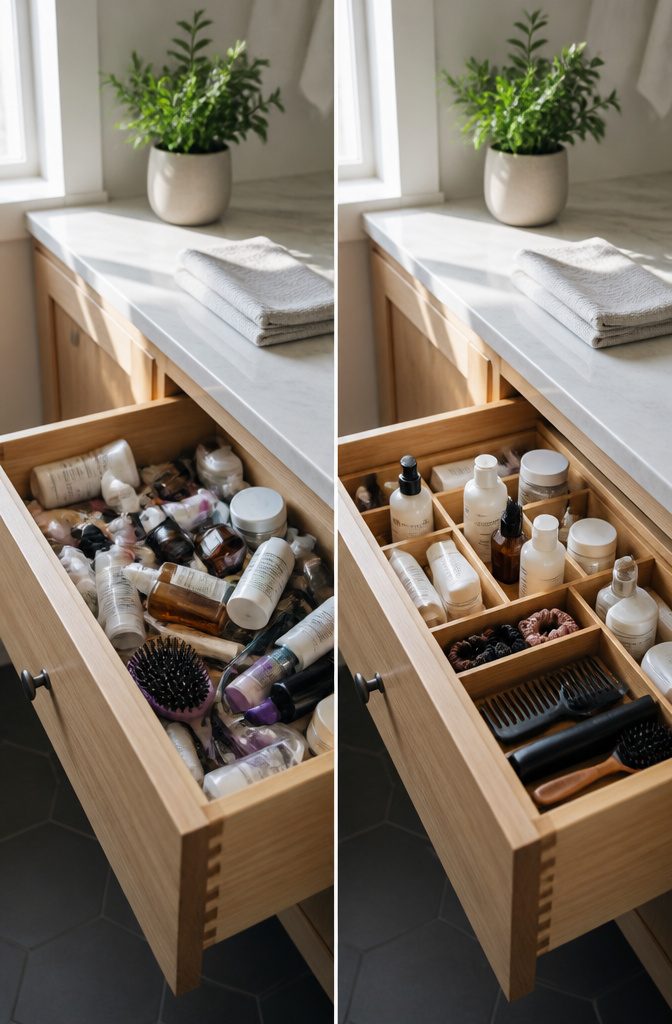
A drawer that looks organized on Sunday can look like a junk drawer by Wednesday if no one checks what goes back in.
Revisit each drawer every three to six months, or sooner if you find yourself shoving things around to close it.
The real signal is friction: a divider that no longer fits what you actually own, or a container sitting half-empty because the category moved somewhere else.
Small habits matter more than big resets.
Put items back in their section every time, not near it. When something new enters the drawer, something old needs to leave or find another home.
I have watched a kitchen utensil tray slide back into chaos simply because I kept the old whisk after buying a better one, and the extra tool warped the whole layout.
A quick purge takes ten minutes once you know the system.
Pull the organizer out, toss anything broken or unused, and check whether the categories still match your routine. Labels help, but only if the label still describes what lives there.
Pick the Right Material
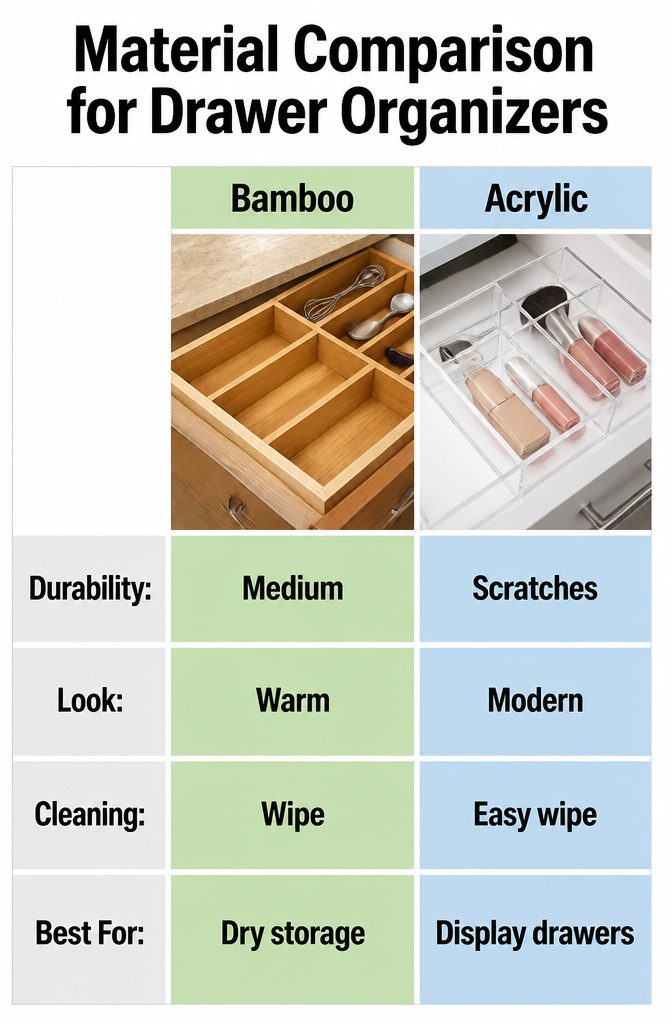
Bamboo organizers look warm in a kitchen drawer but the grain traps oil and crumbs you will not fully wash out.
Acrylic stays clear and wipes clean with a cloth, though it scratches eventually and starts to look cloudy where utensils slide.
Plastic is the cheapest option and holds up fine in a bathroom or closet where moisture and heat stay low, but the thin walls crack under heavier items and the finish dulls faster than the other two.
| Bamboo | Acrylic | Plastic | |
|---|---|---|---|
| Durability | Medium; splits if soaked | Scratches; otherwise solid | Low; cracks under weight |
| Look | Warm, hides dust | Modern, turns cloudy | Basic, dulls quickly |
| Cleaning | Wipe only; no soaking | Easy wipe | Easy wipe |
| Best for | Dry storage, light items | Display drawers, makeup | Temporary or light use |
For a renter building a system to move with, acrylic costs more upfront but survives three apartments. Bamboo works if you are staying put and want the look, though replacing it every few years is part of the math.
Frequently Asked Questions
How do I organize my drawers?
Pull everything out, group similar items together, toss or donate anything broken or unused, then choose organizers that fit each category.
Leave a quarter inch of wiggle room around any tray or divider so it installs without fighting the drawer walls. Check back every three to six months to purge what no longer belongs.
Should you roll or fold clothes in drawers?
Use whichever method you will actually stick with.
Rolling or file folding lets you see every item at once; traditional stacking is faster to do. The consistency matters more than the technique, since a method you abandon leaves the drawer messy in a week.
What is the best way to organize a junk drawer?
Create divisions so every item has a fixed spot, using modular bins, expandable trays, or even a shoebox with the lid torn off for a trial run.
Sort first with what you already own to test the layout; if it holds for a month, rebuild it in sturdier material or keep the free version.