
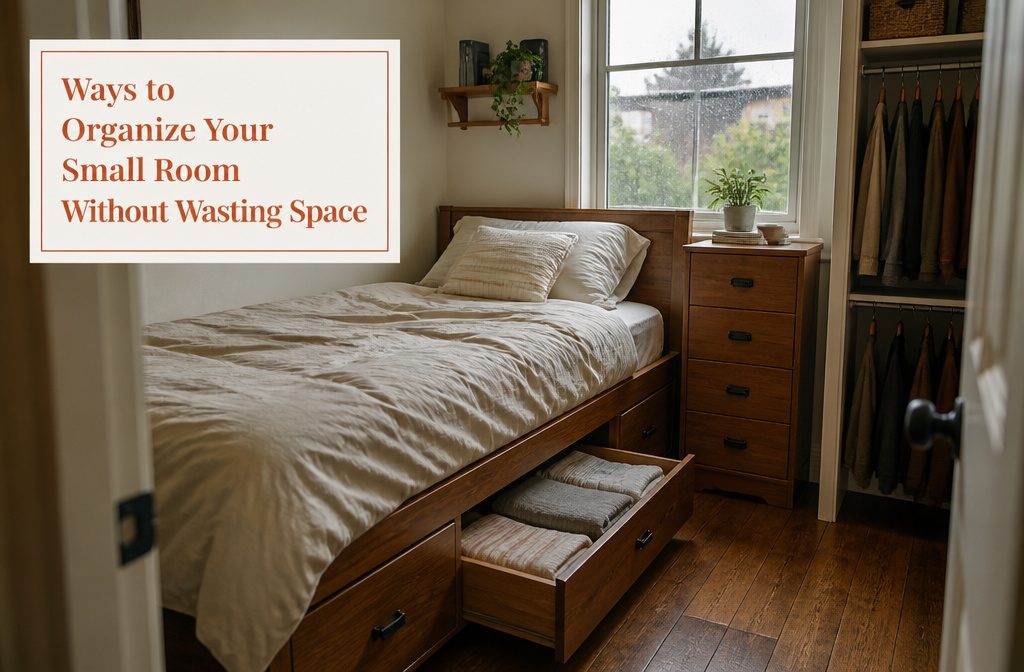
A small bedroom holds more than it looks like it can when you treat the bed, the walls and the closet as storage first and furniture second.
The difference comes down to whether you’re willing to put bins under the mattress, hang a second closet rod below the first one, or swap a nightstand for a small chest of drawers that actually holds something.
A storage bed with built-in drawers opens up as much space as a three-drawer dresser without claiming any additional floor area.
1. Declutter and Limit What Stays

The four-box method sorts through a small bedroom fast: one box for throwing away, one for giving away, one for what you keep in the room, and one for items that belong in storage elsewhere.
I use this whenever a space feels overstuffed, because it forces a decision on every single item instead of shuffling clutter from one corner to another.
Clothing you haven’t worn in twelve months is the first thing to remove.
That rule cuts through the justifications and clears drawer space immediately. If a sweater sat through an entire winter untouched, it won’t suddenly become useful next year.
Small commitments work better than marathon decluttering sessions.
One drawer a week or five items a week into a donation bin keeps the room from creeping back into chaos. The consistency matters more than the pace, and a single cleared drawer shows progress without requiring a whole Saturday.
2. Choose Furniture With Built-In Storage

A storage bed opens up drawer space you wouldn’t have otherwise, and in a room where the closet is already full, that matters.
Platform beds with built-in drawers sit below the mattress and hold folded clothes, shoes, or seasonal bedding without taking up any additional floor area.
If drawers aren’t an option, a simple frame with clearance underneath works just as well—slide bins or boxes into the gap and you’ve turned dead space into usable storage.
A small chest of drawers can replace a nightstand and give you more capacity than a table with a single shelf ever would.
Measure carefully before you commit; the chest needs to fit beside the bed without blocking the door or making the room feel jammed.
If there’s no room for a nightstand at all, the bed itself is still your largest piece of furniture and the most logical place to add storage.
Ottomans and benches do double duty. The Bonlife folding ottoman runs $73.49 and works as a footrest, seat, coffee table, or storage box depending on what the day calls for.
A boucle option at $398 adds texture but costs more than five times as much—worth it if the piece sits in plain view and the room needs that finish, less so if it’s tucked at the foot of the bed.
A storage bench at the end of the bed holds blankets, games, or anything that would otherwise pile up on a chair, and it gives you somewhere to sit when you’re pulling on shoes.
3. Use Vertical Space
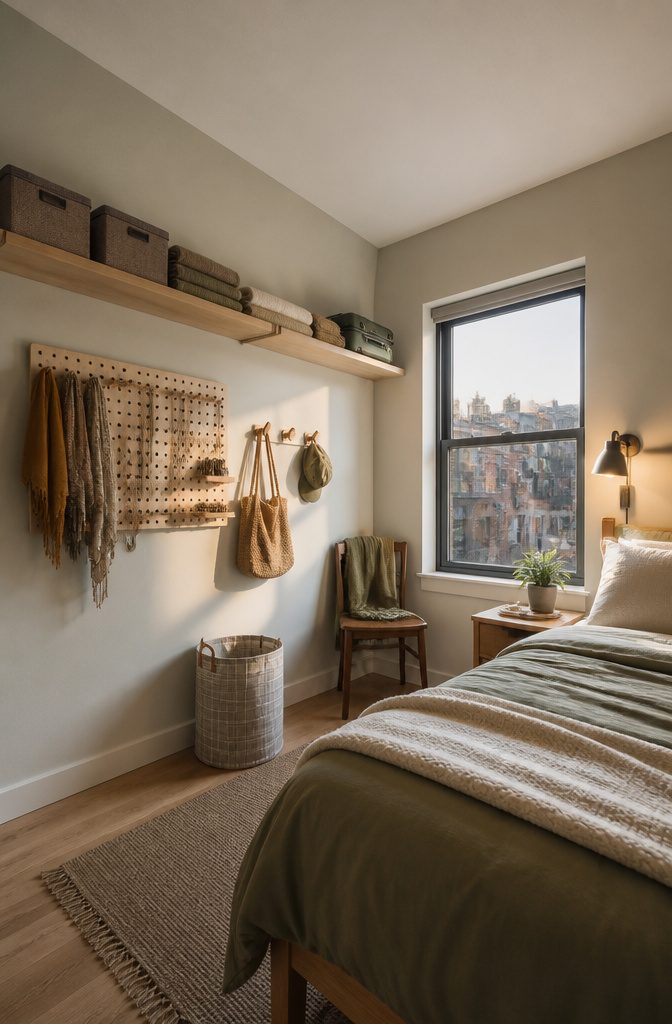
Use Vertical Space
When floor space runs out, the walls still have room.
Shelves, hooks, and pegboards pull storage off the ground and leave the floor open for movement. I usually recommend floating shelves for books, bins, or small items you want at hand but not on a desk or dresser.
Install shelves 1 to 2 feet below the ceiling if you need to stash things you rarely reach for—seasonal clothes, luggage, extra linens—and they’ll stay out of the way without taking up a single inch of usable floor.
Pegboards work well for jewelry, scarves, or anything you’d otherwise toss on a chair.
Hooks on the wall handle bags, hats, or even necklaces that tangle in a drawer. I prefer wall-mounted storage over freestanding units in a small room, because the footprint disappears.
Lighting follows the same rule. Hang lights at least 7 feet above the floor to clear head space, or mount sconces and pendant lights on the wall instead of using table or floor lamps that eat up surface area.
For laundry, ceiling-mounted clothes airers use dead space overhead and collapse when you’re done, which beats a floor rack you have to step around all week.
4. Make Use of Under-Bed Storage
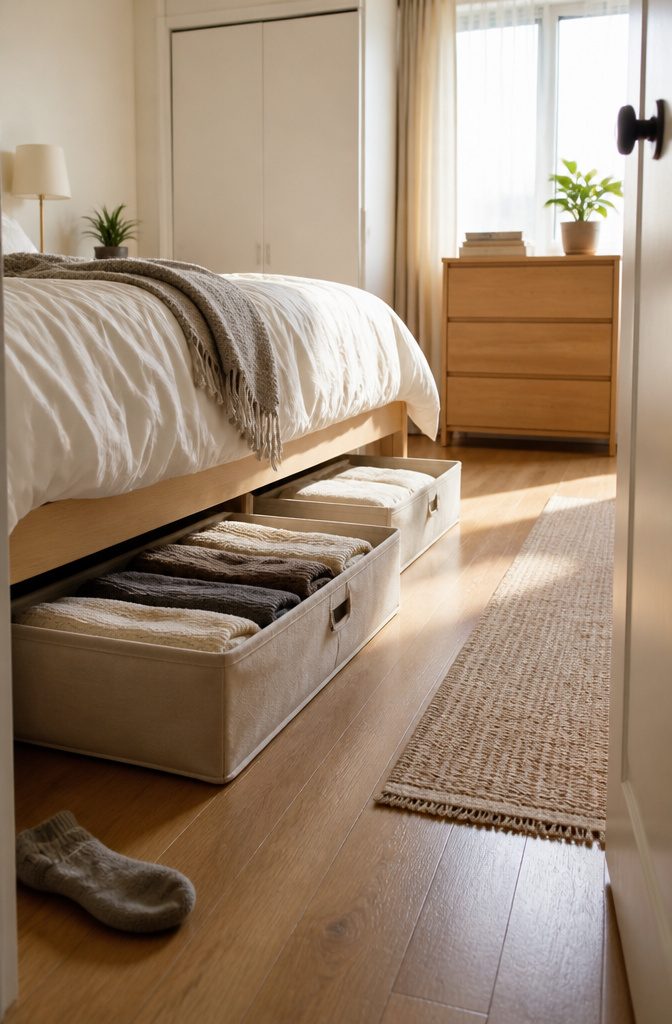
The bed takes up floor area no matter what, and the space beneath it can hold as much as a three-drawer dresser if you put a system there.
Long plastic bins work best because they slide without catching, and wheels make the heavier ones easier to pull when they’re full.
Canvas containers keep things from looking institutional if the bed sits high enough that you can see under it from the doorway.
Store what you won’t reach for more than a few times a year: out-of-season clothes, extra bedding, memorabilia you’re keeping but not displaying.
You get storage that stays out of sight until you need it. If your bed sits too low, risers lift it high enough to fit storage underneath without changing how the mattress feels.
Some bed frames include built-in drawers, which keep everything contained and dust-free, though they cost more up front than bins you buy separately.
Whatever you use, give each container a specific category rather than treating it as overflow for whatever doesn’t fit elsewhere, or it turns into the junk pile you can’t see.
5. Organize the Closet

I start by sorting clothes and accessories into what I wear often, what I don’t, and what can leave the room entirely.
The stuff I keep gets a bin or a designated spot—sweaters stacked on a shelf, underwear in fabric bins, shoes in a hanging organizer.
I’ve found that a stainless steel pants hanger holds up to five pairs without wrinkling them, which clears out a full drawer. For jewelry, an 80-pocket hanging organizer keeps necklaces and earrings visible instead of tangled in a box.
IKEA’s Pluggland hanging storage runs $6.03 and handles socks or small folded items without looking terrible. Give every category a container or a hanger so nothing piles on the floor or on top of the dresser.
If the top shelf is wasted space, plastic bins with lids work for off-season clothes or bags. I don’t leave the closet door open unless the room is very tight and the door swings into walking space.
6. Give Everything a Home

Assigning every item a spot stops the homeless pile on top of the dresser.
When books, chargers, jewelry and papers all land in the same default zone, you end up standing there mid-cleanup trying to figure out where something goes, and that friction is usually enough to just leave it out.
I put similar things together—all charging cables in one drawer, all jewelry in a single box, scarves folded and standing in a basket the way shirts are sometimes filed—so retrieval takes one move instead of three guesses.
The morning routine gets faster when the bracelet lives in the bright box on the shelf and you can walk straight to it.
This takes an afternoon to set up the first time, but once everything has a known address, putting a room back in order becomes automatic instead of a negotiation with yourself about where to stash the remote.
7. Keep Flat Surfaces Clear

The surfaces in a small bedroom collect clutter faster than anywhere else, mostly because anything you reach for every day ends up wherever you set it down last.
The fastest fix is deciding whether what sits on your dresser or nightstand actually belongs there.
If you use it in the morning or right before bed, keep it out. If not, put it somewhere else.
Once you narrow it down, corralling what remains makes the difference between looking tidy and looking cluttered. Small trays or stackable boxes keep phone chargers, hand cream, glasses, and jewelry contained instead of scattered.
I arrange them so each item has its own spot, which means I can find things without hunting and the surface stays clean even when everything is out.
A bare nightstand reads as organized even if the rest of the room has work to do.
When flat surfaces are clear, the whole room feels lighter and less cramped, because your eye isn’t stopping on piles every time you scan the space.
8. Place Furniture to Fit the Room
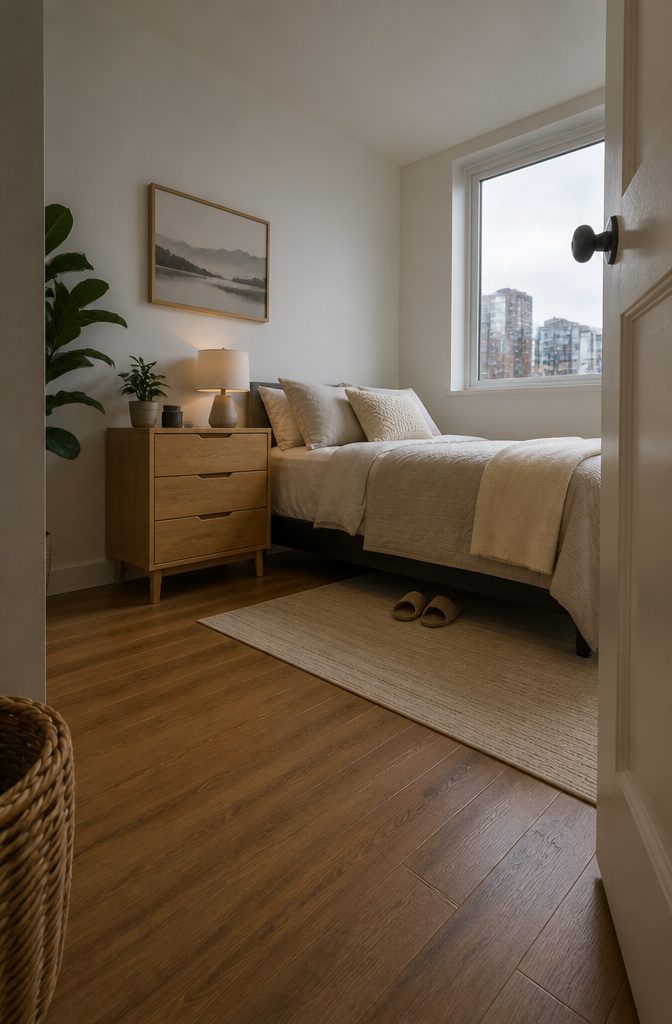
Place Furniture to Fit the Room
The bed goes where it frees up the most usable floor, which usually means placing it along the longest wall rather than centering it in the middle of the room.
If you shift the bed off-center and leave just 1–2 feet between the frame and the wall, you can often fit a small chest of drawers on one side where a nightstand would normally sit.
That chest holds far more than a single-drawer nightstand, and the clothes storage matters more in a small bedroom than symmetry does.
At the foot of the bed, keep at least 3 feet of clearance before the door so you can open it without hitting the frame.
That space also lets you move around the room without feeling trapped. A low dresser at the foot of the bed works when the room is long enough; it replaces a bench and adds storage without blocking circulation.
9. Use Baskets, Boxes, or Bins

Baskets, boxes and bins catch the overflow that otherwise lands on the floor or piles up on furniture.
The setup is simple: group belongings by type, drop them into a container, and slide the container under the bed, into the closet, or onto a high shelf.
I reach for bins when the items don’t need to be visible but still need to stay accessible—throw blankets, seasonal clothes, shoes that don’t fit on a rack, books waiting to be read.
UOMIO kitchen cabinet organizers come in a four-pack for $33.73 and work beyond the kitchen. The stackable steel-and-wood dividers fit just as well in a bedroom cabinet for small accessories or toiletries.
For closet shelves that need doubling without adding a whole unit, OAKNO expandable wardrobe storage runs $23.50 and extends to fit the width of most shelves.
The plastic construction means you keep the load light—folded t-shirts and small linens, not hardcover books or heavy shoes.
10. Add Movable Storage
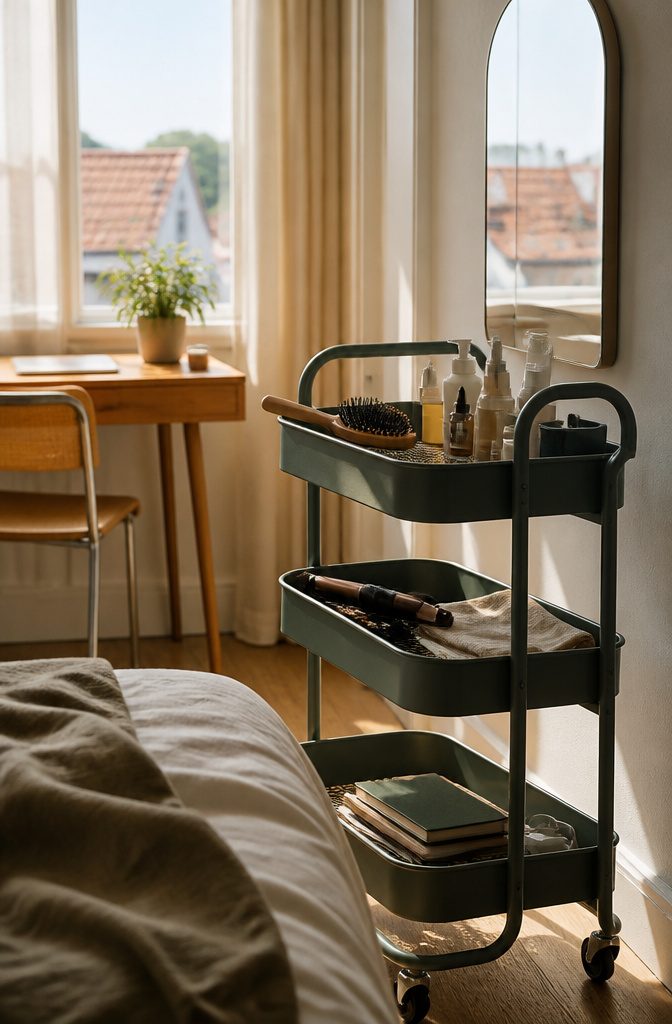
Rolling carts and storage trolleys give you a way to keep what you need within reach without claiming the floor permanently.
In a room where the bed doubles as a desk and the nightstand holds tomorrow’s work clothes, storage that can shift location when the room changes purpose buys back usable square footage.
I find carts work best for things you use daily but don’t need visible all the time.
A three-tier rolling cart can hold makeup, hair tools, and skincare products next to the mirror in the morning, then tuck into the closet or slide under a desk when you’re done.
The mobility matters more in a small room than it would in a larger one, because the same 50 square feet has to accommodate getting ready, sleeping, and whatever else you do there.
A cart also solves the problem of items that belong to different routines but share limited shelf space.
You can load one with charging cables, a lamp, and notebooks for evening work, then roll it aside when you need floor space to stretch or fold laundry.
If you load the cart too heavily or stack awkward shapes on top, it becomes stationary again, which defeats the setup.
11. Make the Bed and Reset Daily
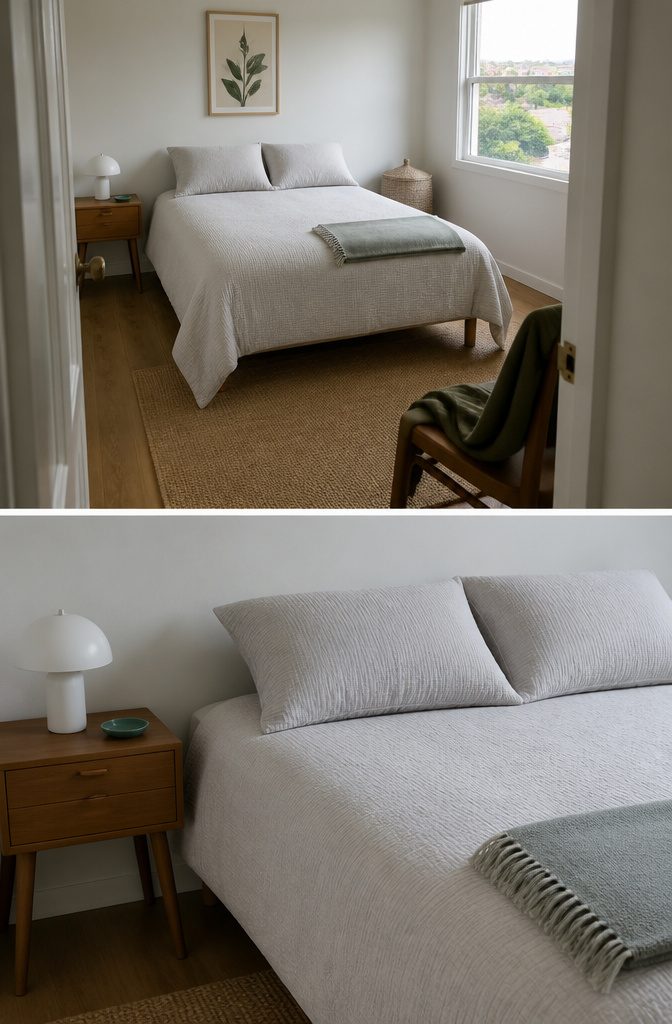
The simplest habit that keeps a small room organized is making the bed as soon as you’re dressed, and it takes about five minutes.
An unmade bed is the fastest way to make even a tidy room look cluttered, and fixing it every morning sets the tone for the rest of the day.
I keep pillow arrangements minimal in small bedrooms because piling on throws and decorative cushions just means more to move and store. If you’re taking them off at night anyway, pare back to what you actually use.
Spending 10 minutes at the end of each day resetting the place for the next day will do the trick. We can reassure you that you’ll be grateful for it the following day.
That ten-minute end-of-day reset is what keeps clutter from piling up faster than you can manage it. Put away anything that migrated during the day: clothes back in the closet, dishes to the kitchen, trash out.
Small spaces show mess faster than large ones, and waiting until the weekend means you’re living in visual noise all week. The reset works because it prevents the accumulation rather than fighting it later.
12. Use Room Zones

I divide the room into a sleep zone, a getting-ready zone, and storage even when those zones sit two feet apart.
The division creates order without needing walls or separate rooms, because each zone gets its own purpose and the things that belong there stay there.
In a small bedroom, zones will overlap—the dresser might sit at the foot of the bed, and makeup storage can double as a nightstand—but the mental map stays clear when similar items live together in bins or baskets that move between zones as needed.
Rolling carts work well here. I use one to hold bathroom items that I keep in the bedroom but move to the bathroom when I need them, and the cart rolls back after.
Clustering furniture around each zone helps define the boundaries without blocking floor space.
A rug under the bed, a different wall color behind the desk, or a small bookshelf between the sleep and work areas all mark where one zone ends and another starts without taking up room a physical divider would.
Add an Extra Closet Rod or Shelf
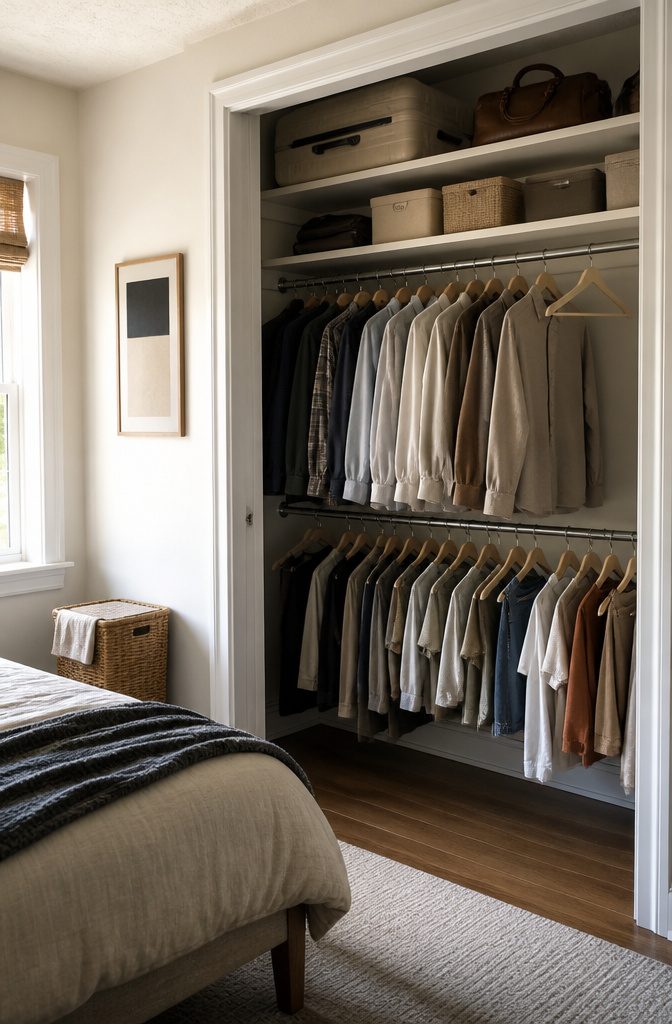
A second hanging rod below the first one doubles the hanging capacity without taking up more floor space in the closet.
If you have a full rod of long-hanging dresses or coats, look at the other side. Shirts, folded pants, and jackets only need about half that vertical clearance, which leaves room to install a second rod underneath.
The setup turns one zone into two and immediately frees up floor space or drawer real estate you were using to stack things that could hang.
The shelf above the main rod is often wasted or piled so high that nothing on it stays reachable.
I treat that shelf as prime real estate for handbags, small suitcases, or bulk household stock like extra paper towels and toilet paper. If you’re storing small items up there, add a second shelf to split the vertical height.
A single tall gap invites clutter. Two shorter shelves force you to keep categories separate and make retrieval much faster.
Use Corners and Dead Space

Corners sit idle in most small rooms because shelves and cabinets feel too bulky for the angle.
Corner shelves fix that without adding visual weight. Open shelving lets light move through the room, which matters more in compact spaces than closed storage ever will.
I’ve seen five-shelf corner units hold books, plants, and everyday gear without crowding the floor, and a floating corner shelf reads as decorative first and functional second, which keeps the room from looking overstuffed.
Dead space shows up along narrow walls, behind doors, and in gaps too small for furniture. Hooks and slim shelves fit those spots without blocking traffic.
A vertical strip beside a window or next to a closet door can hold keys, bags, or scarves on mounted hooks. The difference between wasted inches and working storage often comes down to whether you noticed the gap at all.
Frequently Asked Questions
How do you organize a very small space?
Start with vertical storage like shelves and pegboards to pull items off the floor, then use under-bed bins for seasonal clothes and extra bedding.
Choose furniture with built-in storage, add hooks behind doors for bags and accessories, and use drawer dividers to keep small items separated. Declutter first so you’re only organizing what you actually use.
What are the best storage solutions for small apartments?
Platform beds with built-in drawers, storage ottomans, floating shelves, and over-door organizers give you capacity without claiming floor space.
Vacuum storage bags compress seasonal clothing, and pegboards handle jewelry or accessories that would otherwise pile up. Rolling carts work well for items you need to move between rooms.
How do I make a small bedroom feel bigger and more organized?
Use light colors on walls and bedding, mount the TV instead of using a stand, and keep flat surfaces clear of clutter.
A bed with storage drawers and floating nightstands reduce visual bulk. Mirrors reflect light and add depth, and clearing one surface completely makes the whole room feel lighter.
What should I get rid of when downsizing to a smaller home?
Remove clothing you haven’t worn in 12 months, duplicates of items you only need once, and furniture that won’t fit the new layout.
Seasonal decorations you don’t put out and sentimental items that can be photographed instead of stored also free up space. Keep only what you use or display regularly.
What is the 50% rule for clutter?
The 50% rule means keeping storage spaces only half full so you can see what’s inside and retrieve items without unpacking the entire container.
It prevents the overstuffed bin problem where everything gets jammed in and nothing stays organized. The extra breathing room makes it easier to put things back where they belong.
What are some must-haves for a small bedroom?
A bed with storage underneath, either built-in drawers or clearance for bins, is the single most useful piece.
A small chest of drawers can replace a nightstand and hold more than a table ever would. Floating shelves, wall hooks, and one or two stackable boxes for corralling surface items round out the essentials.