

A moderately cluttered bedroom takes 2 hours to clear if you work drawer by drawer without second-guessing. Heavy clutter pushes the timeline to 3 to 5 hours, and a room with full closets and piled surfaces can stretch across a weekend.
The stage most people get wrong is sorting: they move clutter from one corner to another instead of setting up 4 bins—keep, donate, trash, and store—before they touch anything.
1. Choose One Room or Area and Make a Plan

I start with a drawer. Not the whole dresser, not the closet behind it — one drawer I can finish in twenty minutes and feel the difference.
That single completed space gives me a template for the rest of the room and proof that the work pays off before I commit to the bigger sections.
If the whole room looks overwhelming, breaking it into sections you can finish in one sitting keeps the project from stalling out halfway through.
Some people block off a whole day and work through an entire room in one push. That approach works if the clutter level is moderate and you have five or six uninterrupted hours.
For a heavily cluttered room, plan on separate sessions and tackle one zone at a time: the floor along one wall, then the closet, then surfaces.
Setting a timer for twenty minutes and working through that block without switching to your phone keeps momentum up. I’d rather finish a shelf completely than half-finish three areas and leave all of them unusable.
Before I touch anything, I decide what counts as done.
Do I want every item off the floor, or will I settle for clear pathways and visible carpet? Do I need the closet organized by category, or just functional enough that I can find things without digging?
Writing down that goal — even if it’s one sentence — gives me a line to stop at instead of chasing perfection and burning out before the room is usable.
2. Set Up Keep, Donate, Trash, and Store Bins

Before you start sorting, set out four places: keep, donate, trash, and store.
Bags work fine if you have them. Boxes or bins make it easier to see what you have decided and harder to tip everything over halfway through.
The risk here is obvious: without a place for each decision, you end up moving clutter from one corner to another instead of actually removing it.
Some people prefer three bins instead of four, combining donate and trash into a single "get rid of" category.
That works if you plan to sort donations from garbage later, but I find the four-bin method forces a clearer decision in the moment.
The storage bin is for items you genuinely need but not right now, like seasonal clothes or sentimental pieces.
If you have not used something in over a year, it goes in donate or trash, not storage. Be honest about which pile wins, because storage can become clutter you just moved to a closet.
3. Empty One Section, Clean It, Then Sort Item by Item

I start by pulling everything out of one drawer or one shelf at a time, then I clean the empty space before anything goes back in.
Working section by section instead of the whole room at once keeps the process manageable and you can actually finish a drawer in fifteen minutes.
The decision that matters is whether you used the item in the last six months, except for things with an obvious season attached.
If a sweater sat untouched from April through September, that still counts as worn. If a gadget or accessory hasn’t come out in half a year, it leaves.
Some people stretch that window to a full year before letting go, and in a very small space you might apply a fifty-percent rule to pare down what stays in a single drawer.
I find six months works for most bedroom items without forcing you to toss things you genuinely like.
Once the keepers are sorted, I wipe down the drawer or shelf, add dividers if the space needs them, and return only what passed the test. Then I move to the next section and repeat until the room is done.
4. Remove Unwanted Items From the Room
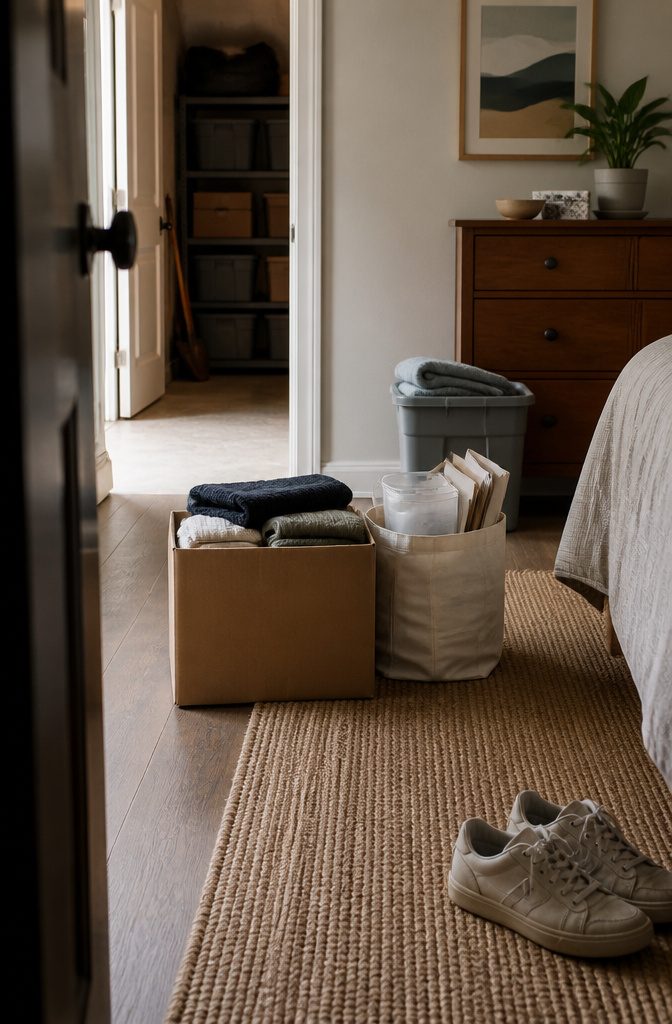
Once you’ve sorted everything, the question is what leaves the house and what gets stored.
Donation and recycling handle most of what you’re letting go, and if you have enough worth selling, a garage sale or online resale can bring in a few dollars while clearing space.
It costs time. I find that donation is faster and the tax deduction often beats what you’d make pricing and shipping individual items, but if you’re sitting on furniture or good-condition electronics, selling makes more sense.
What’s been deemed as non-essential then needs to be removed in one way or another, whether by donating, selling, throwing away or by moving it to where it should be in the home.
One detail that makes a real difference: move donation or sale items outside the home immediately, not into a box that sits in the corner for weeks. Load them in your car or take them to the garage.
Seasonal clothes, sentimental keepsakes, and anything you want but don’t use regularly can go to storage bins, but only if they’re labeled and out of sight. Leaving them stacked in the room just shifts the clutter instead of solving it.
5. Give Each Item a Designated Place
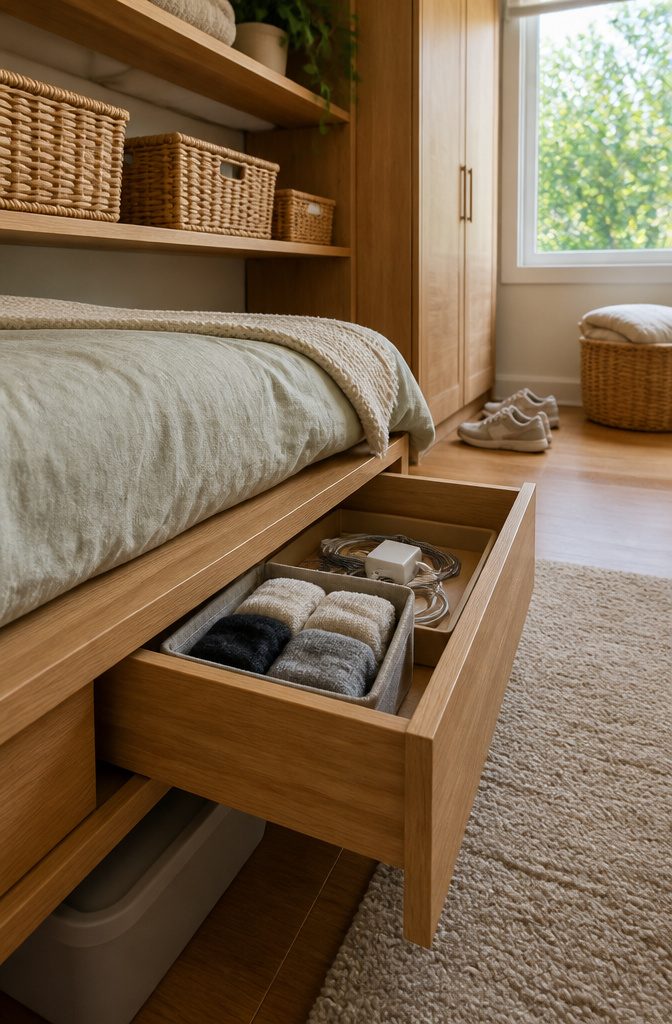
The easiest place for clutter to start up again is when you don’t know where something should go. Group similar items together and give each one a designated spot, whether that’s in a drawer, a basket, or on a shelf.
I usually start with drawers, since those hide the most random accumulation. Pull everything out, sort what stays, then add dividers or small containers so that socks live with socks and charger cables don’t wander into the miscellaneous pile.
You can repurpose gift boxes or shoe boxes if you don’t want to buy anything new.
Once the drawers are settled, measure your shelf space before you buy bins or baskets. I’ve watched plenty of people come home with containers that don’t fit, and the whole system stalls out.
Keep like items together and choose container sizes that actually match what you’re storing. Small things get lost in large bins, so use a mix if you need to.
For the rest of the room, under-bed storage handles what you don’t reach for daily. Out-of-season clothes, extra bedding, and shoes all fit neatly in bins that slide under the frame, freeing up closet space without adding visible bulk.
Lidded containers keep dust out and the whole setup stays hidden. Vertical storage works the same way: shelves, wall hooks, and over-the-door organizers pull things off the floor and keep them accessible without eating into the room itself.
If you have space near the ceiling, use it for items you rarely touch.
6. Clear Floors and Surfaces, Review Furniture

I start by pulling out everything that doesn’t belong in the bedroom—books left over from last week, dishes, laundry that never made it to the hamper.
Once the room holds only what actually lives there, I look at the furniture.
A bedroom crowded wall to wall feels smaller than it is, and sometimes the fix is as simple as pulling out one piece: the extra chair that collects clothes, the side table nobody uses.
I rearrange first, but if the room still feels tight, something leaves.
Flat surfaces come next. I keep fewer than five items on each dresser or nightstand—a lamp, a small dish for jewelry, maybe a framed photo.
More than that and the surface stops looking intentional. The same principle applies to display pieces: a single vase or a family photograph reads cleaner than a cluster of small objects competing for attention.
Fewer, larger items hold a room better than a collection of little ones. Open floor space matters more than most people think.
A bedroom that shows its floor, with enough room to walk freely around the bed, feels organized even when the closet is full. Rooms can look completely different just by clearing a path and leaving the center open.
7. Clean the Room and Return Items After Use

After you’ve sorted and placed everything, wipe down surfaces and sweep or vacuum the floor. Dust and debris settle while you work, and cleaning at this stage makes the organization feel finished rather than half-done.
A quick pass with a microfiber cloth and a vacuum takes ten minutes and keeps the reset from feeling like it only moved the mess around.
Return items to their assigned places after each use. This is the habit that decides whether the work holds or slides back in a week.
Put dirty clothes in the hamper each night instead of draping them over a chair, and set out tomorrow’s outfit at the same time. The two-minute routine prevents the slow pile-up that turns a clean room cluttered again.
A thirty-minute weekly reset keeps the room from turning into a disaster zone.
Use that time to return misplaced items, clear surfaces, and wipe down furniture. Once a month, go through closets, drawers, and storage areas for a deeper purge.
If you haven’t used something in the past few months, consider donating or tossing it. Seasonal changes are a natural time for this: swap out summer clothes for winter ones and remove anything you no longer wear.
Bedroom Items That Can Go

I keep a bedroom chair as a donation staging ground, and that tells you everything you need to know about bedroom chairs: they become clothing piles within days. Here are the items most bedrooms hold onto without needing them.
- Bedroom chairs. If you use it daily for a specific task, keep it. If it holds tomorrow’s outfit or this week’s laundry, remove it.
- TVs. A screen in the bedroom distracts from rest. Move it to a common area or storage.
- Unnecessary furniture. A decorative table, extra nightstand, or bulky piece that serves no active purpose reduces floor space and gives clutter somewhere to land. Use furniture with built-in storage instead.
- Excess accessories. Keep what you use on the nightstand within reach—the current book, a reading light—and clear the rest.
- Broken items. Damaged accessories make the space look worse than empty space does. Replace or discard them immediately.
Why Natural Light and Grouping Keepsakes Helps
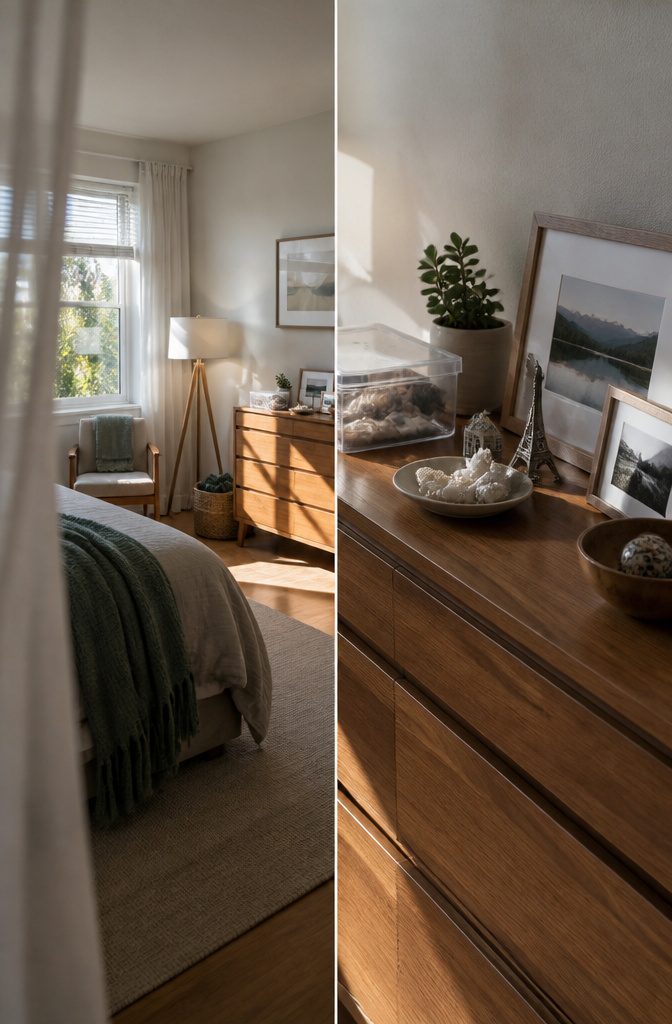
Dark corners pull a room down faster than most people expect. Shadows collect in unmade decisions—the pile behind the chair, the stack that never found a shelf—and suddenly the whole space reads as cluttered even when it isn’t.
Natural light solves half of this on its own: open the blinds during the day, and things that looked like mess an hour ago turn out to be manageable.
If the room faces north or the windows are small, I add table lamps or a floor lamp in the corner that stays dim all afternoon. The brighter the room, the less clutter registers as oppressive.
Small keepsakes are the other recurring problem. A few objects on a dresser look fine; twelve look like you lost control of the surface.
I group similar items—all the travel souvenirs together, all the small frames in one spot—or rotate what stays out and box the rest.
An interesting box with a glass lid or a clear jar keeps tiny objects visible without scattering them across three surfaces.
Grouping in odd numbers helps when the display matters, but honestly, most of the time putting half of it away does more than any arrangement trick.
Matching Storage Containers by Color and Material

Mismatched storage quickly makes a room look messy even when it isn’t. I’ve found that painting thrift-store baskets gives them a cohesive look without replacing anything.
Mix a whitish or gray paint with water until it’s thin enough to soak into the weave, then brush it on rattan, wicker, water hyacinth, or seagrass baskets and let them dry.
The wash settles into the texture instead of covering it, so the material still shows through but the color unifies the group.
If you’d rather buy new, choose baskets or boxes that share a color family and stick to one or two materials across the room.
A shelf of natural wicker next to a bin of dark wood reads as intentional; the same shelf with plastic, metal, fabric, and wood all competing looks like you grabbed whatever fit.
How Much Time One Room Takes

A bedroom usually takes anywhere from 30 minutes to a full weekend, depending on how cluttered it is.
I’ve seen single drawers clear in five to ten minutes when you’re focused: a nightstand drawer with 19 items removed took five minutes, a lower drawer with 16 items out took ten, and a chest of drawers holding 35 things to remove ran about ten minutes total.
That pace holds when you’re making fast decisions and moving straight through each section.
A moderately cluttered room runs a couple of hours if you work drawer by drawer and don’t stop to second-guess.
Heavy clutter pushes the timeline to three to five hours, and a bedroom with full closets and surfaces piled high can stretch across an afternoon or consume a weekend.
Most rooms finish within a weekend if you set aside uninterrupted time and tackle one zone at a time without backtracking.
Why Decluttering Reduces Stress and Supports Sleep
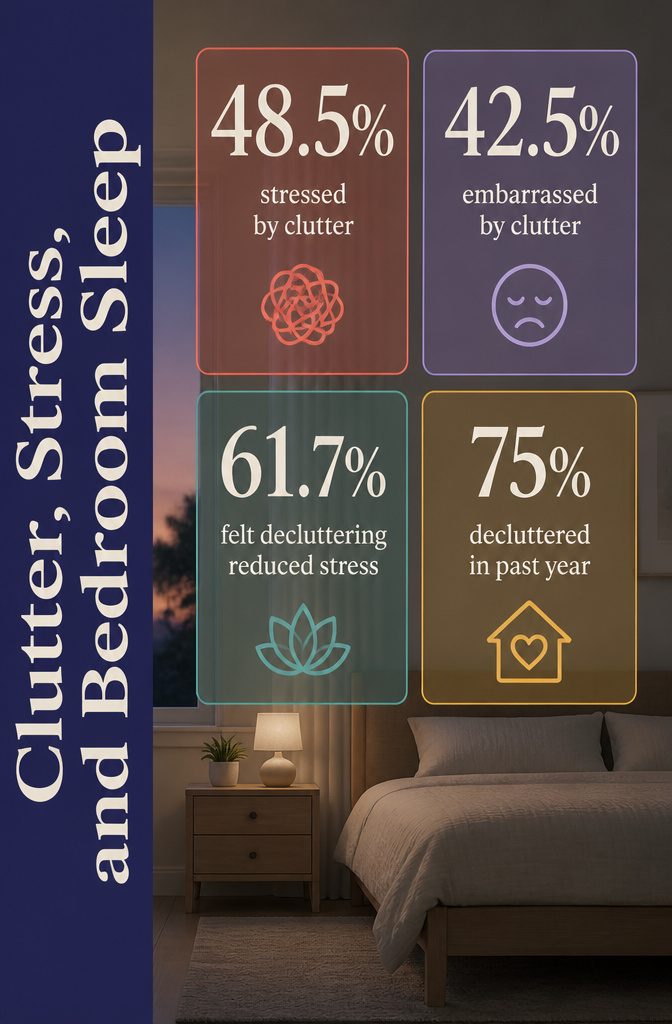
I started reading through decluttering research because I wanted to know whether the idea that a clean room feels calming actually holds up, and the numbers are stronger than I expected.
A 2023 survey found that 48.5% of Americans reported feeling stressed by clutter, and 42.5% said they felt embarrassed by it. The same survey tracked what happened after people cleared a space: 61.7% said the act of decluttering itself reduced their stress.
That lines up with what I see when a room goes from chaotic to organized—the shift in how the space feels is immediate, not gradual.
The bedroom is where this matters most. A tidy bedroom supports better sleep, because your brain registers the visual quiet before you close your eyes.
When surfaces are clear and belongings have places, the room reads as restful rather than demanding. Cleaning takes less time when you are not moving piles to reach the floor, and you get back usable space that clutter was occupying.
Seventy-five percent of Americans completed a decluttering project in the past year, which tells me the need to reclaim a room is common enough that most people have felt it firsthand.
Frequently Asked Questions
What is the 50% rule for clutter?
Empty a small, cluttered space like a drawer or shelf and return only half of what you pulled out, keeping just the essential items.
The rest gets donated, trashed, or relocated to where it actually belongs. This method works best for manageable spaces where decisions come quickly.
How often should you organize a room?
A 30-minute weekly reset keeps clutter from building back up, and a monthly purge handles closets, drawers, and storage areas. Seasonal changes offer natural opportunities to swap out clothes and remove what you no longer use.
How can I make my bedroom clutter-free?
Remove items that don’t belong in the bedroom, clear nightstands and dressers to fewer than 5 items each, and organize clothes into their proper places or a hamper.
Finish by cleaning the floor and surfaces so the space looks and feels complete.
What should you not put in your bedroom?
Bedroom chairs turn into laundry piles within days, TVs distract from rest, and unnecessary furniture reduces floor space while giving clutter somewhere to land. Keep accessories minimal and remove broken items immediately.