

End corner kitchen cabinet ideas range from a $40 weekend pull-out tray to a full custom drawer rebuild that eats a Saturday and your entire budget.
The deciding factor is not how much you spend but how square your existing cabinet box is; older corners often are not, and a rotating carousel or magic corner pull-out will bind or dump its load if the sides lean even slightly.
A 28-inch Lazy Susan tray with two levels outperforms a cramped three-tier stack that scrapes every turn, which is why diameter matters more than shelf count when you are trying to keep the project under a few hundred dollars.
1. Lazy Susan
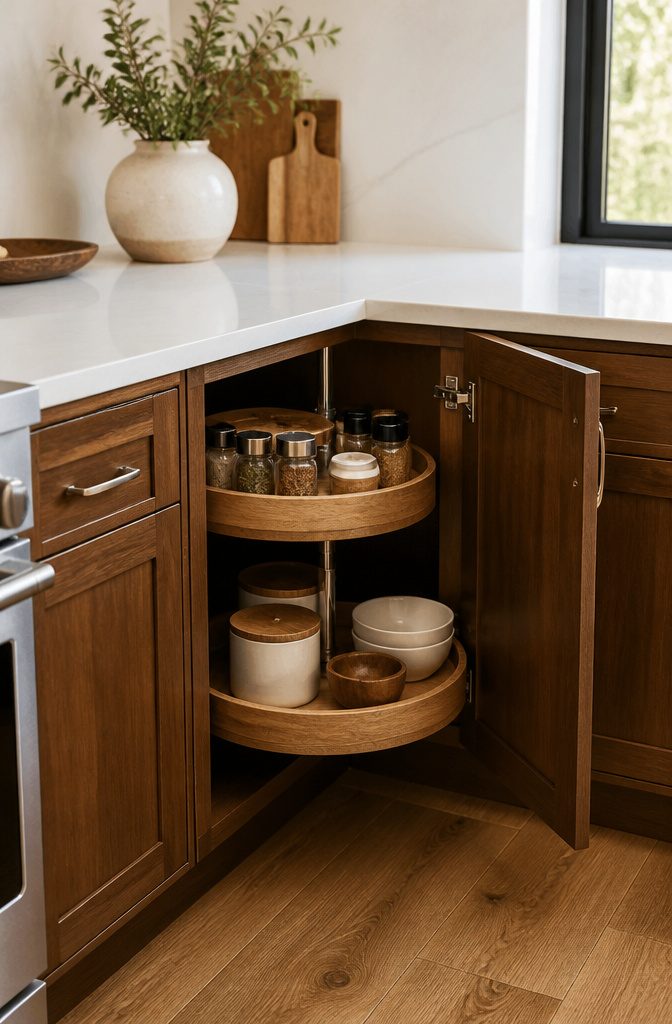
A rotating tray system turns the dead zone of a blind corner base cabinet into storage you can actually use.
The classic Lazy Susan setup spins on a central pole so items at the back come to you instead of you crawling in after them.
Adjustable-tier models work best if you store both tall pots and shorter spice jars, since fixed heights waste vertical space or block the turn.
Full-circle trays fill cabinets with doors on both adjoining walls.
Kidney-shaped designs fit the single-door blind corner where one opening is all you get. The half-moon or pie-cut versions leave space for the door swing and still carry a surprising load.
Small containers and everyday spices ride the top tier where they stay visible. Heavier cookware belongs down low; the physics of a loaded spin feel wrong when weight sits high.
What convinced me, reading through a dozen of these installs, is that the tray diameter matters more than the tier count. A 28-inch shelf with two levels outperforms a cramped three-tier stack that scrapes the walls every turn.
The catch is the center pole. It shrugs off a load of canned goods but fights back if you try to wedge a stand mixer in the corner.
Lazy Susans stay affordable because the hardware is simple. For a few hundred dollars and a free Saturday, the reach problem basically disappears.

Maximize your Kitchen Space: 2-shelf, 28-inch kidney-shaped Lazy Susan for your kitchen cabinets; Great as a Lazy Susan for spices for organizing kitchen goods and other cooking essentials

CUSTOMIZABLE HEIGHT & EXACT FIT: Telescoping shaft adjusts 26-31" vertically. 28" diameter kidney shape. For hinged-door base corner cabinets (not door-mounted). Min 11.5" door opening required.

Size & Compatibility: Organize your space with our Polymer Pie-Cut Two-Tier Lazy Susan for corner base cabinets. This rotating kitchen organizer measures 28"W x 18.25"D x 26"H.
2. Magic Corner Pull-Out
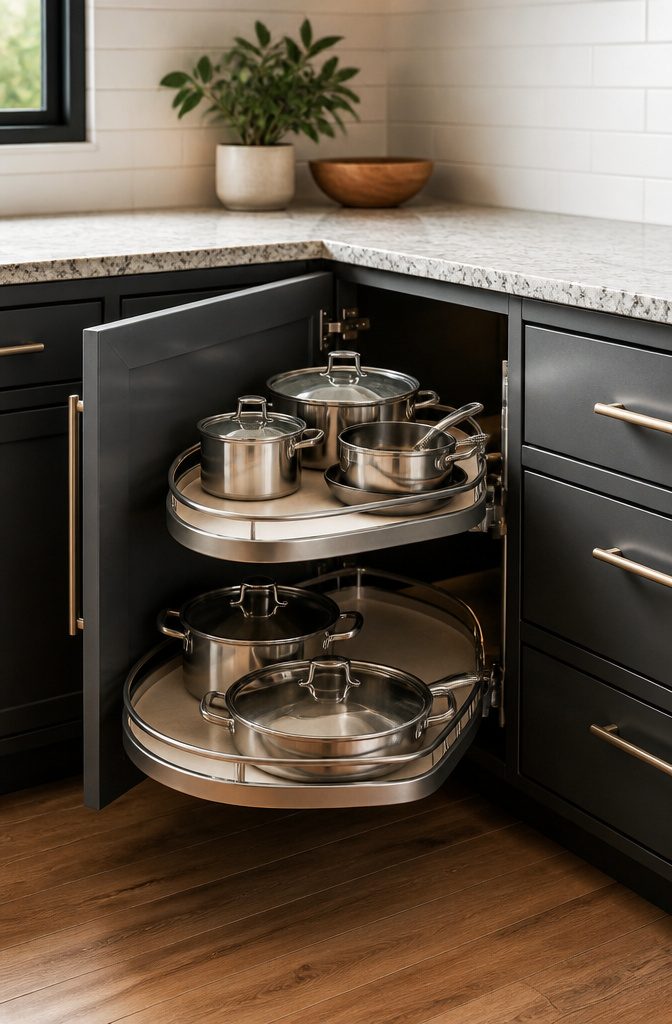
A magic corner pull-out turns dead space into reachable storage by moving the contents to you instead of you reaching into the corner.
The mechanism attaches shelves to the door itself. When you open it, the front trays glide out into the open kitchen space, and the rear trays slide laterally to follow behind.
That motion brings items from deep inside the cabinet into plain sight, which is the main difference from a standard pull-out that only travels in a straight line and leaves the back corner untouched.
The system can utilize up to 80% of the available corner cabinet space, a sharp jump from the usual blind corner where half the volume goes to waste.
I have seen the circular swinging versions too, like the one IKEA sells, and they work for big pots but leave gaps in a rectangular cabinet.
The magic corner’s rectangular trays fit the box shape tighter, and the removable baskets lift out for cleaning at the sink.
The hardware costs more than basic pull-outs, and installation takes precise measuring because the slides must clear the door frame and neighboring cabinets.
For a weekend project with a few hundred dollars, this is the upgrade that makes you stop losing storage to geometry.
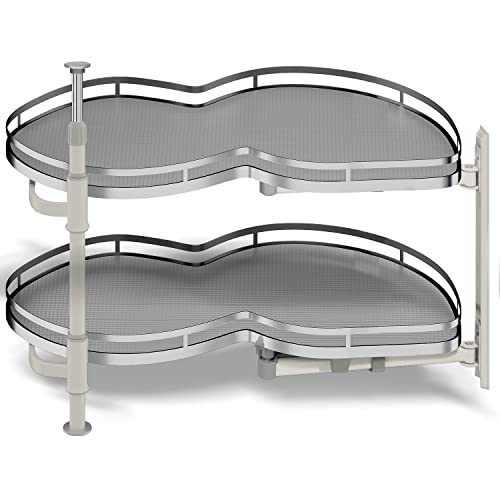
Please measure the cabinet dimensions before purchasing, and choose the appropriate size according to your needs to avoid unnecessary returns. A significant difference between the cabinet and turntable dimensions will result in low space utilization.

Please measure the cabinet dimensions before purchasing, and choose the appropriate size according to your needs to avoid unnecessary returns. A significant difference between the cabinet and turntable dimensions will result in low space utilization.

Cabinet Blind Spot Storage: The kitchen blind cabinet organizer features a clever design that addresses kitchen corner blind spots, transforming hard-to-reach deep spaces into efficient storage areas and preventing wasted space. When your cabinet door opens to the left, choose the right rotation pull-out turntable.
3. Corner Drawers
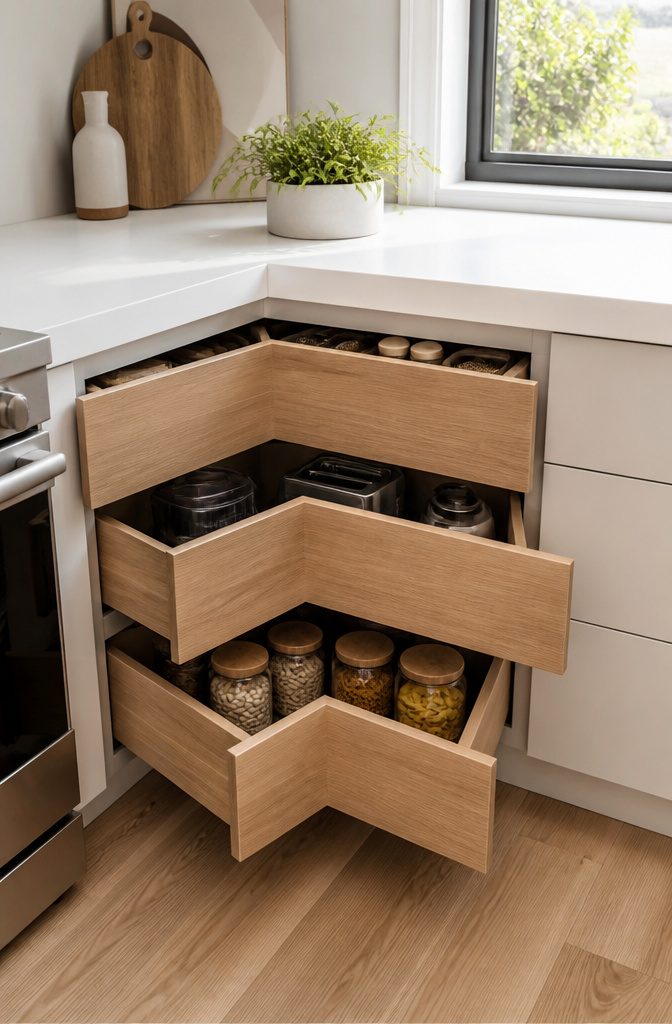
Corner drawers angle out from the corner itself, usually in an L-shape or a diagonal stack that fills the full depth of both walls.
The shape means every inch of that corner becomes usable storage, not just the front wedge you can reach. Pots, small appliances, and bulk dry goods slide out on full-extension hardware instead of getting lost behind a spinning tray.
That efficiency costs more. The drawer boxes need custom angles, specialized slides, and precise fitting to keep the gaps tight and the motion smooth.
A standard Lazy Susan installs into a basic square box; corner drawers replace the whole cabinet carcass. Most kitchens will need a custom shop or a high-end cabinet line that offers the sizing already engineered.
Installation is not a weekend swap. The drawer fronts have to stay perfectly aligned as the weight shifts on those angled slides, and the cabinet itself needs shimming to square because any twist binds the whole stack.
If your existing corner is a standard blind base, the whole unit comes out, not just the door.
For a first-time renovator with a few hundred dollars and Saturday morning free, this is probably a project to price out, then bookmark for the next kitchen.

CONVENIENT CORNER SOLUTION: GWANLUKEJ corner cabinet pull out with swing out shelves – Crafted to maximize tricky blind corners, this solution offers easy access and spares you from fruitless searches

【Full Blind Corner Utilization】 HANKEY blind cabinet organizer transform wasted blind corner space into fully accessible storage. Slide shelves outside of the cabinet making every item easy to reach without stretching or digging

Lazy Susan Organizer Dimensions : 26.1"W x 22.0 "Dx 23.6"H . The minimum installation cabinet size is 40"W x 22"D x 23.6"H and the opening abinet is 18" inches or more. Basket measuring 16.5x11.8x3.5 inch / 420x300x88 mm and 11.8x14.8x3.5 inch accommodating bowls, plates, spices, and jars. Especially large pots and pans are great to put in the blind corner cabinet pull out to fully utilize the corner space
4. Diagonal Corner Cabinets
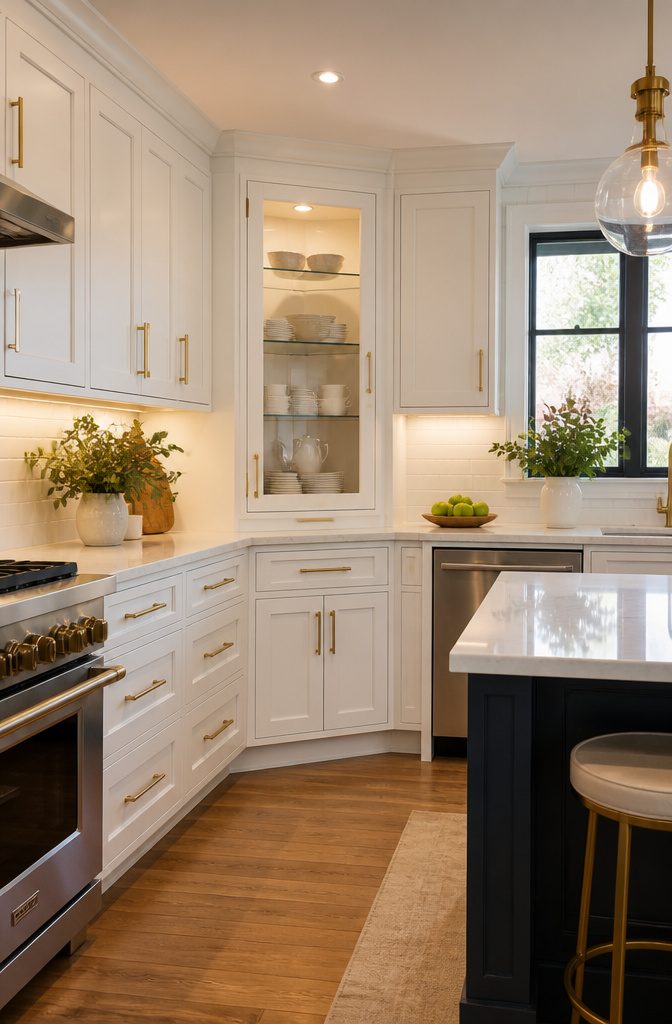
A diagonal corner cabinet sits at a 45° angle to the two walls that meet behind it, so the front face points into the room like a flat edge where two standard cabinets would have left a gap.
That angled face breaks up the long horizontal lines of a typical cabinet run and softens the corner instead of boxing it in.
The visual effect reads as intentional, almost architectural, which is why this style tends to feel more modern than a blind corner or a squared-off box.
The same configuration works for uppers or lowers, and the interior can still take a lazy Susan or pull-out drawers to keep the storage functional.
Without that hardware, the deep corner still turns into dead space, so the angle alone does not solve access; it just changes how the kitchen looks while you solve it.
I would not bother with a diagonal front unless I were already planning the interior fitting, since the cabinet costs more than a standard box and the payoff is entirely in the sight line.
Pair it with a matching tile backsplash if you want the angle to read as part of a cohesive run rather than a one-off accent.

√【Magic of Blind Corner】With this swing pullout organizer, you can fully use the cabinet blind corner space and easily take the stuffs inside, so to maximize the storage of your kitchen cabinet.

🤍 A KEEPSAKE THAT WILL BE LOVED & USED - Classic jewelry armoire is made Extra Special once personalized. A great gift for girls of any age or any occasion - birthdays, graduation, dance recitals, engagements.

Premium Materials & High Load Capacity: Made of premium iron, aluminum and tempered glass with powder coating surface, this Corner Cabinet Organizer is sturdy, wear-resistant and rust-proof. Each basket owns high load capacity up to 33lbs, ensuring stable bearing of heavy kitchen utensils and long-term service life
5. Corner Pantry
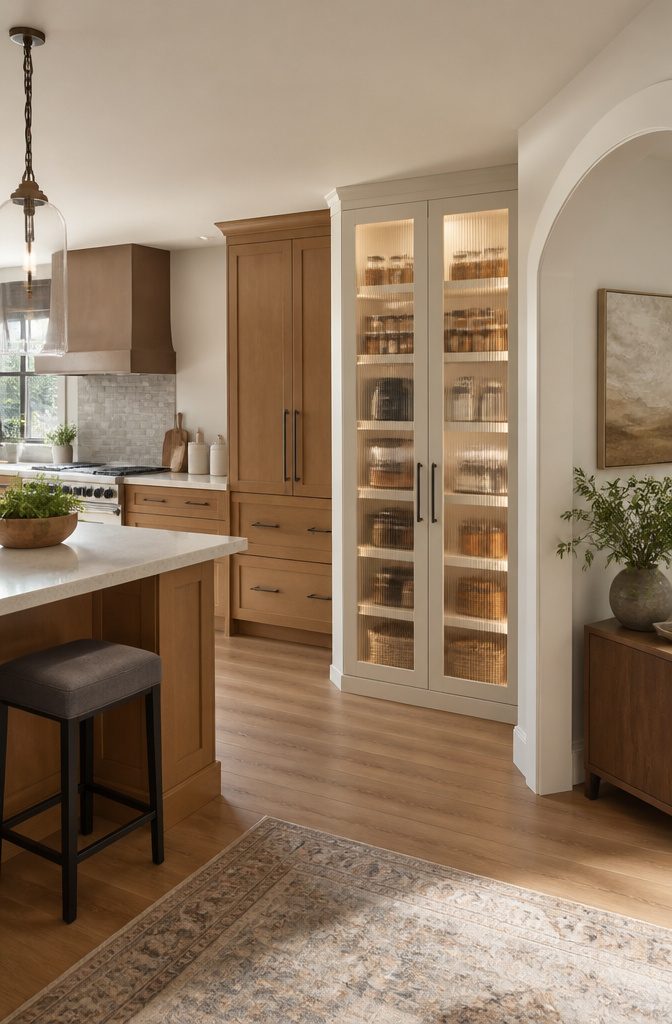
A corner pantry takes the dead space where two walls meet and turns it into vertical storage that actually reaches the ceiling, not just the countertop.
Where a base cabinet only swallows pots and loses half its depth to darkness, a full-height unit stores tall items upright: brooms, mop buckets, the stand mixer you use twice a month but will not part with.
Dry goods organize best here. The sources mention spices, cookbooks, and small appliances as the natural load, and that tracks: these are light enough to lift down from a high shelf and awkward enough to clutter your daily cabinets.
A frosted glass door, if you choose one, keeps the visual noise contained without the dust-collecting openness of bare shelving.
The trade-off is footprint.
This cabinet eats floor space a lazy Susan would share with adjacent counters, so it suits kitchens where wall pantry space is already gone. For renters, it is only viable if you are replacing existing cabinetry, not adding fresh.

material: square lazy susan Use of galvanized steel, which prevents oxidation and rust,and sturdy.

✅ 135° Concealed Hinge for Corner Kitchen Cabinet.

Pie-Cut 2-Shelf Lazy Susans: Effortlessly organize your space with our Polymer Pie-Cut Two-Tier Lazy Susans for Corner Base Cabinets; dimensions: 18" W x 10.58" D x 26" H; weight per shelf: 25 lb.
6. Open Shelving
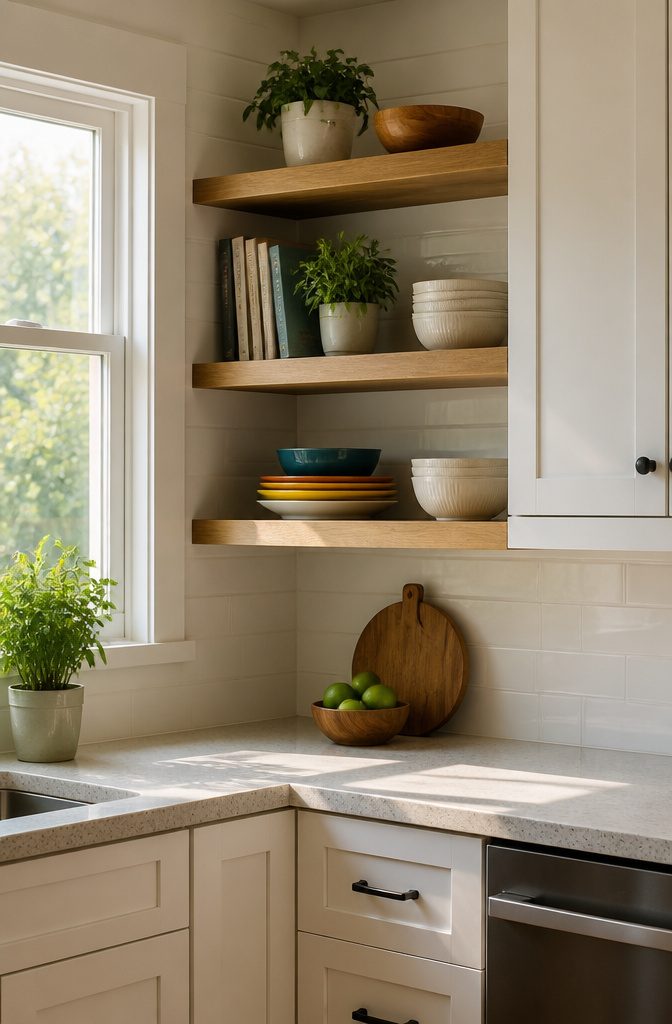
Open shelving in a corner trades the boxed-in feel of standard uppers for something closer to a pantry wall.
Without doors or corner-hinge hardware, the cost drops to lumber and brackets, which matters when the budget is a few hundred dollars rather than a full cabinet order.
The trade is immediate visibility: everything sits out, so the shelf either looks curated or it looks messy, with little middle ground.
What works is a narrow selection. A stack of two or three cookbooks, a small plant, and a set of bowls that share a color read as intentional.
Random mugs, half-empty spice jars, and the mail pile read as clutter the first time you walk in. The corner itself makes this harder, since the back few inches go dark and items pushed there tend to stay there.
A corner open shelf rewards the person who will edit it weekly, not the one who wants to unload groceries and move on.
Dust and grease settle on exposed dishes the way they settle on any flat surface near a stove.
Sources note that open shelving demands more frequent cleaning and organizing than closed storage, and that matches what a renter or weekend project person actually lives with: another surface to wipe, another visual check before guests arrive.
If the kitchen is already tight on storage, losing the enclosed volume of a corner cabinet for a few feet of display shelf may not be the right swap.
The balance some kitchens find is one open corner shelf among otherwise closed cabinets, getting the airiness without giving up every hidden spot.

Three Size Options: One for 26" diameter corner lazy Susan, one for 28", and the other for 32". Please make sure you measure the diameter of your lazy susan first and then CHOOSE THE RIGHT SIZE bins. More Quantity Options: Four bins create a semicircle, Six bins create 3/4 circle, Eight bins create a circle.

Pie-Cut 2-Shelf Lazy Susans: Effortlessly organize your space with our Polymer Pie-Cut Two-Tier Lazy Susans for Corner Base Cabinets; dimensions: 28" W x 18" D x 26" H; weight per shelf: 68 lb.

Easy Access to Kitchen Items: Easily access pots, pans, dishes, kitchen gadgets, and food with this wooden, 2-tiered 28-inch kidney-shaped Lazy Susan spice rack for your kitchen cabinets; Features independently rotating hardware and Maple wood construction with a clear coat finish for durability.
7. Pull-Out Shelves
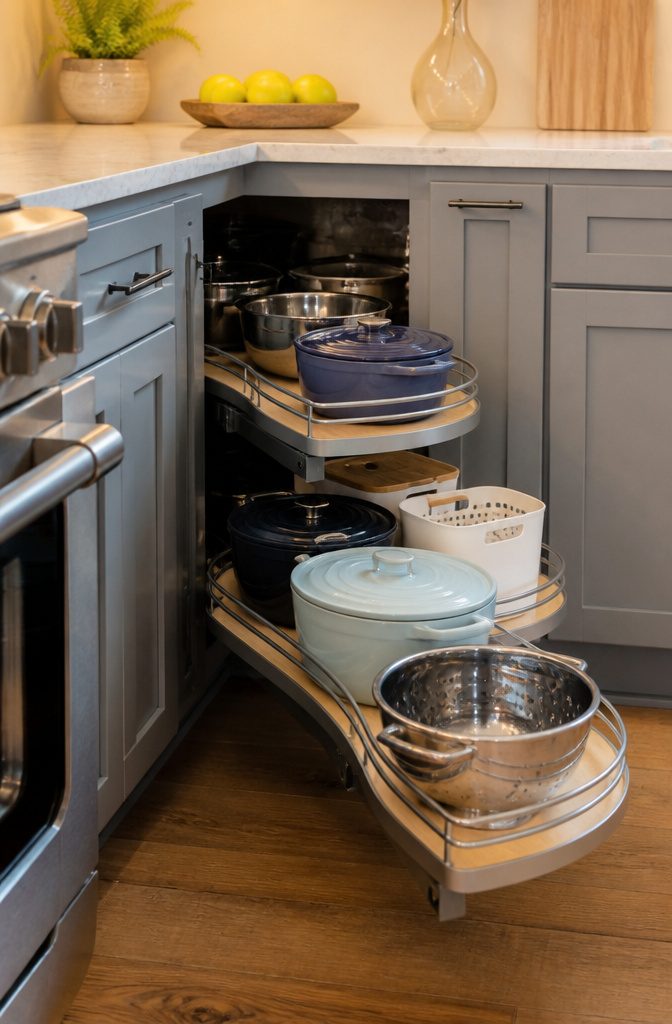
Pull-out shelves turn a blind corner cabinet into something you actually use, not just a cave where lids go to disappear. The rails mount to the cabinet floor and sides, and the whole tray slides forward into the light.
Nothing articulates or pivots; the shelf travels straight out on drawer slides, which is why these cost a fraction of a magic-corner system and why a patient weekend DIYer can handle the install.
Woodcrest and similar makers sell these in varying widths, shapes, and heights, so matching one to your opening means reading the fine print on dimensions rather than eyeballing it.
Multi-tiered versions work well for pots, pans, and small appliances; a single deep tray suits larger items you want in one motion.
The tradeoff sources keep noting is access timing: while a pull-out is extended, the adjacent cabinet door is blocked. For most layouts this proves minor, but in a tight galley it matters.
Material choice shapes both cost and longevity.
Melamine-coated particleboard is the common budget option and holds up fine for everyday dishes. Plywood with a hardwood front faces humidity better if you are storing near the sink.
Metal baskets ventilate well for produce but rattle. Whatever you choose, measure the diagonal of your opening before ordering; a shelf that clears the face frame on paper can still jam on the hinge side in reality.

MAXIMIZE LARGE CORNER STORAGE: This 32-inch kidney-shaped Lazy Susan turns deep, oversized corner cabinets into easily accessible storage. With an expansive 32" tray diameter, it maximizes every inch of space—we recommend at least 34-36 inches of internal cabinet width to ensure smooth, scratch-free rotation. The 2-tier shelves adjust in height to accommodate anything from tall cereal boxes to heavy Dutch ovens (fits interior heights of 22" to 29"). Please measure before ordering.

Please measure the cabinet dimensions before purchasing, and choose the appropriate size according to your needs to avoid unnecessary returns. A significant difference between the cabinet and turntable dimensions will result in low space utilization.

Please measure the cabinet dimensions before purchasing, and choose the appropriate size according to your needs to avoid unnecessary returns. A significant difference between the cabinet and turntable dimensions will result in low space utilization.
8. Corner Sink Cabinet
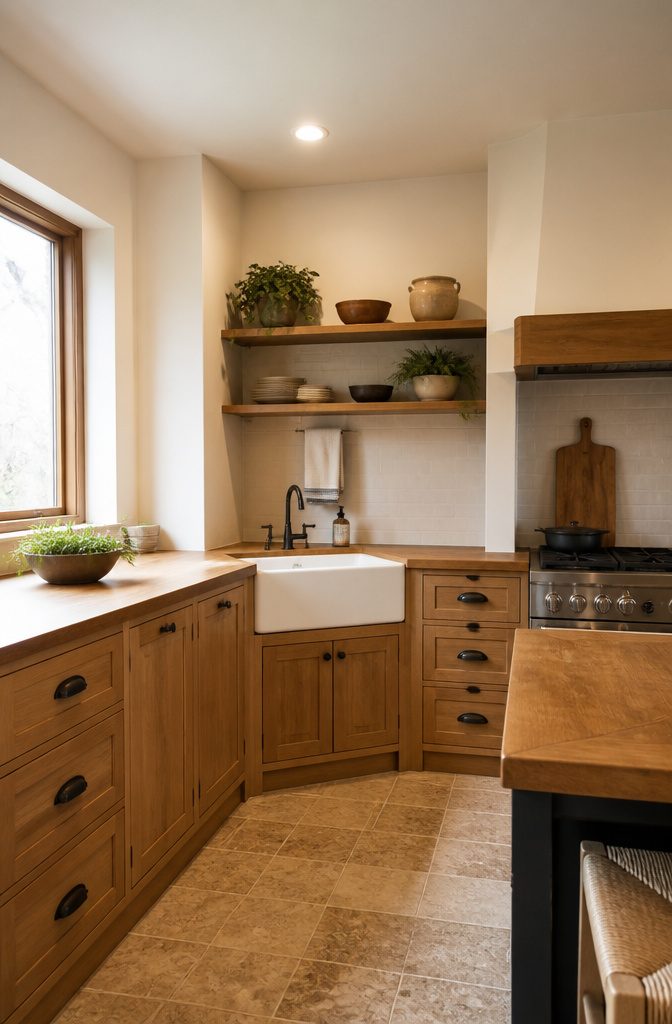
A corner sink cabinet tucks the basin where two runs meet, which frees the straight counter for actual prep work.
The trade is plumbing complexity: the drain and supply lines have to make a 90-degree turn behind the cabinet, and not every existing layout cooperates without extending pipes through adjacent bases.
I have watched enough kitchen timelines slip because this got treated as a swap-in like-for-like.
The ergonomic hit is real.
You stand centered on the corner diagonal, so the sink front sits farther from your body than a standard base. Reaching the back corner of the bowl means leaning, and that strain adds up over a long evening of dishes.
A farmhouse apron front helps some by bringing the basin edge closer, while a standard undermount leaves you stretched across more counter depth than the measurement suggests.
Open shelving above the corner, rather than a full wall cabinet, keeps the zone from feeling boxed in and gives you somewhere to set a hand towel or a soap dispenser without the door-swing conflict you get with upper storage in tight angles.
The look is more deliberate than the lazy susan everybody defaults to, but it asks more of the installation.
If your plumbing stack sits on an outside wall, this idea may fight you; if it rises through the floor near the corner already, the pieces fall into place fast.

√【Magic of Blind Corner】With this swing pullout organizer, you can fully use the cabinet blind corner space and easily take the stuffs inside, so to maximize the storage of your kitchen cabinet.

Magic of Blind Corner Storage- This pull-out organizer fully utilizes your cabinet’s blind corner space, maximizing your kitchen storage capacity. Both baskets can be fully extended for easy access, making it incredibly convenient to retrieve or place items.

Corner Champion: Turn the dreaded blind corner into your favorite cabinet—one 270° swing brings every pot, spice jar and pantry box into daylight, no more lost Tupperware in the back.
9. Appliance Garage
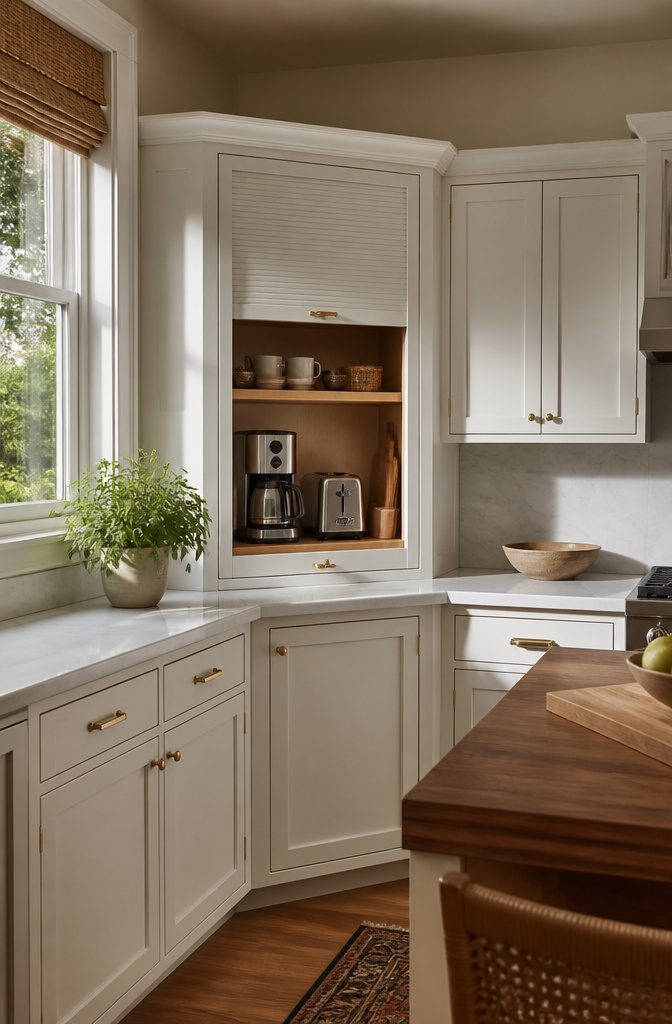
An appliance garage tucked into a corner cabinet keeps the toaster or coffee maker within reach but off the counter.
The corner placement works because the door, whether a tambour slide or a lateral swing, opens into otherwise dead space rather than across your work zone.
A lateral swing mechanism keeps the opening radius tight, which matters in a small kitchen where every inch of floor counts.
What you store here shapes whether the idea sticks. Daily-use items, the coffee maker you run every morning, earn the spot because the routine justifies the door action.
Occasional appliances, the blender for monthly smoothies, tend to migrate back to deep storage once the novelty of the garage wears thin.
The sliding or folding systems, Wingline or Hawa, keep the face clean when closed, but the door type decides how often you will actually use it.
Tambour slides stay out of the way; standard hinged doors in a corner fight you unless the swing is engineered for the tight space.

🖤【High Space Utilization】The right angle design of the product allows this product to be installed in the corner of the cabinet, making full use of the space inside. The four storage baskets provide plenty of places for spices, snacks, drinks, and other items in organize to keep your room tidy and clean.

ENHANCE SPACE UTILIZATION: Blind corner cabinet organizer makes full use of the wasted space in the cabinet corners so that you can easily access all units in the kitchen, making various corners that are easy for us to overlook into our storage places.

Cabinet Blind Spot Storage: The blind corner pull out organizer features a clever design that addresses kitchen corner blind spots, transforming hard-to-reach deep spaces into efficient storage areas and preventing wasted space.
10. Rotating Carousel Cabinet
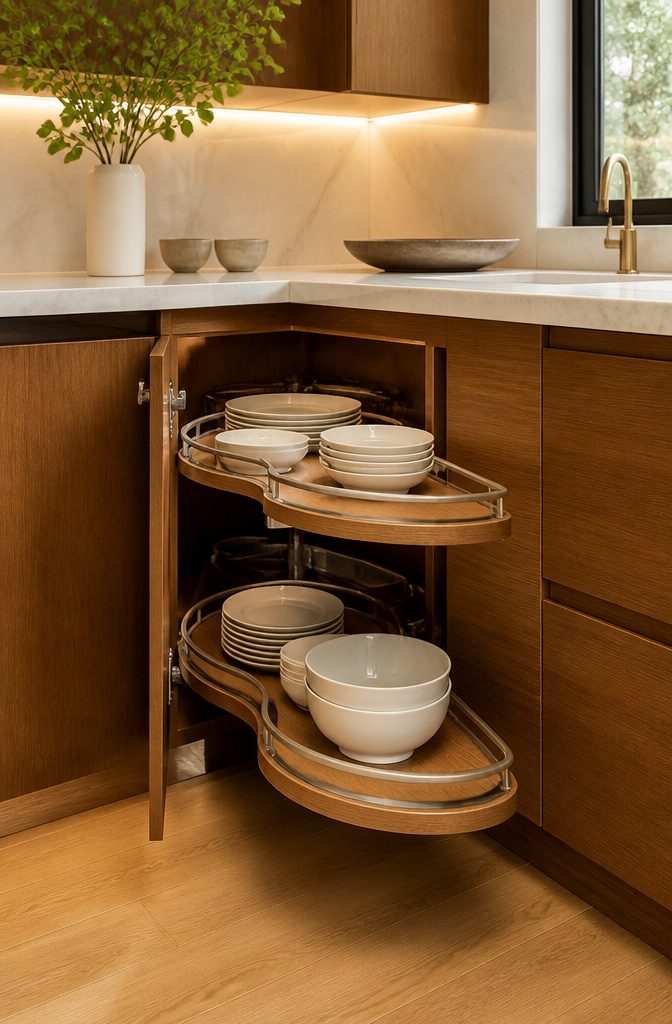
A rotating carousel cabinet differs from a Lazy Susan in one way that matters for loading: the whole unit turns, not just a tray sitting on a fixed post.
The hardware I keep seeing referenced, like Richelieu’s Le Mans II, mounts to the cabinet sides and swings out before rotating, which means you are moving the entire frame plus whatever is stacked on it.
That swing-and-turn motion is where weight becomes the limiting factor.
The Le Mans II lists 25 kg per tray, roughly 55 pounds, and in practice that is enough for a full set of dinner plates or a stack of mixing bowls but not for a loaded cast-iron collection.
The tipping point tends to be height: a tall narrow item on the upper tier catches the cabinet frame when the unit pivots, and if the base is weighted toward the back, the tray can hang up or dump forward during the swing phase.
Lower, wider loads ride better.
For a weekend install, the carousel demands precise side-mount alignment. The cabinet box needs to be square, which older corners often are not.

SMOOTH ROTATION - Enjoy effortless rotation with this lazy susan bearing that spins smoothly and evenly

Size & Capacity: This three-shelf lazy susan measures 18"W x 18"D x 38"H and its telescoping post adjusts up to 46"H. Each shelf holds up to 30 lbs. of kitchen essentials.

(2) Shelf White Polymer Full-Circle set with telescoping shaft
11. Hidden Storage Behind Panels
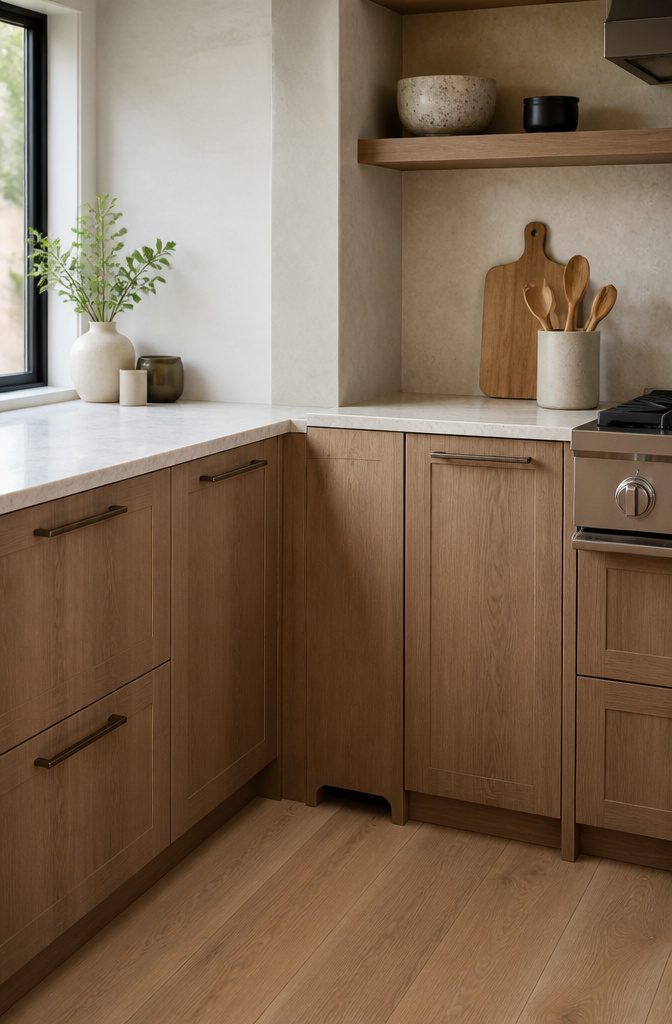
A false drawer front or panel that swings open turns the blank triangle at the end of a cabinet run into hidden storage for cleaning supplies or an emergency kit.
The difference between this and a working drawer is exactly what you sacrifice: a panel has no hardware, no glide, no pull-out shelf.
You reach inside with your arm, same as opening a basic cabinet door, except the door itself is designed to look like nothing at all.
The clean line across the toe kick or the end panel is what you pay for, and the cost is daily convenience.
A tilt-out bin for sponges or a secret pull-out shelf for small valuables would need a real drawer box, real slides, real clearance that a false front does not have.
What you get instead is a compartment that disappears until you need it, which works best for things you grab monthly rather than daily.
What a Blind Corner Actually Is
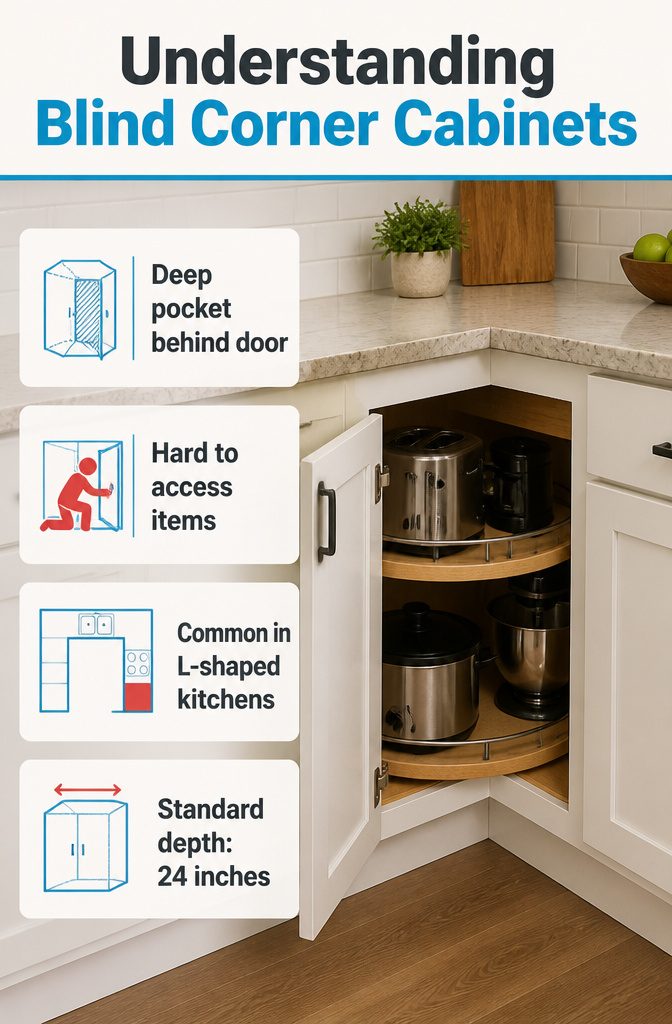
A blind corner cabinet sits where two rows of base cabinets meet at a right angle.
The adjoining row blocks part of the opening, leaving a deep pocket you cannot see into or reach without contorting past the frame and door of the neighboring unit. That shadowed void is what every corner solution tries to solve.
The problem is mechanical, not decorative. Standard cabinet depths run about 24 inches; at a corner, the usable space runs much deeper because the geometry pools it behind a blind wall of wood.
Items slide back there, and retrieving them means fishing on hands and knees or removing everything in front. I have watched friends install beautiful kitchens, then watched those same cabinets swallow half their small appliances within the first month.
The L-shaped or U-shaped layout common in American kitchens almost guarantees at least one of these pockets.
Some builders skip the corner entirely and leave dead space, which trades one problem for another. Most install the blind corner and leave the owner to sort out access later.
Glass Fronts and Finish Choices

Glass-front corner cabinets soften the heaviness that solid doors stack onto a small kitchen. The upper corner is already fighting shadows; swapping that blank panel for glass lets light pass through and gives the eye somewhere to rest.
One way to play it is to keep glass only on the corner cabinet and run solids everywhere else, so the display feels intentional rather than scattered.
Inner cabinet lighting helps, though the wiring adds a half-day to the install and another line on the budget.
The finish on the frame matters as much as the glass itself.
A painted frame reads cleaner in a tight space; stained wood ties back to other wood tones in the room but can turn the corner into a dark hole if the stain runs deep.
I would skip anything with heavy glazing or distressing in a corner; the shadows do that work for free, and busy surfaces just compete.
Open shelving in the same spot achieves a similar airiness without the door cost, though the dusting load shifts to the homeowner.
Renters sometimes prefer glass fronts because the hardware holes are standard and the doors travel with them, whereas open corners need bracket holes patched at move-out. Either way, the corner stops being dead storage and starts reading as designed space.
DIY Upgrades That Actually Work
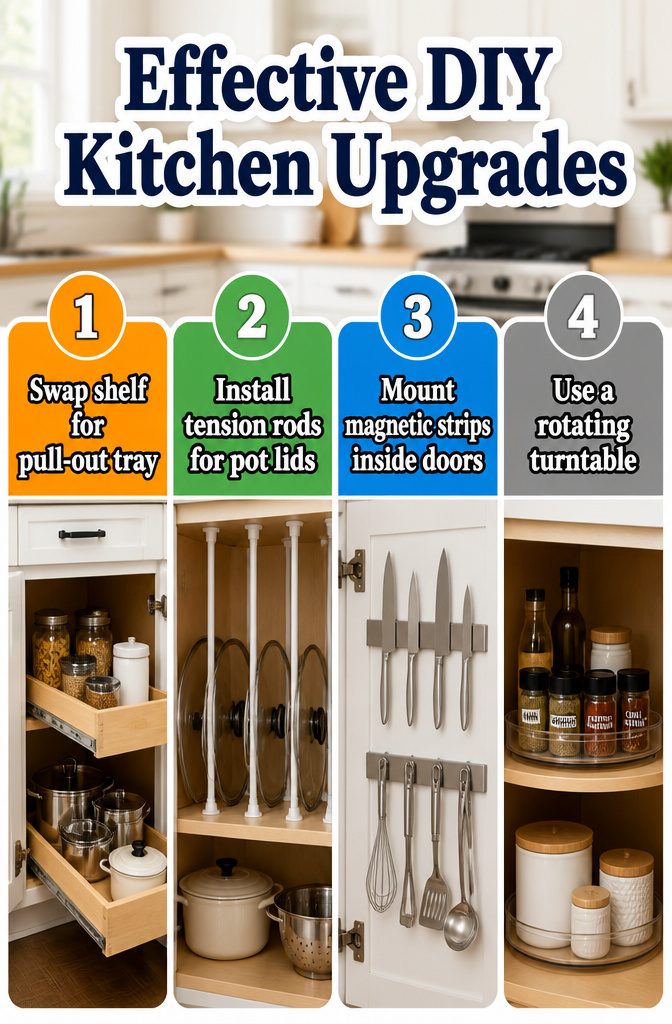
The first real improvement I made in my own kitchen was swapping the fixed shelf in a blind corner for a pull-out tray on full-extension slides.
The hardware cost about forty dollars, took under two hours to install with a drill and a level, and suddenly the back corner was usable.
Sources describe these as slide-out trays or pull-out drawers, and they are typically found in lower cabinets where the depth hides the most space.
Tension rods are another fix that sounds too simple until you try them. Standing two or three rods vertically inside the cabinet creates slots for pot lids that otherwise slide everywhere and block the shelf below.
The rods take five minutes to adjust, cost next to nothing, and come out clean when you move.
For the upper corners, mounting magnetic strips inside the door faces stores metal utensils where the dead space already is.
This frees drawer space without touching the cabinet box, which matters if you are renting and patching screw holes later is not how you want to spend Sunday afternoon.
A rotating turntable on an existing shelf can also serve as a DIY Lazy Susan. The budget stays under thirty dollars, the install is instant, and the access improves enough that you stop avoiding the corner entirely.
Frequently Asked Questions
What is a blind corner cabinet?
A blind corner cabinet sits where two rows of base cabinets meet at a right angle.
The adjoining row blocks part of the opening, leaving a deep pocket you cannot see into or reach without contorting past the neighboring door and frame. That shadowed void is what every corner solution tries to solve.
How can I effectively organize a corner kitchen cabinet?
Pull-out shelves or a Lazy Susan are the most practical fixes. A pull-out tray on full-extension slides costs about forty dollars and installs in under two hours, bringing the back corner into reach.
A rotating turntable on an existing shelf works as a budget Lazy Susan under thirty dollars with no installation time.
Are corner drawers better than a Lazy Susan?
Corner drawers use every inch of the corner as usable storage, but they cost significantly more and require replacing the whole cabinet carcass.
A Lazy Susan stays affordable because the hardware is simple; for a few hundred dollars and a free Saturday, the reach problem basically disappears.
Drawers are the upgrade to price out and bookmark for the next kitchen, not a weekend swap.
What are some creative alternatives to traditional corner cabinets?
Open shelving, a corner sink cabinet, and an appliance garage all trade the standard box for something different. Open shelving drops cost to lumber and brackets but demands weekly editing to avoid clutter.
A corner sink frees straight counter for prep but adds plumbing complexity and ergonomic strain. An appliance garage keeps daily-use items within reach but off the counter, with the door type deciding how often you actually use it.