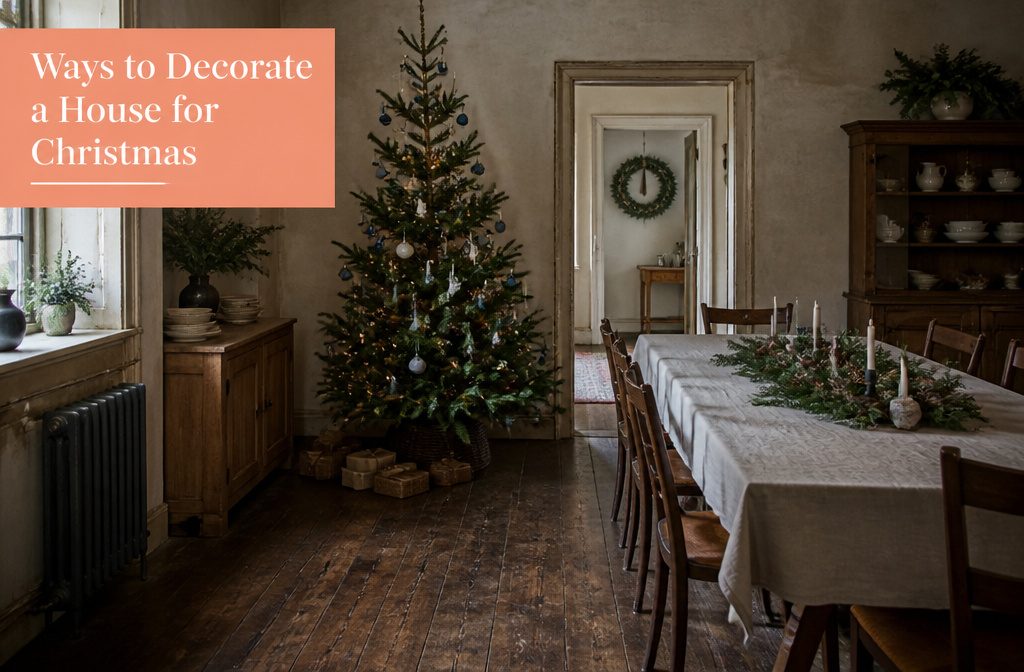
Decorating a house for Christmas scales from a single wreath to a full multi-room scheme, and the deciding factor is whether you want consistency or room-by-room variety.
The difference shows up in whether you anchor the whole house to one palette—blue and white, say, repeated across tree, mantel, and dining table—or let each space carry its own mood.
Lee McNichol and Jose Rivero settled on a 12-foot tree for their converted chapel in Hertfordshire this year, while Susan Burns uses wood ornaments and avoids anything shiny to keep the whole house reading cohesive.
1. Create a cohesive color scheme or theme
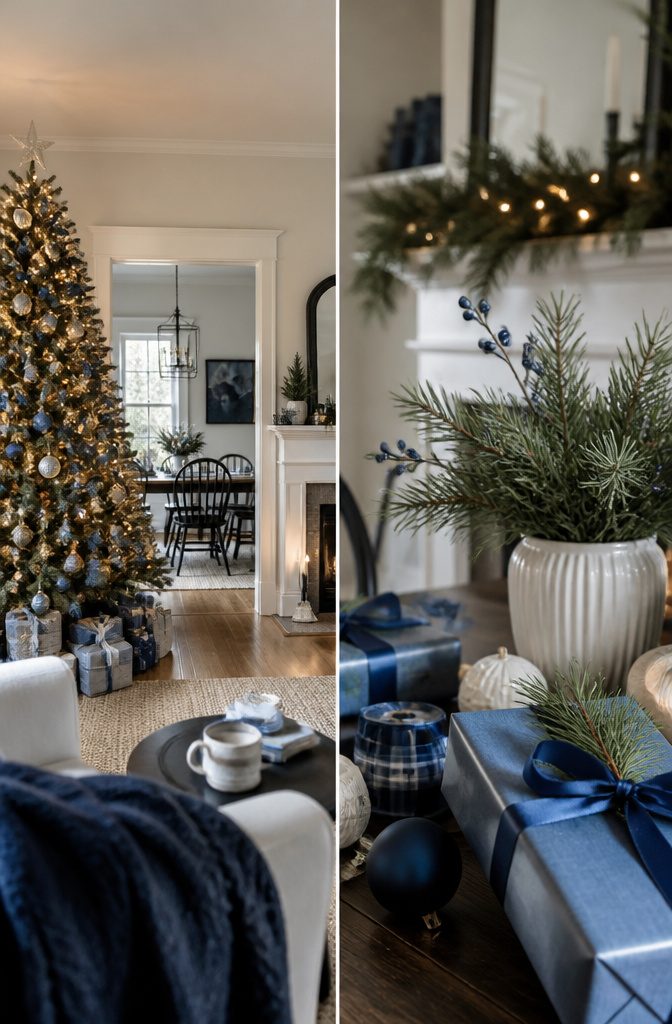
I pick a color anchor first, then repeat it in three places: tree, mantel, and whatever sits on the dining table.
Blue and white across the main rooms makes the house feel intentional instead of like I bought whatever caught my eye that week. The palette doesn’t have to be traditional red and green.
Deep green with aged brass reads grown-up. Neutrals with one accent color keep a small house from feeling busy.
Once the anchor is set, I add a second layer: plaid ribbon if the palette needs pattern, or a single type of greenery like pine branches if I want texture without adding more color.
Wrapped gifts in the same two tones become part of the display on a console or styled into the tablescape itself, which ties the rooms together without requiring new decor in every corner.
2. Decorate the tree with a distinct style

A real tree fills a room with scent and texture that faux versions never quite match, though you’ll spend weeks vacuuming needles off the floor.
Lee McNichol and Jose Rivero buy a real tree every year for that reason alone, and this year they settled on a 12-foot tree for their converted chapel in Hertfordshire.
If a full tree will not fit the space, decorated branches in a tall vase or pitcher work better than trying to cram a small tree into a corner where it looks stingy.
On the faux side, a 9-foot pre-lit white tree offers clean lines without flocking, though white trees in that height are harder to source than you would expect. Pre-lit saves time, and faux trees hold heavier ornaments without drooping.
The palette you choose matters more than the tree type. Blue and white reads sophisticated when you layer porcelain ornaments with velvet ribbon and eucalyptus instead of traditional greenery.
Red, white, and black plaid works with chalkboard ornaments and buffalo check ribbon. Oversized bows tied across branches create shape fast, and staying consistent with one palette lets a colorful tree stand on its own.
3. Make the mantel a focal point
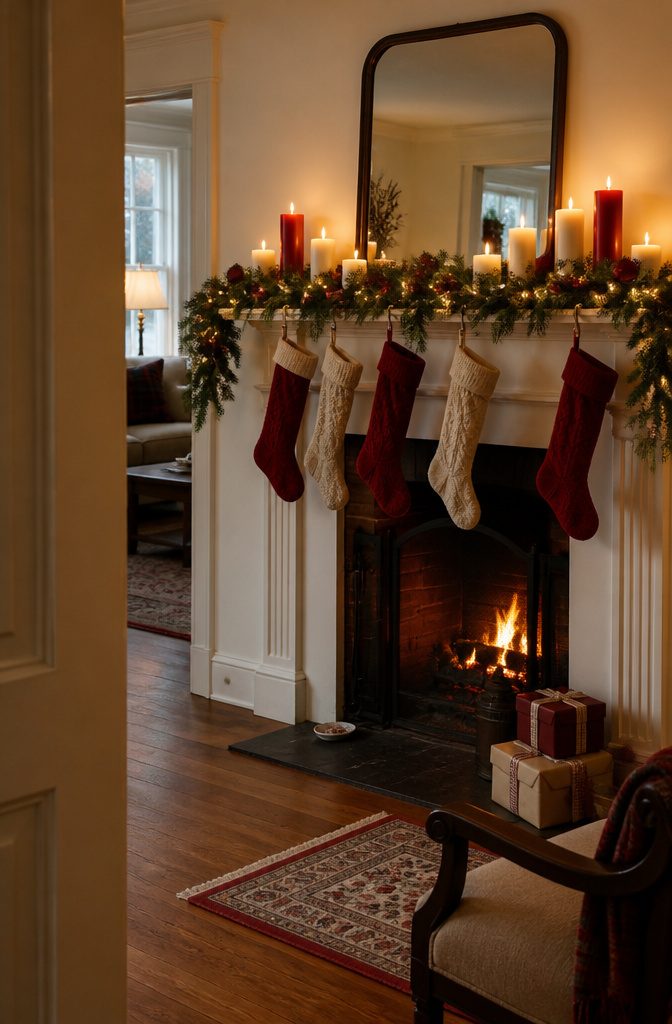
A mantel pairs fresh or faux garland draped along the shelf, white lights woven through, and pillar candles in red or ivory for height variation. That combination alone reads as intentional rather than sparse.
From there, the layering begins: hang stockings from holders in classic red-and-white or plaid patterns, lean a wooden sign with script lettering behind the candles, and tuck ornaments into the greenery where gaps appear.
Wrapped gifts stacked at one end finish the display without needing the tree.
The mistake shows up when everything sits at the same height. Candles lift the eye, garland anchors the horizontal line, and stockings drop below the shelf to pull the composition downward.
A floral arrangement in seasonal tones—deep red, white, burgundy—adds another layer if the mantel runs long enough to hold it without crowding the candles.
In a neutral scheme, swap red for burlap ribbon, eucalyptus mixed with pine, and natural wood accents. The mantel becomes the room’s focal point because it concentrates multiple textures and light sources in one sightline from the doorway.
4. Add garlands to windows, mirrors, mantels, stair rails, or a nook
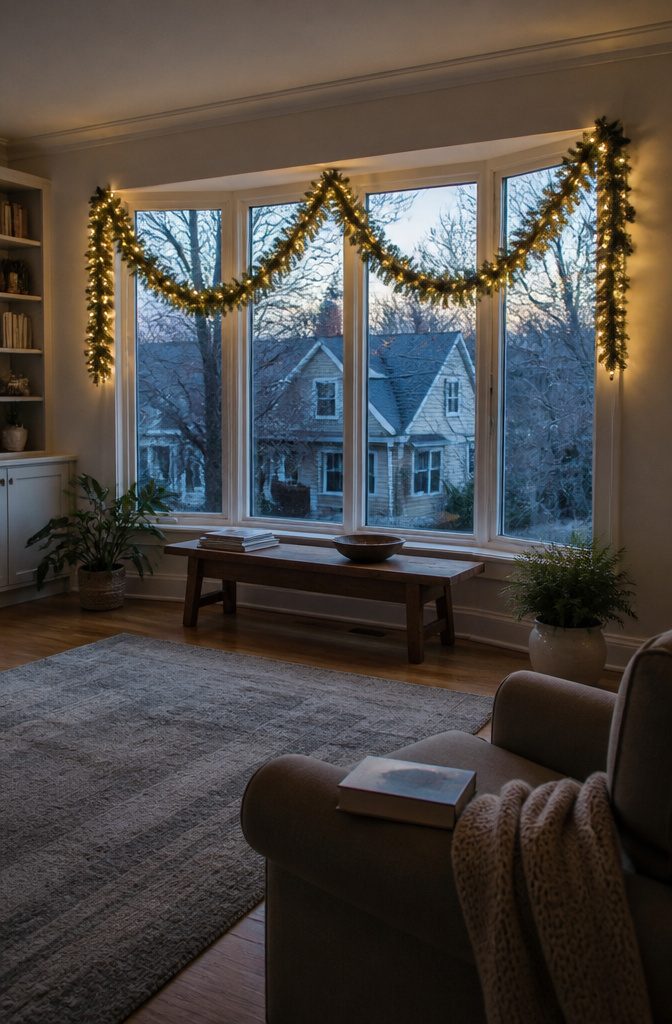
Garlands offer flexibility that single wreaths do not, and you can hang them across spaces that do not take a vertical decoration easily.
Fresh greenery brings scent and texture, but it sheds and dries within a few weeks; faux holds its shape all season and stores flat for the next year.
I lean toward mixing both when the budget allows it, using fresh garland on the mantel where people get close enough to notice the smell, and pre-lit faux garland on windows or high rails where maintenance is harder.
The 9-foot pre-lit garland works well for draping.
Three of them hung in a classic drape frame out a large window or a reading nook, and the length gives you enough slack to let the swag fall naturally without pulling tight at the ends.
Mirrors and mantels take shorter runs, usually just one garland laid across the top edge or looped loosely along the frame. Stair rails need securing every few feet so the garland does not slip when someone brushes past it.
Non-greenery garlands open up other palettes entirely.
Paper garland wraps well around small trees or along bookcases, and burlap or jute ribbon works when the theme leans neutral. I have seen garland made from dried eucalyptus mixed with magnolia leaves, which stays neutral but still reads seasonal.
5. Use wreaths with added detail
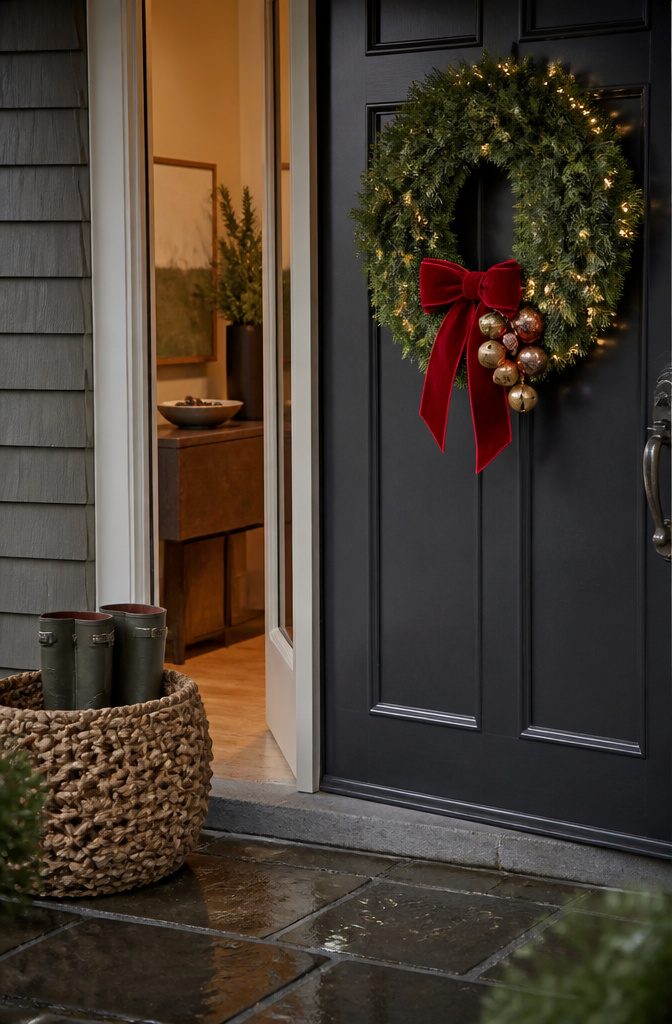
A wreath styled with nothing more than pine reads flat, even when the greenery itself is good quality.
Adding ribbons, bows, bells, or ornaments gives a wreath depth and pulls it into the room’s palette instead of leaving it as a generic disk of green.
The bigger the wreath, the bigger the bow needs to be to hold visual weight. A 4-foot wreath on a picture window, for instance, needs a bow scaled to match or it disappears against the greenery.
Pre-lit wreaths save the work of stringing lights, and a 3-foot version with warm white LEDs works well on a front door or above a mantel where you want glow without adding another outlet task.
If the wreath is not pre-lit, you can loop battery-operated wire lights through the branches before adding the rest of the trim.
Bells and ornaments fill in any gaps where the greenery thins out, and they catch light better than foliage alone.
I usually cluster them near the bow rather than spacing them evenly, which reads more intentional and less like a craft project.
6. Bring greenery into rooms and displays

Fresh or faux greenery adds texture and an organic feel that softer decorations can’t match.
Sprigs of fir, eucalyptus, and moss work especially well because each has a distinct shape, and mixing types in one arrangement gives depth without needing much else.
I layer them into baskets, pile them on shelves, or tuck them around candles on the mantel.
The smell of real pine or cedar signals Christmas immediately, so even a few real branches mixed with faux foliage makes the whole room feel more alive.
Decorated boughs in oversized clear jars work when space is tight or a full tree isn’t an option.
Pine, fir, or spruce branches hold up for weeks, and you can hang a few small ornaments or ribbons from the stems to tie them into the rest of the room’s color scheme.
Vintage wheelbarrows, baskets on the door, and boxes filled with mixed greenery bring the same texture to entryways and porches without taking up floor space.
7. Decorate the dining table with a centerpiece or tablescape
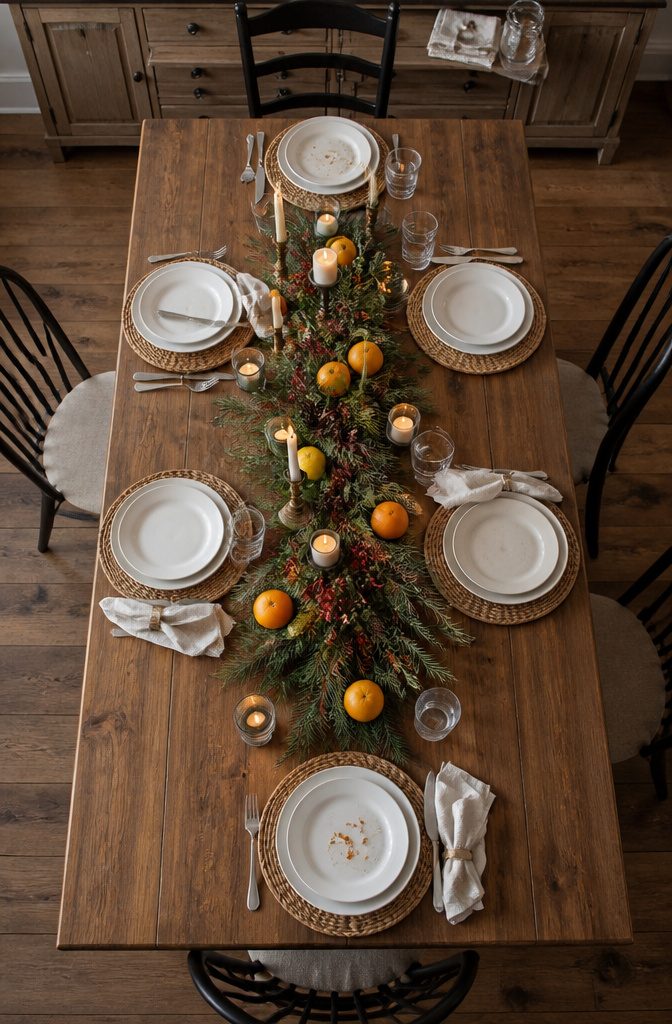
A centerpiece built from candles, greenery, and seasonal fruit holds a dining table without blocking conversation or taking up the space you need when plates come out.
I start with candlesticks and tea lights for height and warmth, then fill in with fresh pine branches, pinecones, and clusters of citrus or cranberries.
The whole thing can be lifted off when it’s time to eat, which matters more than it sounds like it will.
Neutral dinnerware and cream linen napkins let the centerpiece carry the color, and woven chargers add texture without competing.
One approach I keep coming back to pairs whitewashed wood tones with traditional pine branches and red berries, which reads winter without reading predictable.
Another trades glitz for organic materials: wood ornaments on the tree, greenery along the plate rack, and mini cypress trees flanking the table instead of a single sprawling centerpiece.
Candles do two jobs at once. Flickering light is flattering and shifts the mood immediately, but varied heights across the table also build visual interest when every other element sits low.
If you’re working with a favorite artwork or a palette you’ve carried through the rest of the room, pull one or two colors into taper candles and let them tie the tablescape back to the bigger scheme.
8. Add Christmas touches to the kitchen

A bowl of ornaments with battery-powered fairy lights tucked underneath gives the kitchen island something festive without taking up counter space you actually need.
I use a carved wooden bowl when I have one, but ceramic or glass works the same way — the material matters less than keeping it low enough that someone reaching across the island won’t knock it over.
Metallic ornaments catch the light better than matte finishes, and the glow reads warmer than overhead lighting at night.
A tiered tray works better if you keep most of what’s on it functional: mugs, a small pitcher, everyday items the kitchen was already holding.
Add a couple of red ornaments or candy cane straws on one tier, and the whole setup shifts seasonal without looking like you staged it.
The tray moves in one piece, which matters when you need the counter back for actual cooking.
I’ve also seen this done with purely decorative objects arranged like a small village, though that only makes sense if the tray isn’t fighting for space with meal prep.
Small accents among the things already out — a sprig of faux red berries next to the coffee maker, a single ornament leaning against the backsplash — register faster than a centerpiece someone has to work around.
The kitchen sees too much use for anything that makes the room harder to move through.
9. Style shelves, consoles, side tables, or bookcases

Horizontal surfaces offer a natural place to layer small decorations without overloading the room.
I start with a small tree or two as the anchor — felt trees, paper-fold trees, or the miniature pre-lit kind — then build around them with baubles, wrapped books, and holiday cards propped in frames or strung on ribbon.
You want depth, not clutter. On a console, I’ll place a taller tree toward the back, a stack of wrapped books to one side, and a few ornaments scattered near the front edge.
On shelves, I vary the height across levels: a small tree on one shelf, a garland draped on another, a grouping of baubles or a felt star garland on the third.
Cards displayed this way add personal detail and fill vertical space without needing much depth. The whole arrangement should look accumulated, not matched.
10. Add festive touches to the entryway or foyer
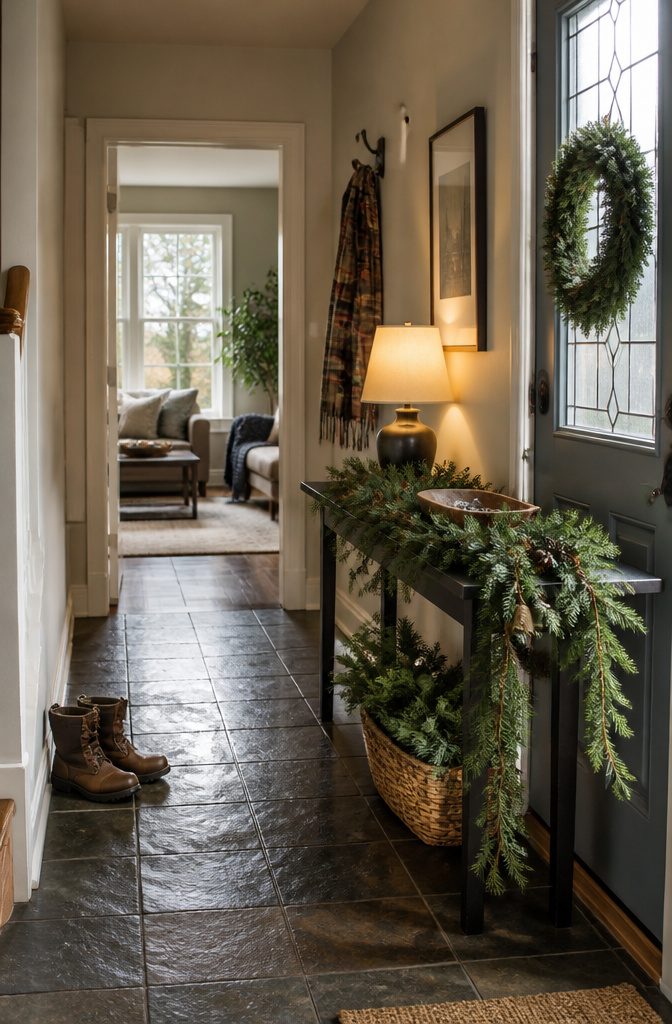
The first thing a guest sees shapes whether the house feels ready for Christmas or just decorated in spots.
I start with fresh greenery at the entrance—a wreath on the door, garland looped along a console, or a vintage wheelbarrow filled with mixed evergreen branches. The scent alone sets the tone before anyone steps inside.
Texture matters as much as greenery itself. I’ve paired fir garland with vintage snowshoes and bells in a foyer that had nothing else seasonal, and the combination read as intentional rather than sparse.
The contrast between soft greenery and weathered metal or wood gives the space depth without clutter.
If the entryway is narrow, greenery still works when you keep it vertical or contained.
A basket of magnolia branches hung on the door, a small arrangement on a narrow table, or command strips holding garland up a staircase all claim space without blocking the path.
You want a clear signal that the holiday starts here, not a traffic jam of decor.
11. Decorate a mudroom or other overlooked room
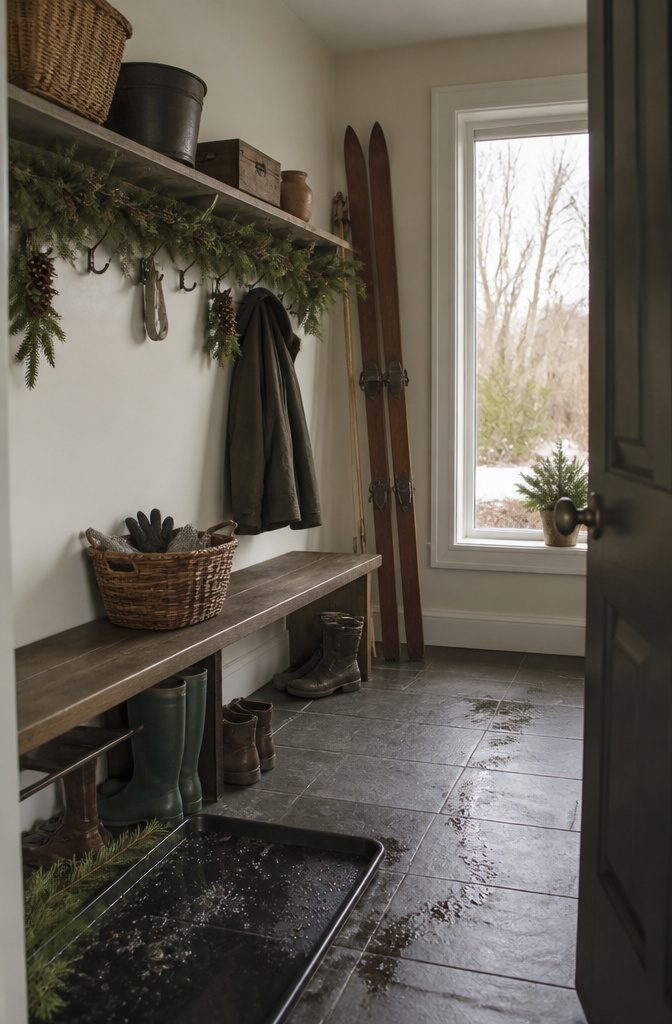
A mudroom sees more traffic in December than almost any other room, and a bit of greenery and natural texture makes those quick drop-offs and pickups feel less like logistics.
The space is small, which means you don’t need much to shift the mood.
A garland looped over hooks or across a shelf does most of the work, especially if it includes pinecones or bare branches mixed in with the evergreen.
I like the look of natural materials here more than shiny ornaments, because they hold up better against coats and boots and don’t feel precious.
If the mudroom has a bench or a basket for gloves, tuck in a few sprigs of fir or a small bundle of cinnamon sticks. The scent is subtle, and the texture reads as intentional rather than decorated.
Vintage wooden skis or snowshoes leaned in a corner add height without taking up floor space, and they fit the rustic direction that works well in a utility room.
12. Bring Christmas into a nook, bedroom, bathroom, or staircase
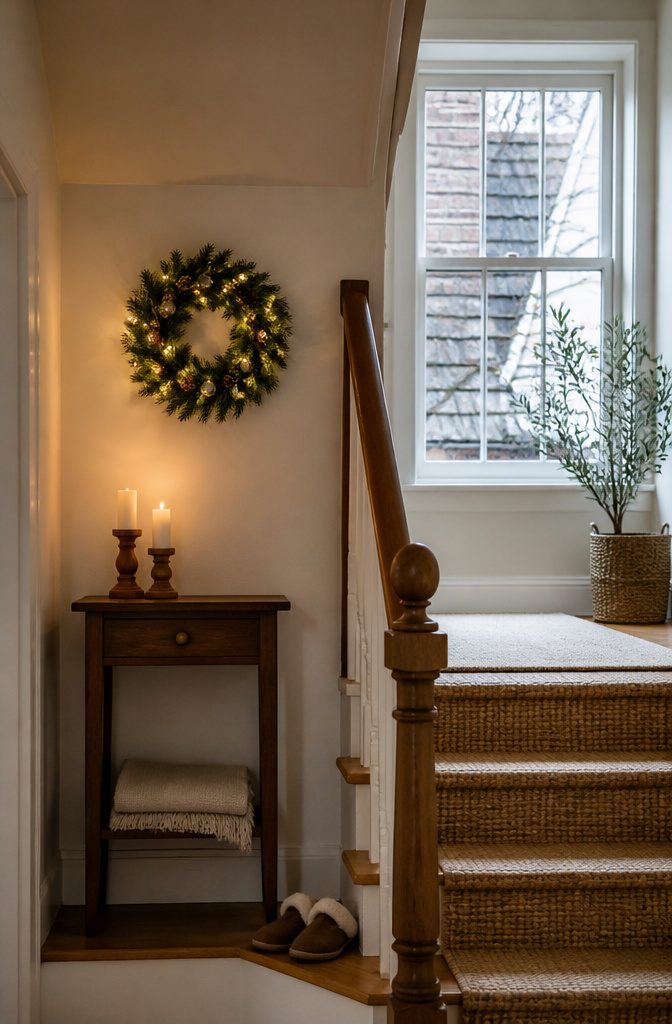
Small spaces deserve Christmas too. A scaled-down version of what you put elsewhere keeps the feeling consistent: if you ran garland along the living room mantel, a shorter strand works on a bathroom mirror or bedroom dresser.
The same accordion paper trees that sit on a dining table look just as good on a console in the hall or a shelf in the kitchen, and they fold flat when January arrives.
Decorations do not need to stay in the main rooms. Hang a small wreath in a bedroom, tuck a pre-lit 3-foot wreath on a landing, or line a staircase rail with greenery.
A nook gets the same treatment as any other surface: a few baubles on a shelf, a small tree on a side table, or a handful of candles in wooden holders.
You’re not duplicating the tree in every corner, just carrying the same warmth through the whole house.
13. Use candles and candleholders to add warm light and height

Candles layered across a mantel or sideboard do two things at once: they fill vertical space where flat surfaces tend to fall short, and they throw the kind of warm, shifting light that overhead fixtures never manage.
I use pillar candles in groups of three or five, varied in height, to break up a horizontal run of garland or picture frames.
Red pillars read immediately as Christmas when you set them against green garland and white candles, but unscented ivory or cream works in rooms where you already have a tree competing for attention.
Candleholders lift tapers high enough to register from across the room, which matters when the dining table or entry console sits lower than eye level.
Brass and wood holders pick up warmth from the flame; glass reflects it and spreads it wider. If the holder itself has detail—turned wood, etched glass, a fluted base—the candle can stay plain.
A slim taper in a dressed-up holder gives you height and light without the visual weight of a thick pillar, and that balance keeps a small space from feeling crowded.
14. Use textiles to add color, pattern, and texture
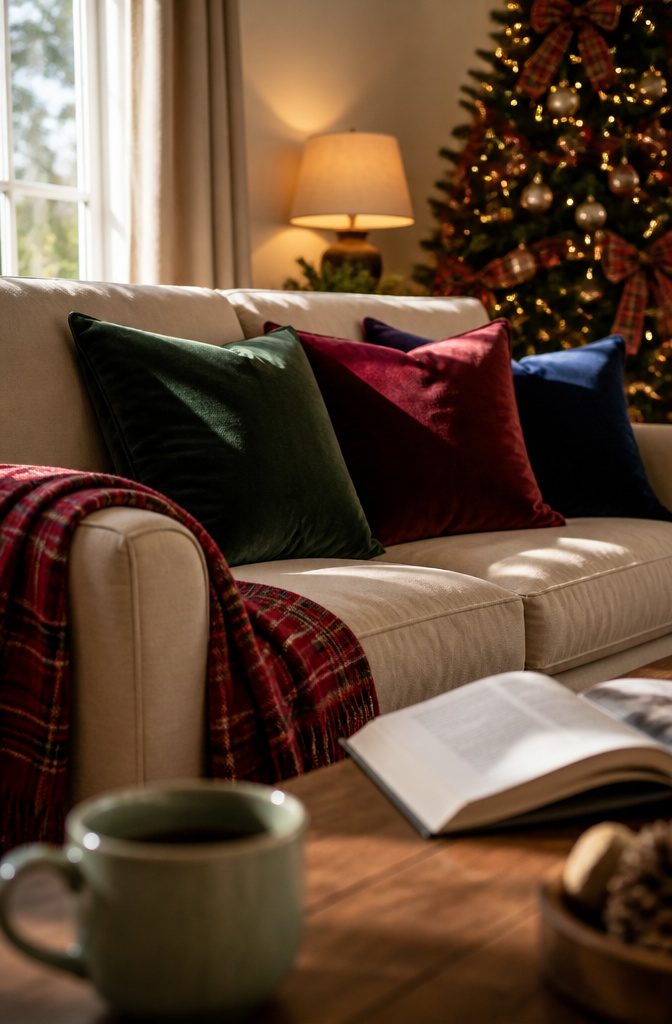
Fabric shifts the whole mood faster than any other single change.
Velvet pillows in jewel tones bring depth and softness to a sofa that otherwise reads flat, and cut velvet in particular catches light in a way that plain cotton never will.
I reach for pillows first because they sit at eye level and cost less than reupholstering anything permanent.
A red checkered throw folded over the arm of a chair or the foot of a bed adds pattern without committing to a full slipcover, and plaid works year-round if the palette stays neutral with a single accent color.
Ribbon carries a theme across the room when you use it consistently. A wide plaid ribbon on the tree, tied into bows on wreaths, and folded into napkin rings creates repetition that feels intentional rather than scattered.
The same ribbon on wrapped gifts stacked under the tree or displayed on a console extends the pattern into functional decor.
For the dining table, a plaid runner or napkins in the same color family pull the palette through without adding clutter, and fabric chargers cut from plaid material give each place setting weight that paper plates lack.
15. Display gifts as decor
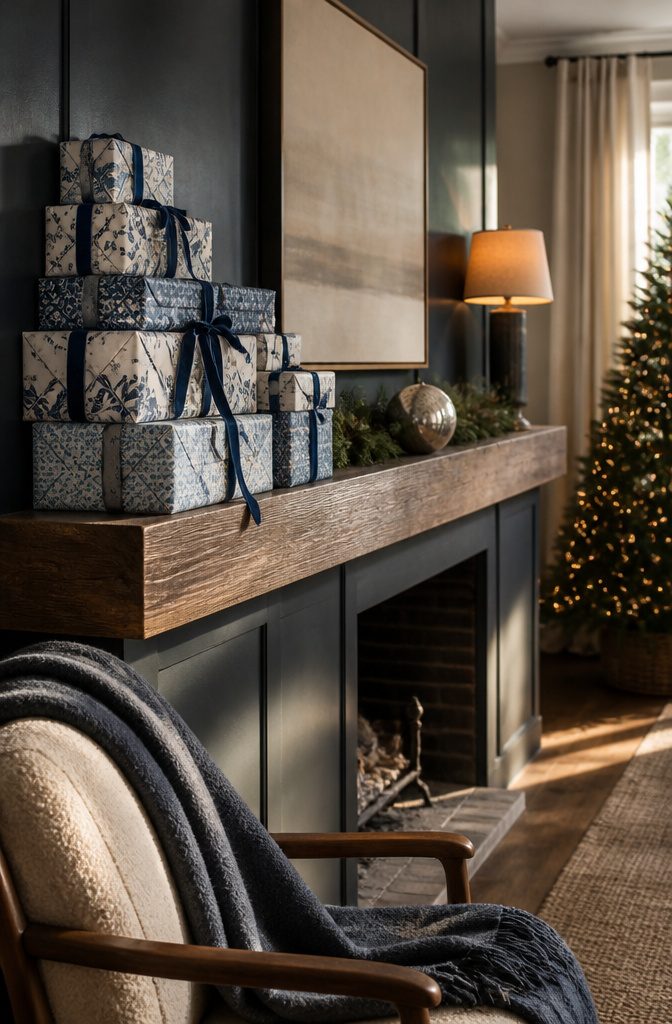
Wrapped presents stacked on a mantel turn a functional surface into part of the display.
The idea works when the wrapping carries the palette you’re already using — if the room leans into blue and white, wrap in coordinating paper and stack the boxes by size rather than leaving them all under the tree.
Velvet ribbon elevates inexpensive paper quickly, and varying the box heights keeps the arrangement from reading flat.
The move also solves a practical problem: gifts placed on the mantel free up floor space in smaller rooms where a tree already dominates one corner.
I treat the wrapped boxes the same way I would candlesticks or vases — as objects that add color and mass to the composition.
If the mantel runs long, flank the stack with greenery or a few oversized ornaments to anchor the ends. The wrapping becomes decor rather than something you hide until the 25th.
16. Make ornaments part of displays
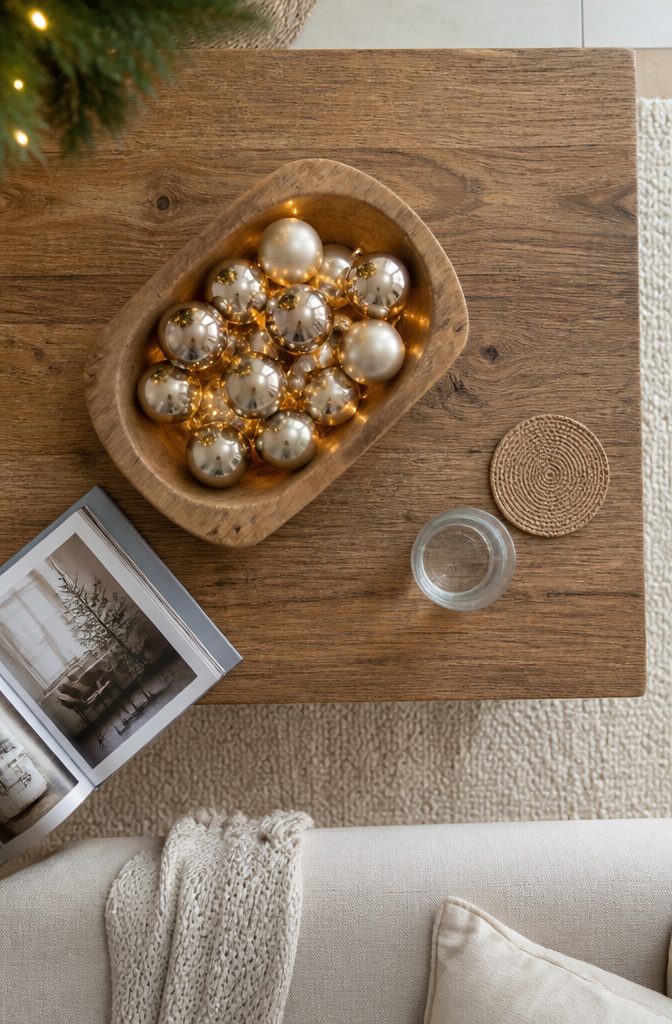
Ornaments don’t have to stay on the tree.
A decorative bowl filled with metallic ornament balls and battery-powered fairy lights makes a flexible centerpiece for a kitchen island or coffee table, something you can move without disassembling when you need the space.
A carved wooden bowl works well, but ceramic, metal, or glass all hold the same idea. Tuck the battery pack under the ornaments and let the metallic finish catch the light.
For the tree itself, handmade or meaningful ornaments carry more weight than matching sets. One designer kept laminated photo ornaments his husband made when their first son was born, and they go up every year because they’re funny and personal.
If you want something that bridges handmade charm with a finished look, a set of six porcelain blue-and-white ornaments fits traditional or cottage-style rooms without reading precious.
17. Use natural materials and found objects
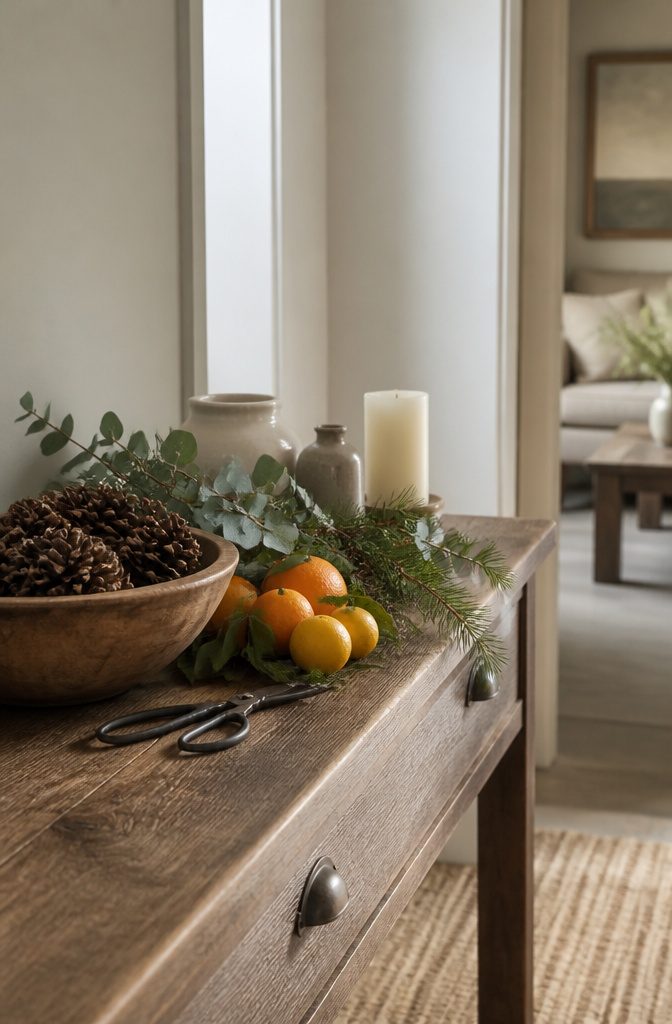
Pinecones, bare branches, citrus, and what you already own can carry more weight than store displays.
I’ve found that natural materials read as intentional rather than improvised when you let their texture do the work instead of trying to dress them up.
A wooden bowl filled with pinecones sits on a console or mantel without looking like it needs an excuse.
Designer Susan Burns uses wood ornaments on the tree, fruit and greenery in centerpieces, and avoids anything shiny, which keeps the whole house reading cohesive instead of segmented by room.
The approach scales: a bin of pinecones upgrades a cabinet, a few sprigs of eucalyptus mixed with pine changes the smell of a room, and vintage wooden skis leaned in a mudroom become the anchor for everything else hung around them.
The advantage is flexibility. Stylist Julien Roserens assembles centerpieces from fruit, flowers, ceramics, and candles he already has, composing something that fits the table that night and can be rearranged the next.
Nothing is permanent, so the display can shift as the season moves. I’d rather spend time arranging what I have than shopping for pieces that only work one way.
18. Decorate with a space-saving alternative
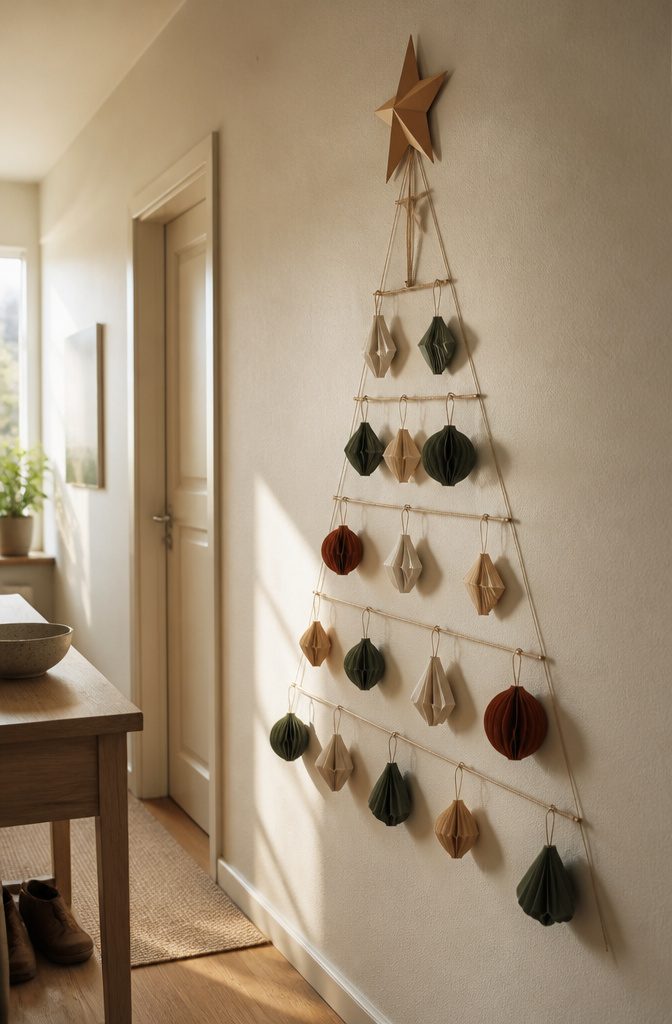
A wall Christmas tree made from a paper star, string, and paper ornaments takes about two feet of vertical space and none of the floor a real tree claims.
I’ve used this in narrow hallways and studio apartments where even a pencil tree feels like an obstacle.
You pin or nail the star at the top, run string down in a triangle shape, and hang lightweight ornaments along the lines.
The whole thing weighs almost nothing, so damage-deposit renters can use removable adhesive instead of nails. It reads as intentional rather than makeshift if you keep the string taut and the ornaments evenly spaced.
When there’s no fireplace, a cloth mural hung on the wall with stockings below gives the same visual anchor without framing or construction.
The mural goes up with tension rods or small nails, and stockings hang from adhesive hooks or a narrow wood strip tacked underneath.
This works best on a blank wall wide enough to center the composition, at least five feet across.
It won’t fool anyone into thinking there’s a real hearth, but it holds the stockings and marks the spot gifts pile up on Christmas morning.
How color and texture shape the overall look
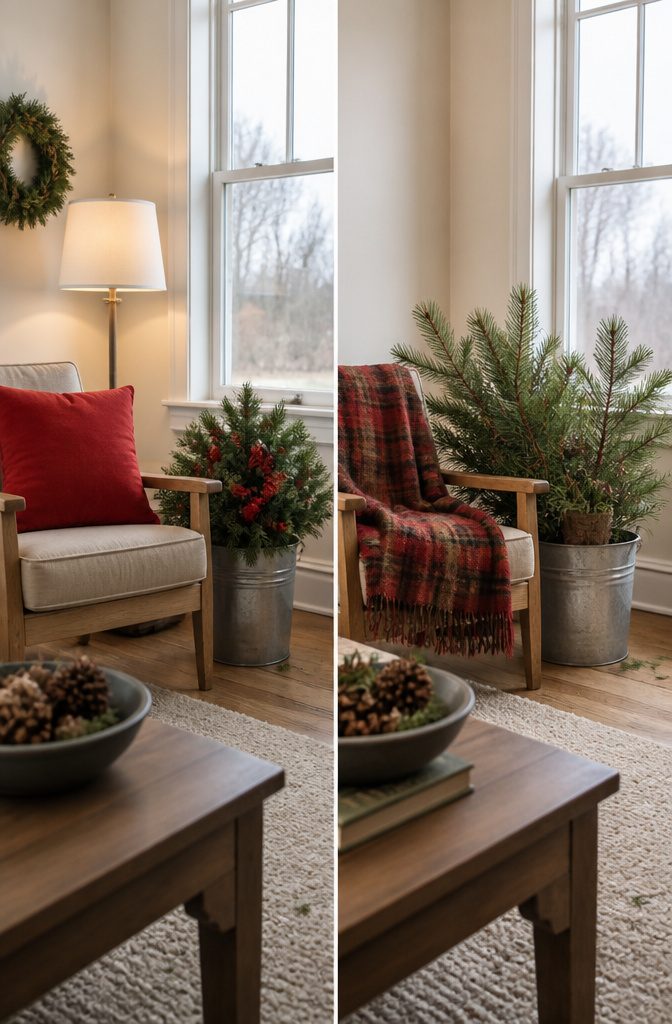
The palette you choose does more than set a mood—it holds the whole house together.
Traditional red and green still work when you let the materials carry the weight: pine branches against galvanized metal, red checkered wool next to fresh cedar.
The color itself isn’t the problem; the problem is treating it like a default instead of a deliberate choice.
Neutral schemes earn their keep differently. Cream, burlap, wood tones and eucalyptus create a calm backdrop that lets texture do the talking.
A flocked tree covered in metallic ornaments, chunky knitted stockings in ochre and cream, whitewashed wood with red berries—all of these lean on contrast in finish rather than color.
The neutrals stay restrained, and one unexpected accent refreshes the whole look without turning the room into a catalog spread.
Jewel tones pair well with warm metallics because the richness reads as intentional rather than busy.
Deep greens work especially well in rooms without much natural light, adding depth instead of making the space feel smaller. Keep one surface lighter: if the cabinets go dark, the countertop stays pale.
When to decorate on your own schedule
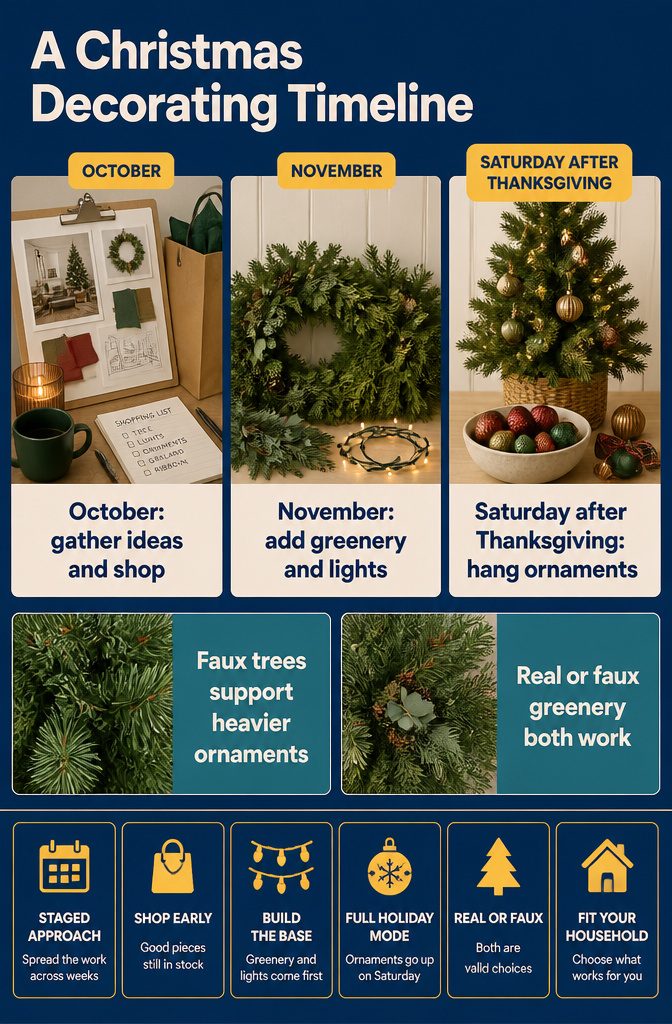
The staged approach gives you permission to spread the work across October, November, and the weeks after Thanksgiving instead of forcing everything into one exhausting weekend. Gathering inspiration and shopping in October means the good pieces are still in stock.
Adding greenery and twinkle lights in November sets the foundation before the big push. Then the Saturday after Thanksgiving, ornaments go up and the whole house shifts into full holiday mode.
The schedule works whether you choose real or faux greenery and trees. Both are valid.
Faux trees hold heavier ornaments and tolerate more weight if you collect a lot of them. Real greenery comes later in the season if you prefer it outdoors.
Pick the timeline and materials that fit your household, not someone else’s, and let the decoration unfold over weeks rather than cramming it into one day that leaves everyone tired.
Frequently Asked Questions
How do you decorate your room for Christmas?
Start with a small tree or decorated branches as an anchor, then layer in ornaments, wrapped books, and holiday cards on shelves or a dresser.
Keep the palette consistent with what you’ve used in the main rooms, and vary the height across surfaces so it reads as intentional rather than cluttered.
A string of battery-powered lights or a small wreath adds warmth without taking up much space.
What are some good themes for Christmas?
A theme can be a color palette like blue and white, deep green with aged brass, or neutrals with one accent color repeated across the tree, mantel, and dining table.
Pattern works too: plaid ribbon on wreaths and gifts, or natural materials like wood ornaments and greenery throughout. Pick one anchor and repeat it in three places so the house feels cohesive instead of scattered.
What is the 2026 Christmas trend?
Natural materials are holding strong: wood ornaments, pinecones, eucalyptus mixed with pine, and arrangements built from fruit and greenery rather than metallic finishes.
Organic textures paired with one or two accent colors keep spaces from feeling busy, and the approach scales easily from small apartments to full houses. The shift is away from matched sets and toward what looks accumulated rather than staged.