
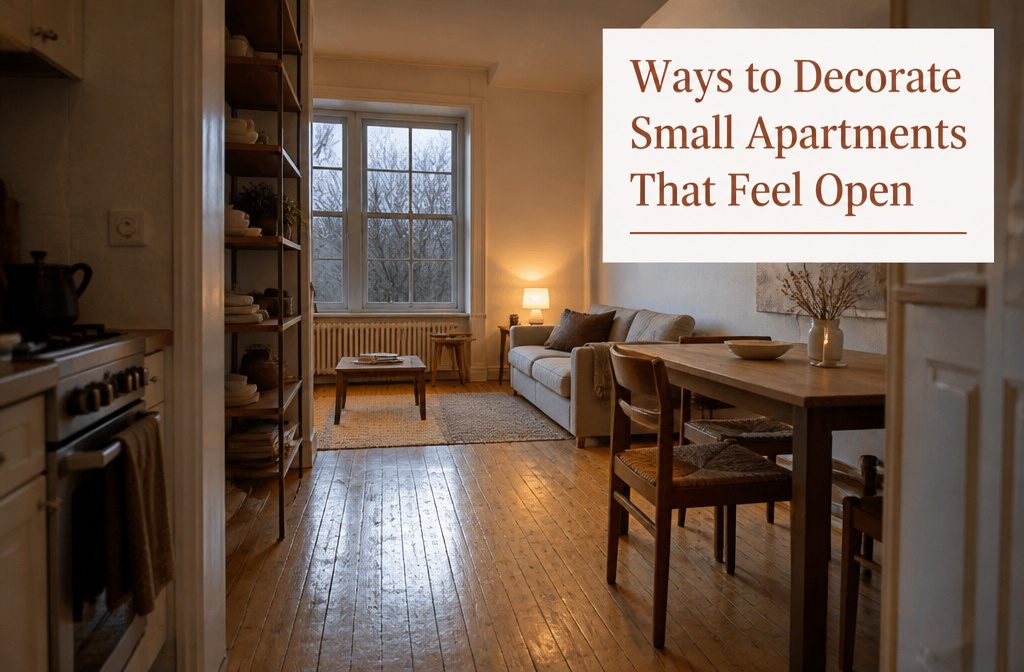
Small apartments open up through furniture choices and layout decisions, not square footage.
The difference between cramped and breathable comes down to what sits on legs versus what blocks the floor, where storage climbs instead of spreads, and whether you measured the 60 cm you actually need between pieces before anything arrived.
1. Use Multifunctional Furniture That Saves Space

Furniture that works twice as hard buys you room you didn’t know you had.
A sleeper sofa replaces both a couch and a guest bed, which matters when a studio apartment has no second bedroom and nowhere to stash an air mattress.
I look for compact designs that don’t sacrifice seating comfort during the day just to fold out at night.
A foldable sofa bed runs around $2,017, which is steep but still cheaper than buying a couch and a separate guest bed frame.
Storage ottomans in the 60–80 cm range sit low enough to tuck under a window or slide next to a sofa, and the lift-top compartment swallows throw blankets, chargers, and the mail pile that never seems to find a home.
Folding tables are worth keeping if you host more than twice a year but can’t give up floor space to a dining set the rest of the time.
The win is function without clutter. Multifunctional pieces rarely look as refined as dedicated furniture, but in a small apartment that compromise is almost always worth it.
2. Build Storage Up the Walls

Floor space stays open when storage climbs the walls instead. Floating shelves above furniture, tall narrow bookcases, and wall-mounted organizers keep everyday items accessible without eating into the room you actually walk through.
I reach for this move in kitchens first, where counter area disappears fast: magnetic knife strips hold blades flat against the backsplash, adhesive hooks catch mugs and utensils, and a simple pegboard turns an empty wall into tool storage that costs almost nothing to install.
Open shelving works when you want the contents on display—cookbooks, glassware, a few plants—but wall-mounted cabinets hide the clutter better if that’s the priority.
I like the hybrid: upper shelves for things worth seeing, closed storage lower down where the eye lands less often.
Even the stretch above doors and windows earns a shallow shelf if the ceiling is high enough, and that forgotten zone holds seasonal items or anything you don’t pull out weekly.
3. Add Storage That Hides Clutter
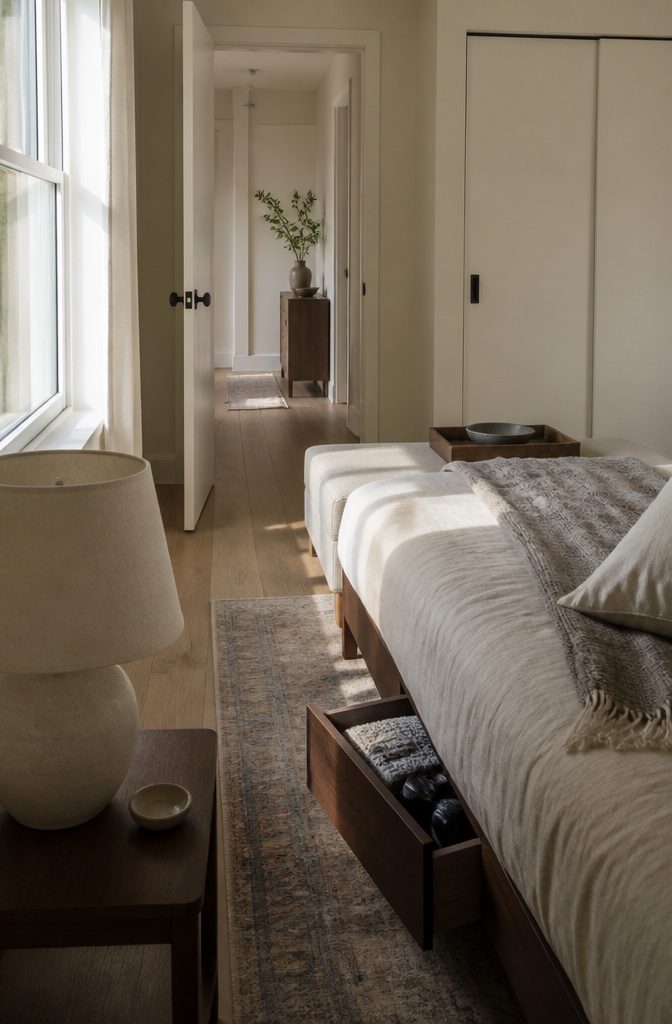
Add Storage That Hides Clutter
The best storage in a small apartment is the kind you can’t see.
Closed cabinets beat open shelves every time, lidded ottomans hide more than baskets without tops, and under-bed drawers work only if your frame sits at least 15–20 cm off the floor.
Measure the clearance before you buy anything. I use under-bed space for off-season clothes, spare bedding, and shoes that don’t need to be out in the hall.
A lidded ottoman between 60–80 cm doubles as a coffee table if the lid is firm enough to hold a tray. Slim entryway cabinets at 25–35 cm depth tuck into narrow halls without eating floor space the way deeper units do.
In bedrooms with high ceilings, a loft bed opens the floor below for a desk or compact sofa, and the elevated sleeping area becomes its own private zone.
The principle stays the same across rooms: give every object a closed home, and the apartment reads calmer immediately.
4. Layer Your Lighting
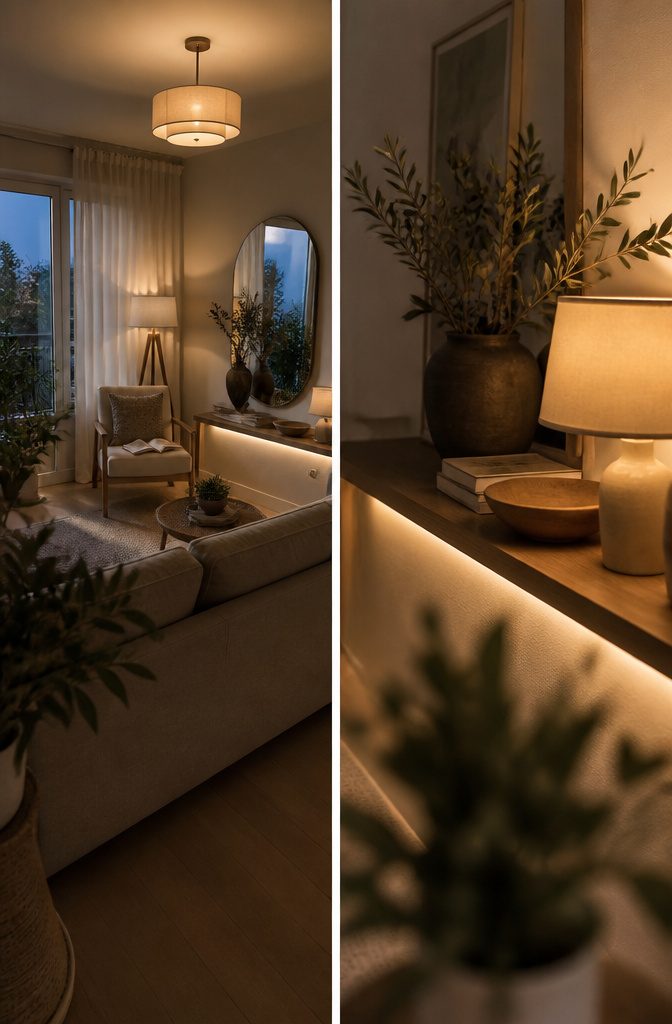
A single overhead light flattens a room and kills depth. Layering lighting—ceiling fixtures, table or floor lamps, and accent sources like LED strips or fairy lights—adds dimension without eating up square footage.
The ceiling fixture covers general tasks. A floor lamp behind a chair or a table lamp on a side surface brings light down to where you actually sit.
LED strips tucked under shelves or along the back of a sofa highlight edges and make the room read as larger than its measurements.
Natural light does half the work if you let it through.
Sheer curtains or light-filtering shades keep privacy without blocking the window. Mount the rod above and outside the frame so the fabric clears the glass when open, and more daylight reaches in.
A large mirror opposite the window doubles the light and stretches the sight line, which makes one room feel like two.
Warm-toned LEDs in the 2700K–3000K range keep a small apartment from reading clinical.
Cool white works in a commercial space; here it makes the room feel temporary. Stick with warm, and the lighting feels intentional instead of provisional.
5. Hang Mirrors Where They Reflect Light

A large mirror opposite a window doubles the natural light in the room and creates the illusion of another space beyond.
The reflection bounces light across surfaces that would otherwise sit in shadow, and the depth tricks the eye into reading the room as larger than its actual footprint.
I place mirrors at eye level or above for the strongest effect, though a floor-length mirror leaning against the wall works just as well if the layout calls for it.
The position matters more than the size.
A mirror hung behind a sofa or in a narrow hallway opens up tight circulation paths, while one across from the brightest window in the apartment pulls that light into the center of the room.
Warm-toned LED bulbs at 2700K to 3000K layer in after dark and keep the space from feeling clinical under overhead light alone.
6. Choose Light or Cohesive Color
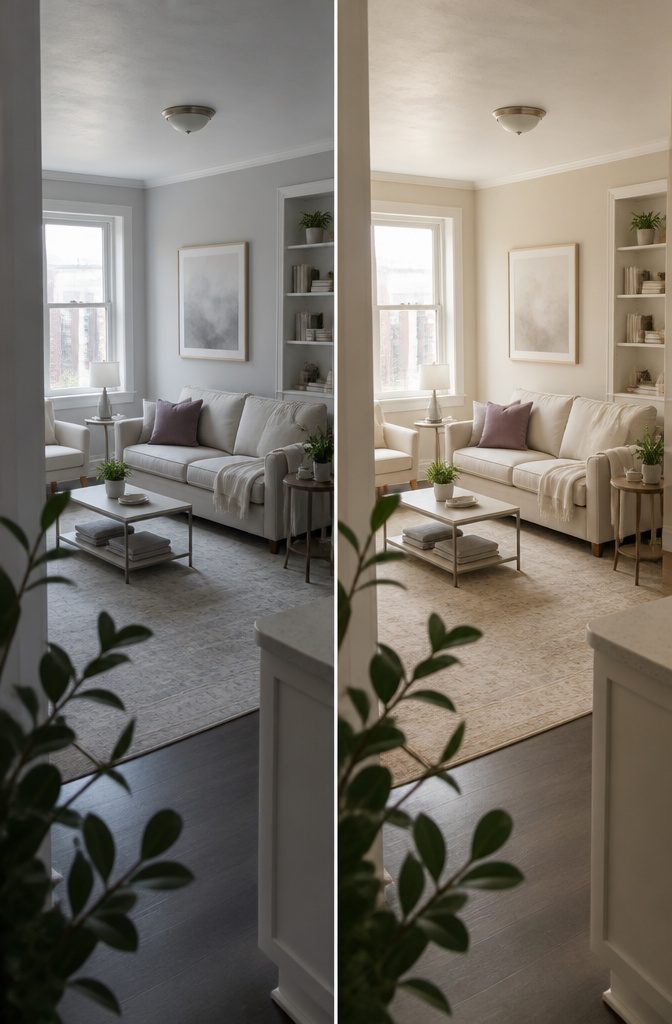
Light shades reflect more light and push walls visually outward, which is why soft neutrals like white, cream, and pale gray remain the most reliable way to open a small apartment.
Glossy finishes amplify the effect. Early Lavender No. 260, for instance, creates a soft backdrop without reading flat or cold, and pale purples in general are showing up more often in rentals where white feels too stark.
But light color is not the only option. Deep, saturated paint on all four walls can make a small room feel deliberate rather than cramped, as long as the palette stays cohesive.
Puck and Hicks’ Blue both work this way when you commit fully instead of stopping halfway. The real mistake is contrast.
Stark breaks between walls, trim, and furniture draw attention to the edges of the room and make it feel boxed in. Keep the whole envelope close in tone, even if that tone is bold.
7. Define Zones With Rugs Instead of Walls
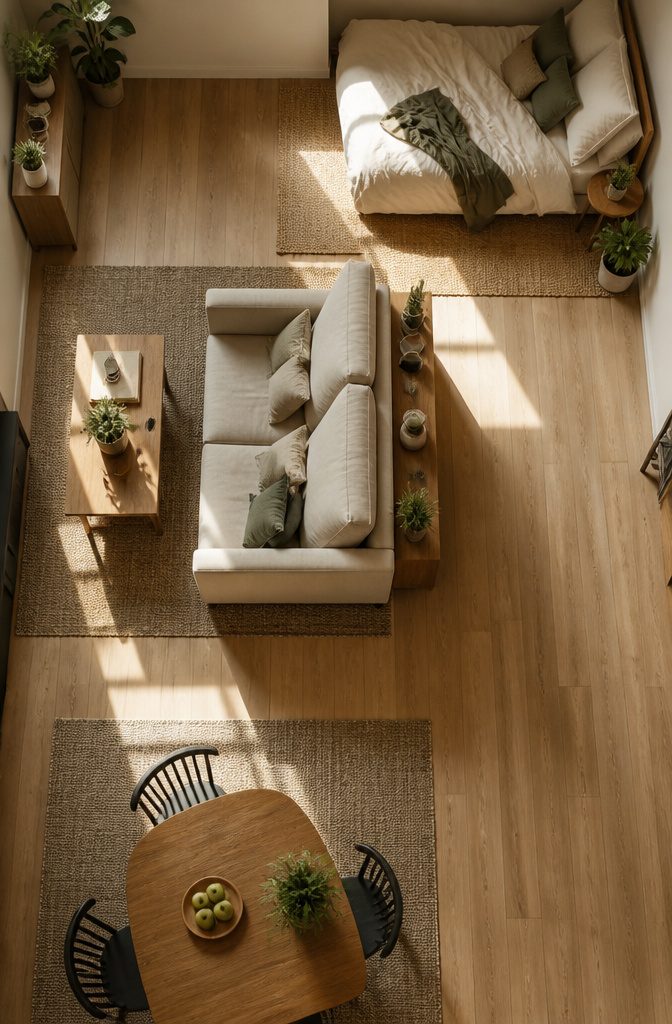
Rugs zone an open-plan apartment without adding walls or breaking up the sight lines that make a small space feel larger.
One under the sofa and coffee table separates the living area, another beneath the dining table anchors the eating zone, and a third beside the bed defines the sleeping corner.
The pattern holds even in a studio where everything sits in one room: the rugs give each function its own footprint, and the layout reads as organized rather than scattered.
Furniture placement does the same work when rugs feel like too much pattern or cost.
A sofa placed perpendicular to the bed creates a visual boundary in a studio, and a low bench or slim console behind it marks where one zone ends without blocking light.
Open shelving, curtains, and folding screens add another layer of separation when more privacy matters, though they take up more visual weight than a rug and work best when the apartment has enough ceiling height to keep them from closing the room in.
8. Pick Furniture That Shows the Floor
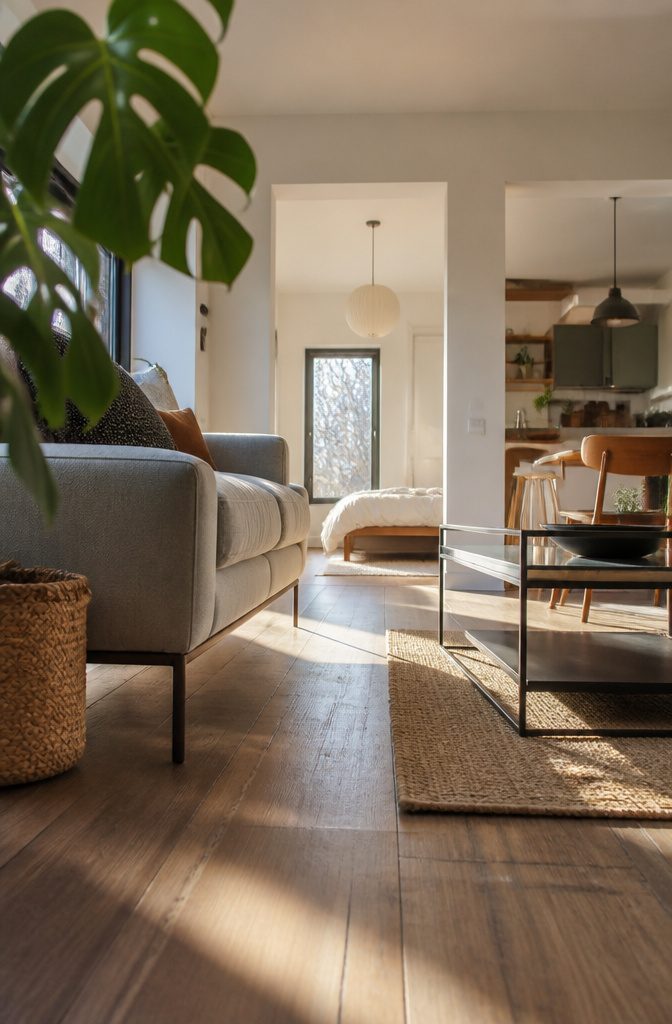
Furniture with visible legs keeps more floor in view, and floor area is what registers as space.
A sofa or bed that sits directly on the ground reads as a solid block; put the same piece on legs and the room opens up because light moves underneath and your eye counts the floor that shows.
Mid-century modern sofas, raised beds, and open-frame coffee tables all give that lift without taking more square footage.
The practical side matters just as much as the visual one.
I measure walking paths before anything gets delivered: at least 60 cm of clear floor between furniture pieces, and 75–90 cm in front of anything that opens—a dresser, a cabinet door, an oven.
Most small-space failures come from furniture sized for a larger home that someone hoped would fit. It won’t, and replacing it later costs more than measuring first.
Low-profile pieces help too.
A sofa with a slim frame leaves more vertical space above it, which makes the wall read taller. Skip anything with a heavy skirt or deep upholstery that closes the floor line.
If a piece can do two jobs—a storage ottoman instead of a separate coffee table, a bench with hidden compartments—it earns the space it takes.
9. Declutter and Keep Decor Intentional
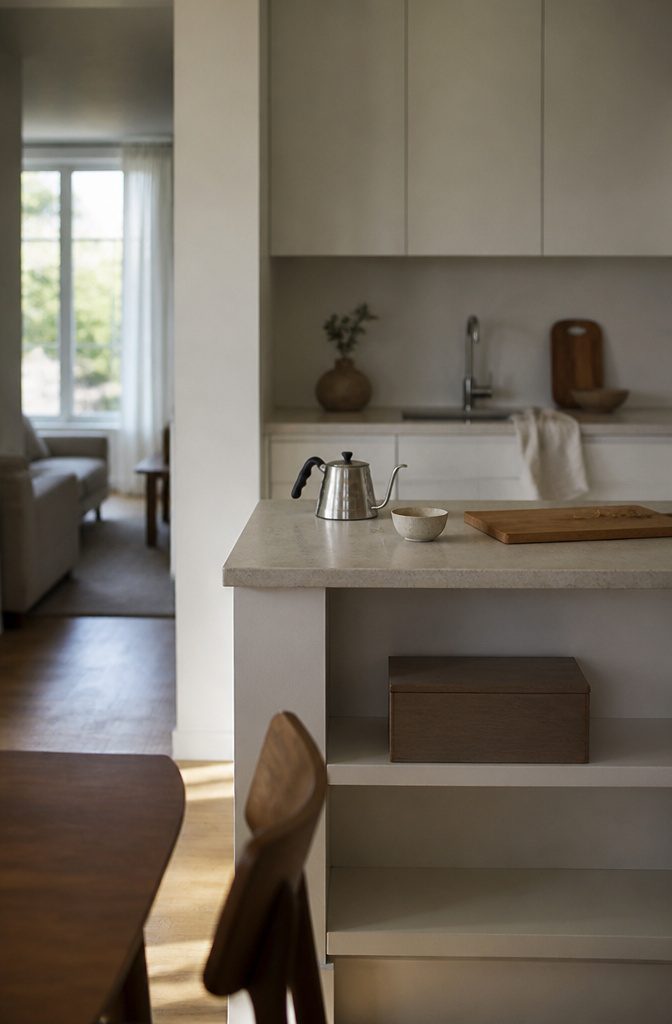
The fastest way to make a small apartment feel larger costs nothing. Clear ten things from each room, box them, and live with the change for a week.
Whatever you don’t reach for in that time can leave for good. The difference shows immediately, because small rooms don’t forgive visual clutter the way larger ones do.
Once the baseline is clear, keep it that way with a ten-minute reset each evening.
I return items to their closed homes, clear kitchen counters to three daily-use items, and consolidate paperwork into one labeled box rather than letting it pile across three surfaces. This routine does more for openness than any purchase.
After that, decor becomes intentional by default.
One bold piece of wall art or a single sculptural vase reads as a choice. Dozens of small objects read as accumulation, and accumulation shrinks space faster than furniture does.
10. Separate Zones Without Closing Them In
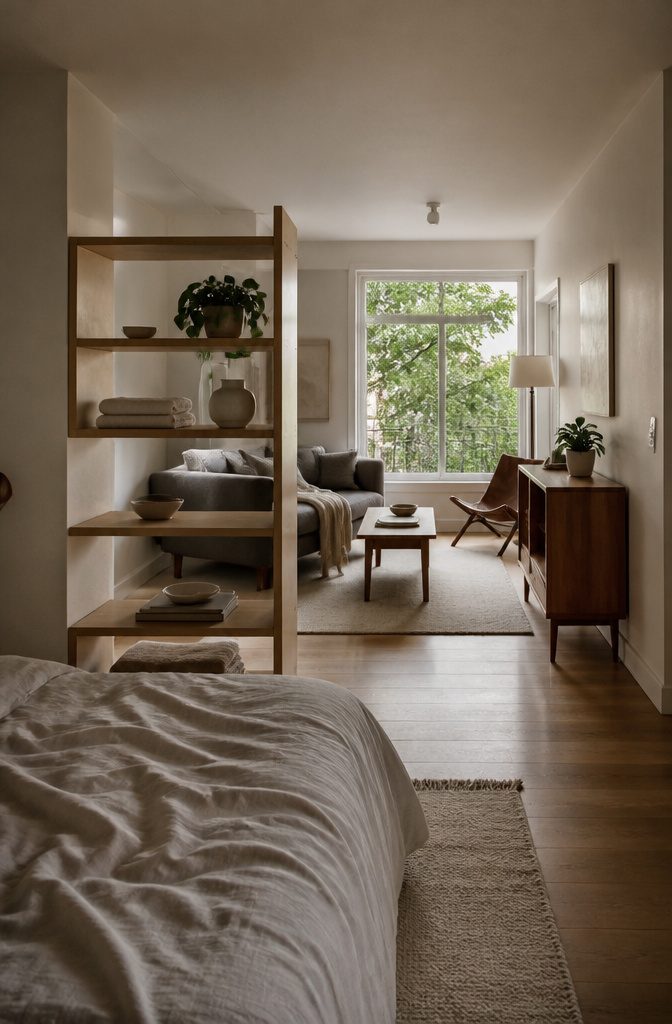
A room divider carves out privacy in a studio apartment without blocking light or making the space feel cramped.
Open shelving placed between the bed and living area separates the two zones while letting you see through to the window, which keeps the room from feeling cut in half.
I like this approach better than a solid screen, because you get storage and division in one piece of furniture.
Curtains work when you want flexibility. Hang a track or rod from the ceiling, and you can pull the curtain closed when you need the bedroom hidden and slide it open the rest of the time.
The fabric adds softness without the weight of a built-in wall, and you can swap it out when the look feels stale.
Furniture placement does the same job without adding a single object. In a studio, placing the sofa perpendicular to the bed creates two zones by giving each area its own boundary.
The couch acts as the divider, and the layout reads as intentional rather than accidental. This costs nothing and works in tight footprints where a bookshelf or screen would crowd the walkway.
11. Fill Walls With Art or Floating Shelves
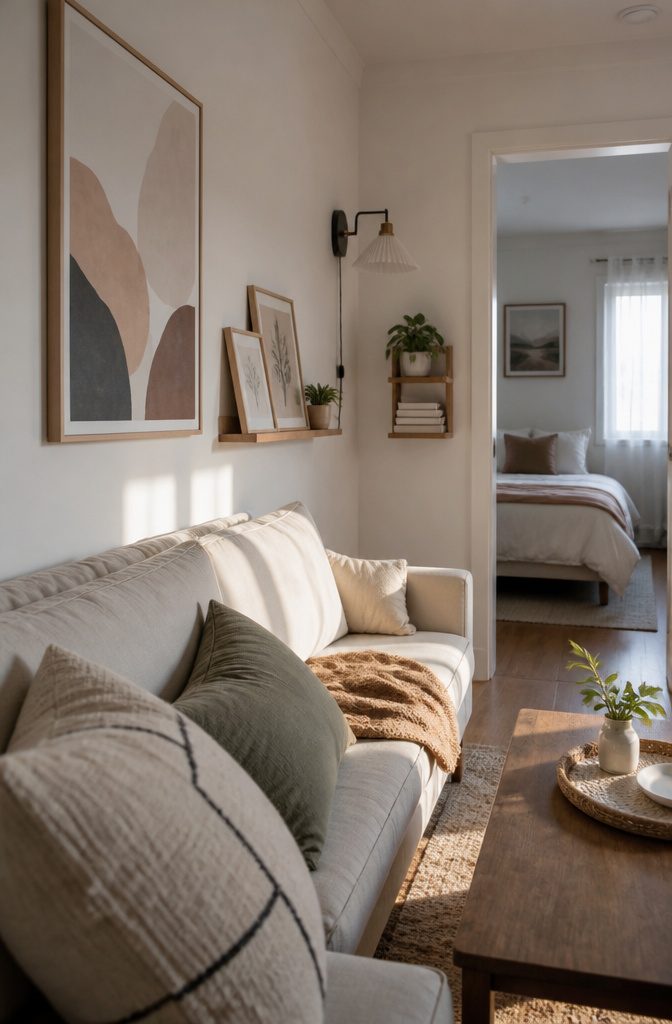
Walls pull double duty when floor space runs tight.
A single large framed print above a sofa often reads calmer than a cluster of six small pieces, and hanging at eye level—center roughly 145 to 150 cm from the floor—keeps the composition grounded.
I look for art in a narrow tone range, soft beige or muted earth tones, so the eye rests instead of jumping from frame to frame.
Floating picture ledges let you layer prints and swap them without drilling new holes every season.
If you rent, adhesive strips hold lightweight frames without the commitment. Oversized artwork that won’t fit on a ledge can lean against the wall on the floor for instant presence.
In bedrooms where floor space matters even more, wall-mounted nightstands or shallow floating shelves replace bulky side tables.
Add a plug-in sconce above each shelf and the setup reads modern, frees circulation, and keeps everything you need within arm’s reach at night.
12. Add Texture With Rugs, Curtains, and Textiles

Textiles change how a room feels without closing it in. Swap cotton throws in summer for knit blankets in winter — the seasonal shift gives you warmth when you need it and keeps the space from feeling heavy when you don’t.
Layer a woven rug under the bed and another in the living zone to soften a studio floor and create quiet separation where walls won’t fit.
In open-plan layouts, rugs mark where one zone ends and another begins: one anchors the sofa, another defines the dining corner, and the apartment suddenly reads as several rooms instead of one unbroken square.
Curtains work the same way when you mount them close to the ceiling. Light linen in a soft neutral makes the wall taller and the window wider, especially if the fabric hits the floor.
Pattern can shift proportions too — a geometric print with vertical lines pulls the eye up and stretches a low ceiling.
I’d pair that with a neutral rug so the room doesn’t tip into visual noise. You want layering that feels deliberate: enough texture to make the space lived-in, not so much that it crowds what little square footage you have.
13. Add Plants Without Crowding the Floor

Plants bring life into a small apartment without taking up the square footage you need for furniture, but only if you keep them off the floor.
Hanging planters and wall-mounted shelves let you fill vertical space that would otherwise sit empty, and the effect is immediate: a room with greenery at eye level and above feels fuller without feeling cluttered.
Snake plants, pothos, and ZZ plants work especially well in small spaces because they tolerate low light and need little attention. Pothos trails naturally, which makes it good for a high shelf or a macramé hanger near a window.
Snake plants grow upright and fit narrow corners or the top of a bookcase. ZZ plants stay compact and forgive missed waterings, so they work in spots you can’t reach easily once they’re in place.
If you have a blank wall near the kitchen or bedroom, a vertical planter grid or a ladder shelf gives you room for multiple plants without claiming any floor.
The arrangement reads as intentional rather than accidental, and the vertical line pulls the eye up instead of spreading it across a surface you might need for something else.
14. Use Corners and Awkward Spaces

Corners pull in storage and display without eating up the room. A narrow corner shelf stacked with a few books or plants uses vertical space that would otherwise sit empty, and the triangular footprint means you lose almost no floor.
Hooks mounted high in a bedroom corner hold bags or hats where they stay visible but out of the way. I find corner installations work best when they stay light in scale.
A tall ladder shelf can fit snugly into a tight angle without the visual weight of a full bookcase, and the open rungs keep the wall from feeling closed off.
Awkward nooks near doorways or between windows turn into drop zones with one small addition. A floating shelf at elbow height gives you a landing spot for keys and mail, and a basket hung below catches shoes.
The setup takes up inches, not feet, and keeps the clutter from migrating to counters. Small apartments tend to have these leftover gaps, and leaving them empty means you end up piling things somewhere worse.
15. Carve Out a Compact Work or Dining Area

A wall-mounted fold-down desk or compact dining table turns an awkward stretch of wall into a work surface that disappears when the meal or the meeting ends.
I’ve found that a fold-away dining table with stackable chairs keeps the room clear most of the day, which matters more in a small apartment than having a full table out all the time.
The wall-mounted version mounts flush when not in use and pulls down when you need it, whether that’s for dinner or for answering email.
If you have space for a permanent piece, a small dining table doubles as a desk during the day.
Corner placement works well because it keeps the center of the room open and still gives you a surface large enough to spread out a laptop and a notebook.
Fold-down and drop-leaf designs free up floor space the rest of the week, and stackable stools tuck under or behind furniture when guests leave. The setup fits tight corners and serves a clear purpose without claiming the whole room.
Layout Numbers That Actually Work

Here’s a practical starting point: leave 60 cm (about 24 inches) behind your sofa if people need to pass through, and keep your coffee table 40–45 cm from the sofa edge—close enough to reach without leaning forward, far enough that you can walk past it.
These are the clearances that actually fit in small rooms:
- Living room: In a 3.5 m × 4 m space, place the sofa along the longest wall, set the TV 2–2.5 m away for a 40–50-inch screen, and angle a single armchair at 45 degrees instead of running it parallel—you gain one clear path to the window and another to the bedroom door.
- Bedroom: You need 60–75 cm on at least one side of the bed to get in and out. If the room is under 2.5 m wide, push the bed against the side wall with one narrow nightstand (30–40 cm) rather than centering it with two—more floor shows, and the room reads larger.
- Kitchen: Keep 90 cm of clear floor in front of the sink and stove. That’s the minimum for opening cabinet doors and standing at the counter without backing into the opposite wall.
- Entryway: A bench under 30–35 cm deep works in entries narrower than 1.5 m. Deeper than that and you lose the walkway.
- Bed size trade: A queen instead of a king frees 18–24 inches per side. Use floating shelves in place of nightstands and the floor stays open.
Rental-Friendly Changes That Leave No Trace

Renters get most of the benefit of a styled apartment without touching anything permanent. A few reliable swaps let you add pattern, color, and personal detail without giving up a deposit.
- Removable wallpaper or wall decals bring in pattern or accent color on one wall. Prime the surface first, especially in kitchens and bathrooms where moisture loosens adhesive faster than it should.
- Adhesive hanging strips and Command strips hold framed art, lightweight mirrors, and floating shelves without drilling. Weight limits matter more than the packaging suggests, so size down if the piece is close to the max.
- Tension rods fit inside window frames or closet openings for curtains, room dividers, or extra hanging storage. No hardware, no holes, and they move when you do.
- Cabinet hardware swaps change the look of a kitchen or bathroom in fifteen minutes. Keep the original pulls and knobs in a labeled bag so you can swap them back at move-out.
Frequently Asked Questions
How do I make my small apartment feel bigger?
Use light colors or a cohesive saturated palette, hang mirrors opposite windows to reflect light, and choose furniture with visible legs so more floor shows.
Declutter to ten items per room and layer your lighting with floor lamps and LED strips instead of relying on one overhead fixture.
What colors make a small apartment look bigger?
Soft neutrals like white, cream, and pale gray reflect light and push walls visually outward.
Deep, saturated paint on all four walls can also work if you commit fully and keep the palette cohesive, because stark contrast between walls and trim makes the room feel boxed in.
What kind of furniture works best in a small apartment?
Multifunctional pieces like sleeper sofas, storage ottomans, and fold-down tables save space by doing two jobs. Choose compact designs with visible legs so light moves underneath and the floor stays in view, which makes the room read larger.
How can I decorate without making the space feel cluttered?
Keep decor intentional by clearing ten things from each room and boxing what you don’t use weekly.
Use closed storage to hide clutter, limit kitchen counters to three daily-use items, and choose one bold piece of art instead of dozens of small objects.
How do you decorate a small apartment with wall art without making it feel crowded?
Hang one or two appropriately scaled pieces per wall and leave generous empty space around them.
A single large framed print above a sofa reads calmer than six small pieces, and keeping artwork in a narrow tone range lets the eye rest instead of jumping between frames.