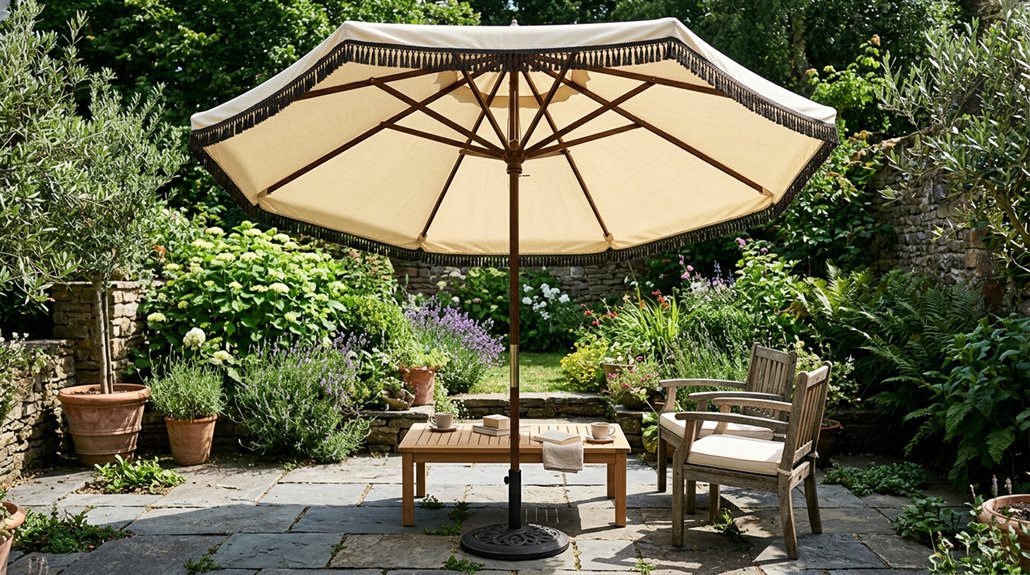
I’ve bought the wrong umbrella size more times than I’d like to admit. Start by measuring your seating area with a tape measure, then add at least two feet of overhang on all sides. For round tables, your umbrella diameter should be the table’s diameter plus four feet. Square tables need about two feet of shade beyond each edge. Match your base weight to your canopy size; heavier bases prevent tipping. These measurements determine whether your umbrella will function effectively and provide adequate shade coverage.
Measure Your Outdoor Space First
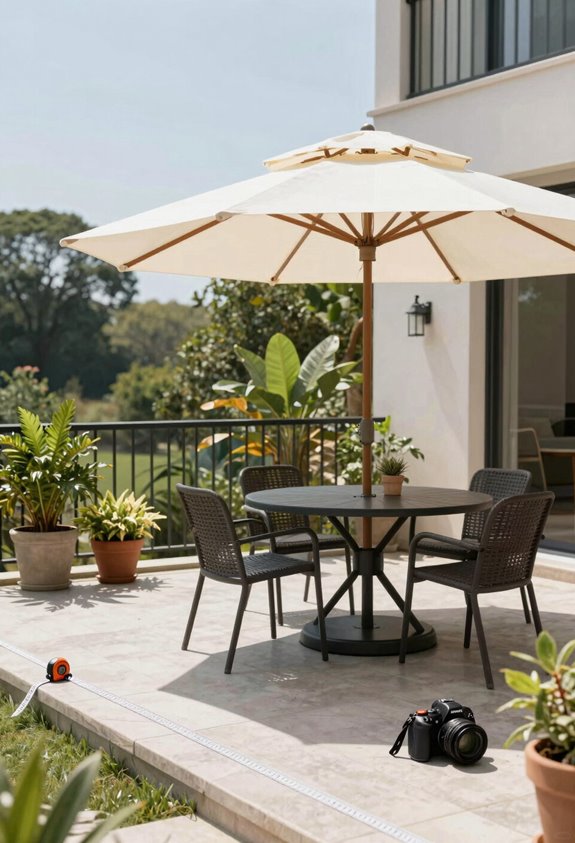
How do you know if an umbrella will actually fit your patio? I start by clearing away furniture and items cluttering my outdoor space. Then I grab my tape measure and check the width and length of the area where I want shade.
I note the maximum coverage I need, thinking about my dining table and seating spots. I plan for at least 2 feet of overhang beyond everything on all sides. This extra space increases shade coverage significantly.
Taking these measurements prevents me from buying an umbrella that’s too small or too large. A proper fit allows you to move around comfortably without feeling crowded, and your guests have room to breathe.

FITS 9FT-12FT PATIO UMBRELLAS WITH ALL-SEASON PROTECTION: Designed to fit 9ft to 12ft market umbrellas, this umbrella cover protects your outdoor umbrella from weather exposure, dust and fading. Please measure your umbrella size before purchasing. It may fit 7ft-8ft umbrellas but may appear loose. Not designed for cantilever or offset umbrellas.

ATTENTION: Due to different screen display, there may be a little color difference from image. If there is any issues on it, please feel free to contact via email

UNIQUE DETACHABLE RIB DESIGN – TOOL-FREE ASSEMBLY & COMPACT STORAGE -- Unlike traditional bulky umbrellas, this 10 ft patio umbrella features detachable ribs that click onto the main frame using bullet buckle connections. No tools required – assembly takes only minutes. When not in use, remove the ribs for compact storage, saving valuable space in your garage or shed.
Standard Patio Umbrella Sizes: 6 to 12+ Feet
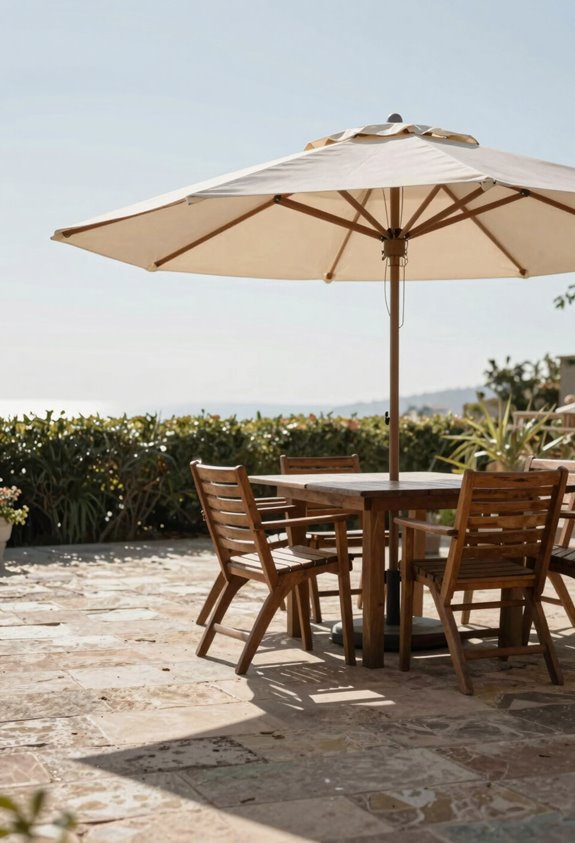
What umbrella size actually works for your space? Patio umbrella sizes range from 6 feet to 12 feet or larger, and each fits different needs. Small 6–7.5 ft umbrellas work well for compact balconies or bistro tables for two people. For a regular dinner party with four to six guests, an 8–9 ft umbrella provides adequate coverage. Larger gatherings benefit from a 10–11 ft option that covers up to eight people comfortably. A 12 ft or larger umbrella creates maximum shade for big seating areas. Standard sizes make finding your perfect fit straightforward. Cantilever designs offer another option when you want shade without a center pole taking up table space.

ATTENTION: Due to different screen display, there may be a little color difference from image

SCALLOPED WAVY-TRIM EDGE: Designed to stand out, the decorative wavy border brings a stylish visual accent - perfect for enhancing everyday patio decor or special outdoor events

ATTENTION: Due to different screen display, there may be a little color difference from image
Match Umbrella Size to Your Table Dimensions
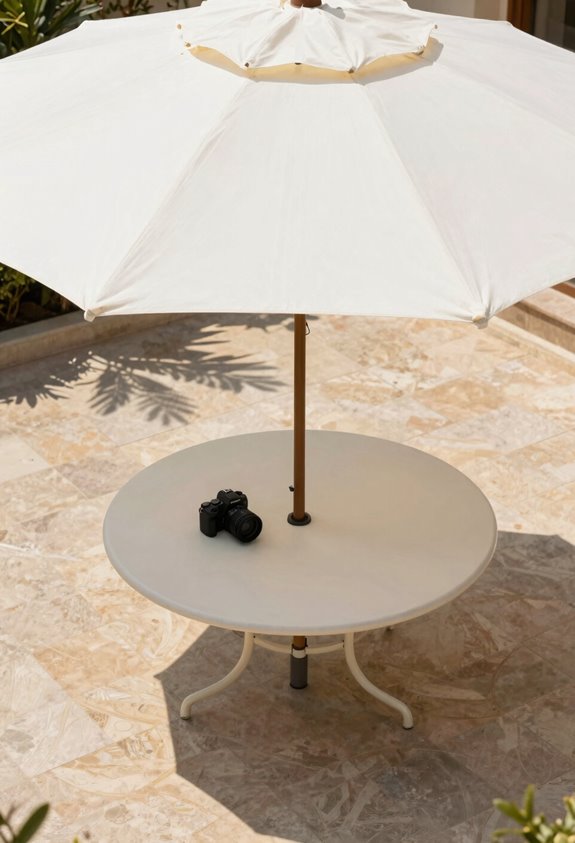
Now that you’ve picked a size range that matches your gathering, get specific about your actual table. Matching umbrella size to your patio table dimensions directly affects real shade coverage.
For round tables, aim for an umbrella extending at least 4 feet beyond the diameter. With square tables, choose one that extends 2 feet past each side. An 8×8 foot table works well with a 10-foot umbrella. For rectangular tables, prioritize covering the longest sides with about 2 feet of overhang. Pair a 6×4 foot table with a 10×8 foot umbrella.
Center your umbrella over the table for balanced coverage. A larger canopy reduces gaps as the sun moves throughout the day.

Package includes: 1 X umbrella, base and furniture NOT included.

Attention: Due to different screen display, there may be a little color difference from image

Easy Set-Up: Our Abba Patio 6.5FT Lyon outdoor patio umbrella features a tool-free, threaded pole design for easy installation. Simply insert the pole into the base and twist - no additional tools required. The robust, rounded threads ensure a smooth operation, making opening and closing a breeze. Designed for convenience, this umbrella allows for quick angle adjustments, saving you time in setup.
Sizing Round Patio Umbrellas: The 4-Foot Coverage Rule
When sizing a round canopy for your patio table, the 4-foot coverage rule provides reliable guidance. This guideline means extending the umbrella shade at least 4 feet beyond your table’s diameter, creating a comfortable 2-foot border all around.
- Measure your round table’s diameter first
- Add 4 feet to that measurement for proper umbrella size
- Choose an 8–9 foot umbrella for standard dining tables
For smaller round tables up to 30 inches, use a 6–6.5 foot umbrella instead. Centering the umbrella keeps shade even across all seating areas. With tilt features, you can adjust the angle as the sun moves throughout the day.

10FT OFFSET PATIO UMBRELLA: Designed to keep you cool and comfortable in your outdoor living space, with more space underneath than traditional patio umbrellas

SPACIOUS 10 FT SHADE: This 10 FT Cantilever Patio Umbrella provides generous shade for outdoor seating areas, helping create a comfortable space for relaxing, dining, or entertaining on your patio, deck, or backyard.

FITS 9FT-12FT PATIO UMBRELLAS WITH ALL-SEASON PROTECTION: Designed to fit 9ft to 12ft market umbrellas, this umbrella cover protects your outdoor umbrella from weather exposure, dust and fading. Please measure your umbrella size before purchasing. It may fit 7ft-8ft umbrellas but may appear loose. Not designed for cantilever or offset umbrellas.
Patio Umbrella Sizing for Square and Rectangular Tables
How do I figure out the right umbrella size for my square patio table? Extending coverage at least 2 feet beyond each side is critical for adequate shade. My 8×8 ft table required about a 10–12 ft square outdoor umbrella to shade the whole surface evenly.
For rectangular patio tables, the math works differently. My 6×4 ft table paired well with a 10×8 ft umbrella, which extended past the long sides by roughly 2 feet.
Key considerations for umbrella placement: Center the umbrella directly over your table to prevent shadow gaps at the corners. Position it to cover adjacent seating areas, accounting for how the sun moves throughout the day. Proper placement maximizes shade coverage across your outdoor space.


Sturdy umbrella stand outdoor base: Our 40-pound umbrella base provides a secure hold for your umbrella. It is designed to be used with a patio table and umbrella

Heavy-duty & weather-resistant: Made of HDPE plastic to withstand impact and constant movement, and treated with a weather and UV-resistant coating
Sun Angle and Umbrella Tilt: Optimizing Shade Coverage
I’ve learned that the sun’s path across your patio changes throughout the day, which means your umbrella’s fixed position won’t always protect you perfectly. Tilt capability addresses this limitation. By adjusting your umbrella’s angle, you can block the sun as it moves higher or lower in the sky, keeping your seating area shaded during peak afternoon hours without repositioning the whole umbrella. The type of umbrella matters too. Cantilever and market umbrellas offer significantly more tilt flexibility than a standard center-pole model, so if you want all-day shade coverage, those designs are worth considering.
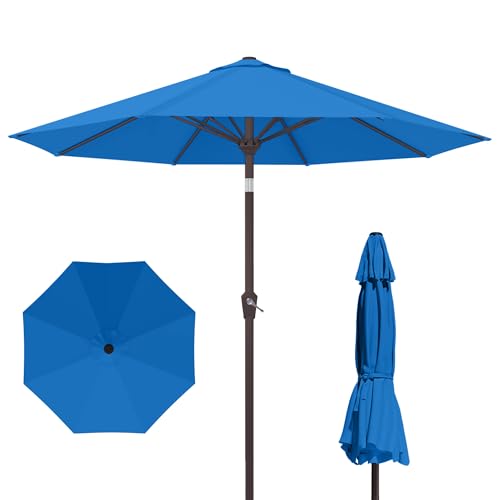
PREMIUM SOLUTION‑DYED POLYESTER CANOPY: Constructed from heavy‑duty 180g solution dyed polyester fabric for this outdoor patio umbrella, delivering outstanding color fastness and long‑term durability. The canopy comes with water‑repellent finish and reliable UV50+ protection to shield you from harsh sunlight during outdoor leisure time.

WATER OR SAND FILLING: Base can be weighed down with up to 55 pounds of sand or 19 liters of water, or empty it out for a lightweight stand that can be taken anywhere

Reasonable Design: 10FT umbrella with elegant ruffled valance. Easy crank open and push-button tilt follow the sun for all-day shade.
Understanding Sun Movement Patterns
Ever notice how that perfect shady spot under your canopy shifts as the day goes on. That’s because of the sun’s trajectory, and understanding it changed how I choose my umbrella.
What I’ve learned about sun movement:
- Morning sun comes from the east, so shade falls to the west side of your patio
- Midday sun sits high overhead, requiring wider coverage to protect the whole table
- Afternoon sun moves west, shifting shadows eastward across your space
I needed tilt functionality to keep pace with these changes. When I adjust my umbrella’s angle throughout the day, I’m working with the sun’s natural path instead of against it. This means I don’t need a massive umbrella to stay comfortable. By tilting and positioning strategically, I’ve extended my shaded hours substantially.
Tilt Features for Dynamic Coverage
Understanding where the sun goes during the day helps you position your umbrella, but adjusting it makes all the difference. A good tilt feature transforms how your shade works throughout the day. With a collar or crank tilt, you can gradually shift your umbrella as the sun moves, keeping coverage exactly where you need it. This approach is more efficient than buying a wider umbrella just to chase the sun’s changing angles. Cantilever umbrellas offer greater flexibility. You can rotate and tilt them together, directing shade away from wind and straight toward your seating area. The key is keeping that shaded spot centered over where people actually sit. Combined with proper sizing and placement, tilt features maintain perfect coverage without overdoing the umbrella’s width.
Why Base Weight Matters for Stability
Your canopy’s base weight is just as important as the canopy size itself. Skipping this detail invites instability even in light wind. The heavier your canopy, the heavier your base needs to be. This becomes critical with cantilever models, which pull weight off to the side and demand bases that might seem excessive until you observe what happens without them. Match your base to both your canopy’s size and placement location, because the right weight keeps everything stable. The wrong choice results in your shade tipped over in your neighbor’s yard.

28 SOLAR-POWERED LIGHTS: Enjoy this umbrella day or night as an integrated solar panel stores energy throughout the day to provide 6-7 hours of continuous light

ATTENTION: Due to different screen display, there may be a little color difference from image

28 SOLAR-POWERED LIGHTS: Enjoy this umbrella day or night as an integrated solar panel stores energy throughout the day to provide 6-7 hours of continuous light
Base Weight By Size
Why does base weight matter when you’re picking an umbrella? The wrong base weight leads to tipping, shifting, and frustration. Matching base weight to umbrella size is essential:
- Standard umbrellas under 7.5 feet need 20–30 lb bases for basic stability
- Mid-sized umbrellas between 7.5–9 feet require 30–40 lb bases to handle wind
- Cantilever umbrellas demand significantly heavier bases. 8 feet needs 70–90 lb, while 8–9 feet requires 200–220 lb due to their off-center design
I underestimated weight requirements and experienced constant shifting. Now I match base weight to both canopy size and local wind conditions. This prevents your umbrella from moving and ensures stable, effective shade protection.
Cantilever Stability Requirements
Because cantilever umbrellas sit off to the side instead of in the middle, they’re naturally top-heavy and want to tip over. This is why their bases need to be so much heavier than regular umbrellas. I learned this the hard way when I underestimated my cantilever’s weight needs.
The base weight directly impacts cantilever stability. The following weights have proven effective:
| Umbrella Size | Minimum Base Weight | Wind Conditions |
|---|---|---|
| 8 ft | 70–90 lb | Moderate |
| 8–9 ft | 200–220 lb | Strong |
| 9–11 ft | ≥280 lb | Very Strong |
You’ll also want to ensure the pole fits snugly in the base opening. Loose connections compromise structural integrity. Wheels help reposition your umbrella, but they cannot replace proper weight in breezy conditions. Match your base to both your umbrella’s size and your local wind exposure.
Matching Base To Umbrella
The right base weight isn’t just about keeping your umbrella from blowing away. It’s the foundation of everything else you’re doing to create a safe, stable setup. I learned this when I matched my umbrella size to a base that looked sturdy but wasn’t heavy enough.
Base compatibility means two things work together properly:
- The pole diameter must fit snugly into your base opening with no wiggling or loose connections
- Your umbrella size determines how much weight you actually need underneath
- Cantilever umbrellas demand even heavier bases since the weight hangs off-center
For standard umbrellas under 7.5 feet, I use 20–30 pounds. My 9-footer needs at least 50 pounds. When I upgraded to a cantilever model, I discovered I needed 70–90 pounds minimum. Getting these details right ensures your setup will remain stable and functional through multiple seasons.
Standard vs. Cantilever Umbrellas: Choosing Your Style
When shopping for a patio umbrella, you have two main styles to consider: standard and cantilever designs.
Standard umbrellas have a center pole, making them ideal for tables with holes in the middle. They’re simpler and require lighter bases. Cantilever umbrellas, by contrast, use a side arm instead. This eliminates the pole blocking your view or seating space.
Standard umbrellas feature center poles ideal for tabled seating, while cantilever designs use side arms to maximize viewing and seating space.
Cantilever models rotate a full 360 degrees and tilt in multiple directions. They’re perfect for lounges, pool decks, and irregular spaces where flexible shade is needed. The trade-off is that cantilever umbrellas require heavier bases, sometimes 70 to 90 pounds or more, to stay balanced since the weight sits off to one side.
Consider your space shape when deciding. Long tables or grouped seating call for a cantilever model. A small bistro set works fine with a standard umbrella.

♦ This 8ft × 4ft half rectangular patio umbrella provides sun protection for for Wall Balcony, Door, Window, Garden, Deck, Backyard, Pool, and any other outdoor area.
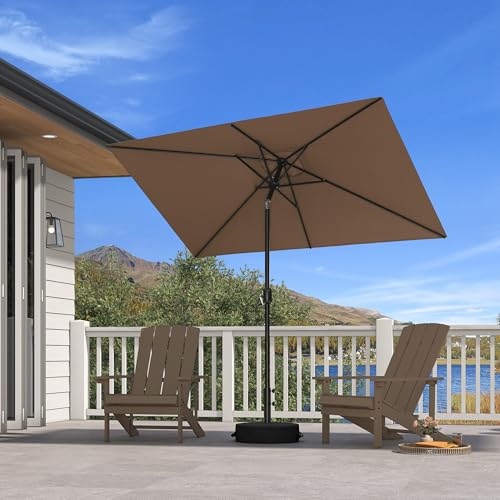
Base Included: outdoor umbrella comes with a built-in base designed for sand filling to enhance stability, sand not included

ATTENTION - The solar panel of the outdoor umbrella is located in the foam box on the top of the box. Please be careful not to throw away the foam box directly
Umbrella Height: Why Eye-Level Clearance Matters
How tall should your umbrella really be? Eye-level clearance makes the difference between comfort and frustration at your patio space.
What matters:
- Standard clearance – Aim for at least 7 feet from ground to canopy underside so nobody bumps their head
- Canopy height alignment – Most dining tables work best with umbrellas around 7–7.5 feet tall, keeping sightlines unobstructed
- Table-specific needs – Bar-height setups require taller umbrellas or pole extenders to maintain proper eye-level clearance
Overlooking this detail leads to tilting your umbrella only to block views across the table. With cantilever models, verify the arm doesn’t obstruct sightlines. Getting the height right eliminates cramped spacing and creates a genuinely functional outdoor area.

10FT OFFSET PATIO UMBRELLA: Designed to keep you cool and comfortable in your outdoor living space, with more space underneath than traditional patio umbrellas

10FT OFFSET PATIO UMBRELLA: Designed to keep you cool and comfortable in your outdoor living space, with more space underneath than traditional patio umbrellas

【WHAT SIZE CANTILEVER UMBRELLA DOES THIS COVER FIT?】 This cover is designed for large cantilever patio umbrellas and measures 103.9" high, 31.4" wide at the top, 55" in the middle and 35.4" at the bottom. It fits round offset umbrellas up to 14ft or square offset umbrellas up to 12ft while providing all-season protection from weather exposure, dust and fading. Please measure your umbrella before purchasing. Not designed for double-sided umbrellas.
Does Your Table’s Hole Fit the Umbrella Pole?
I’ve learned the hard way that matching your umbrella pole to your table’s hole is just as important as picking the right umbrella size. You’ll need to measure your table’s hole diameter and compare it to the umbrella pole. Most standard holes run between 1 1/2 to 2 inches, but yours might be different, so check first. Getting this right prevents your umbrella from wobbling in the wind and eliminates the frustration of a pole that’s either too loose or won’t fit at all.
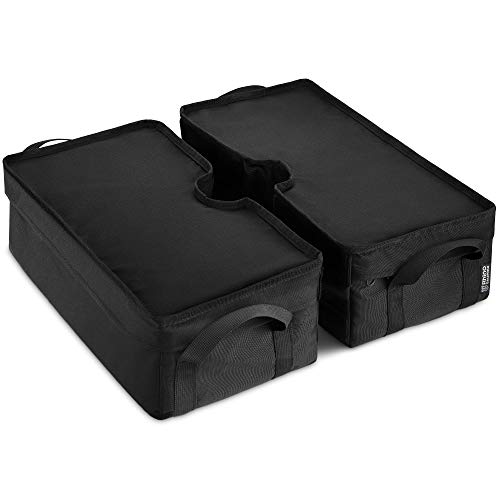
NO MORE TIPPING ON WINDY DAYS. Secure your outdoor umbrella with this umbrella base weight bag, designed to keep your umbrella stable even in strong gusts. Just fill it with sand and wrap it around the umbrella stand — no more wind-related mishaps.

No More Tipping on Windy Days: Fill this patio umbrella base weight bag with sand, wrap it around any umbrella pole, and enjoy more peace of mind in gusty weather.
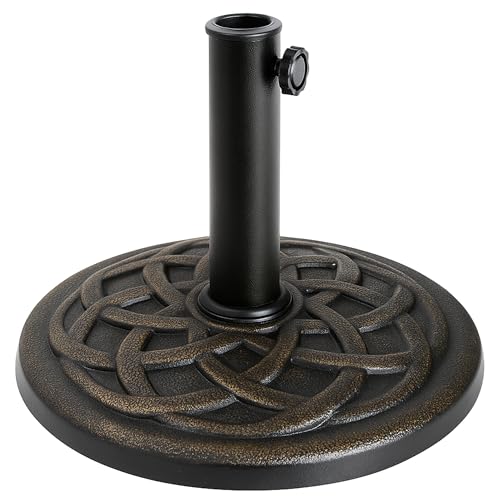
20 LB WEIGHTED STABILITY – Heavy, 20 lb round umbrella base helps keep your patio umbrella upright on the deck, porch, balcony, poolside, or backyard seating areas.
Measuring Pole Diameter
Before you buy an umbrella, one measurement will save you from the frustrating discovery that your new shade won’t actually fit your table: the pole diameter.
I learned this the hard way. What you need to know:
- Measure your table’s hole – Use a ruler or tape measure across the opening’s widest point
- Check common pole sizes – Most umbrellas range from 1 to 2 inches in diameter
- Match them together – Your pole must fit snugly in that hole for stability
Larger umbrellas (9–11 feet) need thicker poles and heavier bases (50–65 lb) to stay upright. If your table lacks a hole entirely, you’ll want a freestanding base instead. Taking five minutes to measure now prevents buying an umbrella that won’t work at all.
Table Hole Compatibility
Once you’ve measured your table’s hole, you’ll want to make sure that opening can actually grip your umbrella’s pole. This is where many people encounter problems.
I learned this through experience. Most standard table holes fit umbrella poles around 1 inch to 1 1/4 inches in diameter. I grabbed an umbrella that looked perfect until I tried inserting it; the pole was too thick for my table’s opening.
I now measure both my table hole and the umbrella pole before buying. They need to match snugly. If your table doesn’t have a center hole at all, don’t force it. You’ll need a freestanding base or edge clamp instead. Getting this right ensures your umbrella stays stable and secure.
Stability and Secure Fit
How stable is your umbrella really? A table hole alone won’t keep your umbrella standing strong, especially when wind picks up. What matters most:
- Your umbrella pole diameter must match your hole size exactly—no guessing allowed
- Common hole sizes range from 1 3/8 to 2 1/2 inches, so measure before buying
- A compatible umbrella base provides the stability your table hole can’t deliver alone
I made the mistake of assuming my umbrella would fit any table. It didn’t. When I paired my pole with the right hole size and added a sturdy base, everything changed. Your umbrella won’t slip, and you’ll sit underneath it without worry. This is what secure fit means.
Wind Load: Base Weight and Stability Standards
Your canopy tilts in the breeze while your neighbor’s remains steady because of differences in base weight and stability standards.
A proper base weight anchors your umbrella against wind. For standard umbrellas up to 7.5 feet, use 20–30 pounds. A 9-foot model needs at least 50 pounds for security. Cantilever umbrellas demand even heavier bases; 8-foot models require 70–90 pounds because their off-center design creates extra stress.
Matching your pole diameter to the base opening prevents wobbling. A snug fit is essential. Adding concrete anchors or ballast options strengthens stability further.
Upgrading your base weight eliminates swaying in gusty conditions. Proper base weight transforms your patio experience from frustrating to functional and reliable.
Patio Umbrella Materials: Fabric and UV Protection Options
Your canopy’s fabric directly affects how well your umbrella protects you and lasts through seasons.
Here’s what works best:
- Solution-dyed acrylic – This offers superior fade resistance and UV protection compared to other fabrics
- Olefin – A mid-range option that dries quickly but doesn’t hold up as well to sun damage over time
- Double-vented canopies – These improve airflow and reduce heat buildup while keeping your UV protection strong
Fabric color matters. Light-colored canopies stay cooler and age better than dark ones, which absorb more heat. When shopping, look for solution-dyed acrylic with double venting for the best combination of comfort and durability.
Tilt and Rotation Features for Flexible Shade
The sun doesn’t stay in one spot; it creeps across your patio throughout the day. Tilt and rotation features solve this problem effectively.
| Feature | Best For | Flexibility |
|---|---|---|
| Crank Tilt | Precise angles | High control |
| Push-Button | Quick adjustments | Medium ease |
| 360° Rotation | All-day coverage | Maximum options |
| Cantilever | No pole obstruction | Best versatility |
| Fixed Umbrella | Budget shopping | Limited adjustment |
Cantilever umbrellas offer the most options since they rotate fully and tilt multiple directions. Market umbrellas give less flexibility but work fine if you don’t mind repositioning occasionally. The right tilt mechanism prevents constant umbrella adjustments. Pairing tilt with a vented canopy maintains comfort and stability during wind.
Non-Standard Spaces: Sizing for Decks, Corners and Irregular Patios
Non-standard spaces demand a different approach to patio shade size. Here’s my method:
Non-standard spaces demand a different approach to patio shade size and careful strategic planning.
- Measure your entire seating area, including lounge zones away from the dining table, then add at least 2 feet of shade coverage on all sides.
- Consider a larger canopy, 9 to 11 feet or more, so shade reaches multiple spots as the sun moves throughout the day.
- Choose cantilever shades for deck corners and edges, since offset poles won’t block your seating.
For windy corners, anchor your base securely or use wall-mounted options. Irregular patios require thoughtful planning and the right shade size to work with your unique space.
Your Patio Umbrella Sizing Checklist
I’ve learned that nailing down the right canopy size comes down to two critical steps: first, I measure my table or seating area carefully and jot down those numbers before I shop, as eyeballing it can result in inadequate shade. Second, I match my canopy base weight to my local wind conditions and canopy size. A heavy base prevents the umbrella from toppling over in windy conditions and protects your investment.
Measure Your Space Accurately
Before you pick out an umbrella, you need to know exactly what you’re working with. I learned this the hard way when I guessed my patio size and ended up with inadequate shade coverage.
Here’s what I do now:
- Clear your measurement area of furniture and obstacles so you can get accurate readings
- Measure your patio’s width and length with a tape measure, then measure your dining or seating space separately from walkways
- Note where the sun hits during your peak patio hours, since shade coverage shifts throughout the day
I aim for at least 2 feet of overhang beyond my desired shaded area on all sides. This extra space ensures you have usable shade, not just a theoretical measurement. Getting these numbers right turns your umbrella from a guess into a smart investment.
Match Base Weight Requirements
Once you’ve measured your space and picked an umbrella size, the base weight becomes your next critical decision.
Your base weight directly supports your canopy diameter. Smaller umbrellas under 7.5 feet need 20–30 pounds, while 7.5–9 foot umbrellas require 30–40 pounds. If you’re going bigger with 9–11 feet, plan for at least 50 pounds.
Cantilever umbrellas demand heavier bases because their weight sits off-center. Use 70–90 pounds for 8-foot cantilevers and 200–220 pounds for larger ones.
Match your base weight to both your canopy size and setup type. Concrete bases work best in windy spots. If you’re using a table-mounted system, verify the base complements your table’s stability to prevent wobbling when wind picks up.